
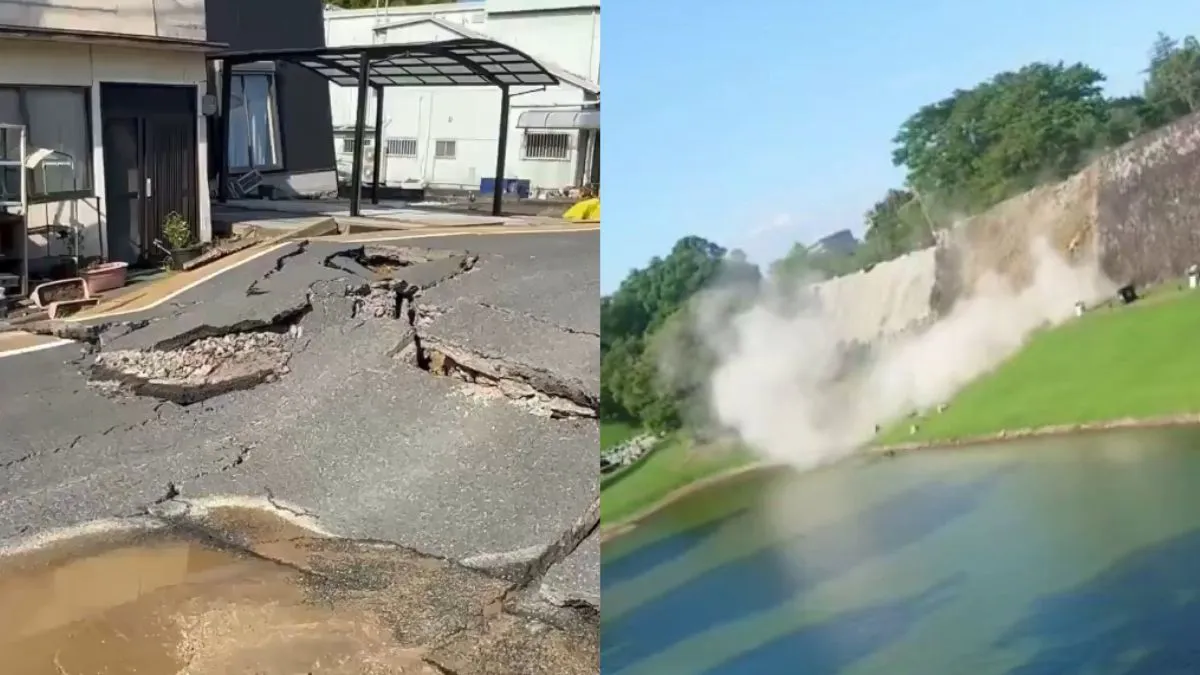
- 7.1 magnitude earthquake hit Japan's Kumamoto Prefecture.
- Emergency alerts and tsunami advisory issued for Kyushu.
- Japan is highly earthquake-prone, located on Ring of Fire.
Japan Earthquake: A powerful earthquake of magnitude 7.1 struck Japan's southern Kumamoto prefecture on Tuesday, causing widespread infrastructure disruptions and triggering emergency protocols. The powerful quake knocked out electricity to thousands of residential homes, disrupted regional transportation networks, and prompted immediate evacuation orders alongside official warnings for imminent aftershocks.
Japanese PM Assesses Damage
Speaking from her office in Tokyo, Japanese Prime Minister Sanae Takaichi stated that emergency response teams and regional authorities are currently on high alert and actively assessing the full extent of casualties and structural property damage across the affected zone.
She said, “We have already been informed that people have been injured…Power outages and fires have occurred in some areas, and there has also been damage to roads and bridges and the collapse of buildings. Above all, I ask everyone to take action to protect themselves, including evacuating to a safe location,” as reported by Reuters.
Recommended For You
40,000 Homes Without Power
According to reports, more than 150,000 people were instructed to go to evacuation centres. Additionally, about 40,000 homes had lost power as a result of the latest quake, Kyushu Electric Power said. Railway company JR Kyushu added that it had suspended services, including its high-speed bullet trains. Kumamoto airport has also shut its runway, with several flights diverted and cancelled.
Many Trapped In AEON Mall Fire
Meanwhile, local police and fire departments have confirmed that an explosion-like sound occurred on the second floor of the Aeon Mall Kumamoto in Kashima Town following the 7.1-magnitude earthquake. Multiple people are trapped inside.
Tsunami Warning Issued
The Japan Meteorological Agency (JMA) issued a 1-metre tsunami warning after the shallow 10-kilometre-deep earthquake struck. The Kumamoto region shook violently, hitting the maximum level of 7 on Japan's seismic intensity scale, while Amakusa and Ashikita recorded a lower level of 6. Videos shared online showed the extreme force of the disaster, capturing large buildings swaying heavily from side to side. No immediate reports of damage have emerged yet.
A magnitude 7.1 earthquake has shaken part of southern Japan.
— Press Trust of India (@PTI_News) July 28, 2026
(Source: USGS) https://t.co/BTb6yIu4tZ pic.twitter.com/sNSqbrO0fZ
ALSO READ: Why Powerful Earthquakes Are So Unusual In Venezuela; Science Behind The 'Rare' Quake
Videos Capture Terrifying Moment
Online videos shared on social media capture the moment sections of the historic Kumamoto Castle collapsed due to the intensity of the tremors. Footage from regional department stores and malls showed consumer goods falling off high shelves, forcing panicked shoppers. Another video from the airport showed travellers sprinting for immediate shelter. According to reports, the shaking also triggered landslides across Kumamoto City. At least 50 people were reported injured in the aftermath of the earthquake.
Severe damage reported in Kumamoto, Japan, with major road cracks following a magnitude 7.1 earthquake.(地震 ) pic.twitter.com/tjYgsVbU0M
— Weather Monitor (@WeatherMonitors) July 28, 2026
Visuals from Aso Kumamoto Airport (KMJ), Japan during the massive M7.1 earthquake. (地震 ) pic.twitter.com/sLTMHBGGuj
— Weather Monitor (@WeatherMonitors) July 28, 2026
Notably, Japan is one of the world's most earthquake-prone countries, with a tremor occurring at least every five minutes. The country located along the "Ring of Fire" of volcanoes and oceanic trenches, accounts for about 20 per cent of the world's earthquakes of magnitude 6.0 or more.
WATCH: 7.1 magnitude earthquake hits Japan.pic.twitter.com/OSjIn242V1
— Open Source Intel (@Osint613) July 28, 2026
Tohoku Earthquake
Japan's most destructive seismic event remains the devastating 2011 Tohoku earthquake and tsunami on March 11, 2011. The magnitude ranged between 9.0 to 9.1 magnitude. The catastrophic disaster claimed over 18,000 lives, with the vast majority of casualties caused by towering tsunami waves that surged up to 40.5 metres high. It also triggered severe meltdowns at the Fukushima Daiichi Nuclear Power Station.
Ring of Fire
The Ring of Fire, surrounding the Pacific Ocean, is considered the most active zone. According to the United States Geological Survey (USGS), about 81 per cent of the world’s largest earthquakes occur here. This zone includes regions like Japan, Indonesia, the Philippines, the Aleutian Islands, the west coast of North America, and the Andes in South America. Some of the most powerful earthquakes in history, including those in Chile (1960), Japan (2011), and the 2004 Indian Ocean tsunami, all occurred in this belt.
ALSO READ: 5.29-Magnitude Earthquake Strikes China’s Sichuan; A Look At World’s Most Active Seismic Belts
You May Also Like To Watch: