
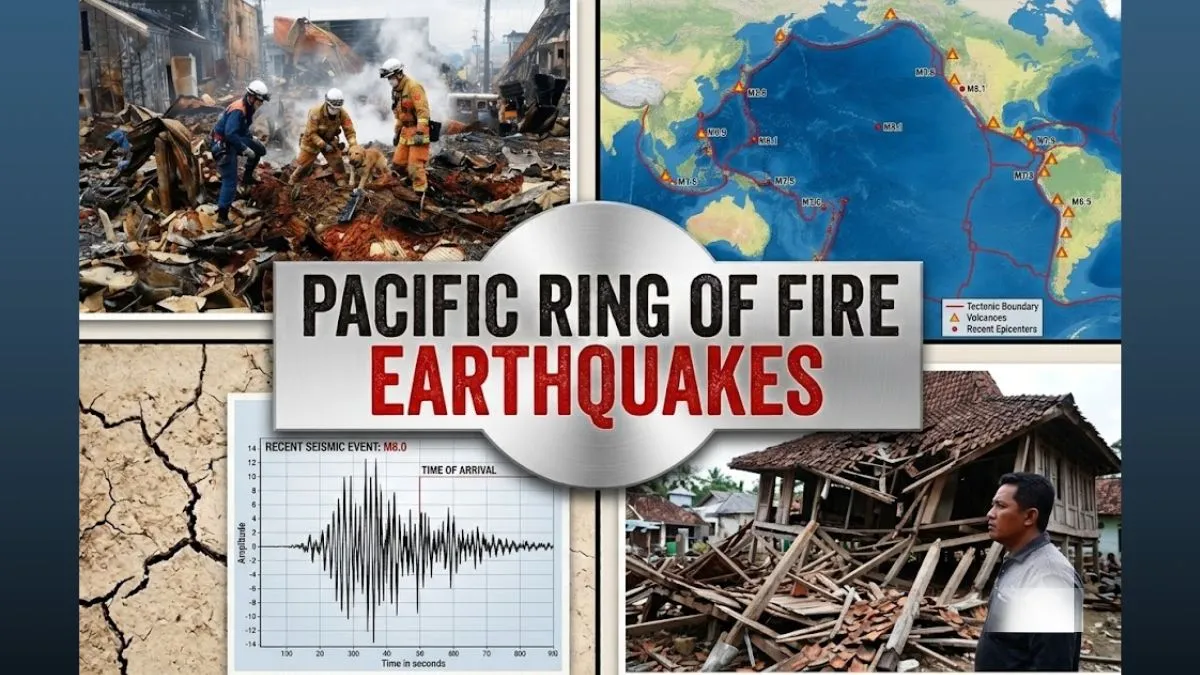
- Japan and Vanuatu hit by strong earthquakes on Sunday.
- Pacific Ring of Fire accounts for 90 per cent of world's earthquakes.
- October marked another active period with over 120 seismic activites.
Japan and Vanuatu were hit by strong earthquakes on Sunday, raising concerns about continued seismic activity along the Pacific Ring of Fire. The tremors come amid a series of earthquakes reported across several parts of the world throughout October. More than 120 earthquakes of magnitude 4.5 or higher were recorded worldwide over the past seven days, most of which were recorded in the Pacific Ring of Fire. The events have renewed attention on why this region experiences frequent earthquakes and which countries face the most risks.
Japan And Vanuatu Hit By Earthquakes
Vanuatu experienced a series of powerful earthquakes on Saturday and Sunday. The magnitude 6.2 earthquake which occurred today was recorded at a depth of around 125 kilometres, according to the United States Geological Survey (USGS). Japan’s Bonin Islands region also experienced a strong earthquake on Sunday. Both locations lie in seismically active parts of the Pacific.
Earthquake of magnitude 6.2 hit E of Port-Olry, Vanuatu at 7:54 am: USGS https://t.co/hkVpdSV1xU
— Press Trust of India (@PTI_News) October 25, 2026
Why Is Pacific Ring of Fire So Active?
The Pacific Ring of Fire is a horseshoe-shaped belt stretching around 40,000 kilometres along the edges of the Pacific Ocean. It accounts for roughly 90 per cent of the world’s earthquakes and also contains a large share of active volcanoes. The region experiences frequent earthquakes as several major tectonic plates meet along its boundaries and are constantly moving.
ALSO READ: Earthquake Of 5.4 Magnitude Strikes Tibet Two Days After 16 Killed Due To Massive Tremors
Recommended For You
In many areas, one plate slides beneath another, which is known as subduction. Pressure builds when plates become locked against each other and is released when rocks suddenly break or shift, causing earthquakes. These movements can also produce magma that fuels volcanic eruptions. Seismic activity is also caused by plates grinding or sliding past each other also known as transform faults. Simply put, the region’s complex network of subduction zones, fault lines and interacting tectonic plates makes it highly prone to repeated seismic activity.
Countries That Face Greatest Risk
Countries and regions along the Ring of Fire include Japan, Indonesia, the Philippines, Papua New Guinea, Vanuatu, the Solomon Islands, New Zealand, Russia’s Kamchatka Peninsula, the United States, Mexico, Peru and Chile. These areas face varying levels of earthquake risk due to their proximity to active plate boundaries. However, the impact of an earthquake depends on its magnitude, depth and distance from populated areas.
October Marks Another Active Period
According to seismic assessments, October has seen reports of strong earthquakes in several regions. Along the Pacific belt, Vanuatu experienced repeated tremors, while Japan’s Bonin Islands region recorded strong tremors. Other events were reported near Papua New Guinea, Kamchatka and Panama in the first and second weeks of October.
As strong earthquakes can damage buildings, trigger landslides, generate tsunamis and lead to civilian casualties, it becomes important that focus is on disaster preparedness across countries located along the Pacific Ring of Fire. This can include constructing earthquake-resistant buildings, making reliable warning systems and public preparedness.
ALSO READ: Vanuatu Earthquake: Two Strong Quakes Of Magnitude 7.2 And 6.9 Hit Island Nation Within 25 Seconds
You May Also Like To Watch: