
- China asserts strict adherence to bilateral border agreements.
- India flagged Chinese troops' deviations along LAC.
- ITBP DG reported ongoing confrontations in Arunachal Pradesh.
Days after India flagged Chinese troops' deviations from established patrolling patterns as a recurring trigger for disturbances along the Line of Actual Control (LAC), Beijing reacted on Monday, asserting that it has consistently and strictly adhered to bilateral agreements and understandings with New Delhi.
Responding to questions during a press briefing in Beijing on Monday, Chinese Foreign Ministry spokesperson Guo Jiakun said that the Chinese side has been "conducting routine patrols and management activities in the border areas to safeguard territorial sovereignty and border stability".
China has consistently and strictly abided by the relevant agreements and important understandings between the two countries, conducting routine patrols and management activities in the #border areas to safeguard territorial sovereignty and border stability, Chinese #FM spokesperson Guo Jiakun said on Monday. He made these remarks in response to reports of another standoff along the #China-#India border, where an Indian Foreign Ministry spokesperson claimed such incidents occur when Chinese troops "deviate from established patrolling patterns." China and India remain in communication through diplomatic and military channels, Guo said. China hopes India will work in the same direction to jointly implement the understandings reached by both sides and take concrete steps to maintain peace and tranquility in the border areas, said Guo. https://t.co/V5UlKcxmls
— Global Times (@globaltimesnews) October 26, 2026
How did the controversy erupt?
The controversy erupted after Indo-Tibetan Border Police (ITBP) director general Shatrujeet Kapur said that confrontations with Chinese troops continue to take place at several areas along the border in Arunachal Pradesh, during a speech days before he is set to retire from the prestigious organisation. Notably, ITBP was formed on October 24, 1962, in the aftermath of the Sino-Indian War. It operates under the Ministry of Home Affairs and guards the 3,488-kilometre-long India-China border, stretching from the Karakoram Pass in Ladakh to Jachep La in Arunachal Pradesh.
ALSO READ: Indian Army Flags Viral Video Claiming China Took Control Of Arunachal Pradesh Areas As Misleading
Recommended For You
How India responded to recent provocations
Reacting to Kaur’s statement, Ministry of External Affairs spokesperson Randhir Jaiswal said on Friday that the situation along the LAC gets disturbed from time-to-time when Chinese forces diverge from established patrolling patterns, asserting that maintenance of peace and tranquillity in the border areas is essential for the overall development of bilateral relations.
"As we have noted in the past, the situation in the India-China border areas gets disturbed from time-to-time when Chinese forces diverge from established patrolling patterns," Jaiswal said at his bi-weekly media briefing. "Both sides continue to use existing diplomatic and military mechanisms to resolve outstanding issues and avoid misunderstanding and miscalculation along the Line of Actual Control (LAC)," he said.
Jaiswal said the two sides have also agreed to discuss ways to improve understanding of the LAC in appropriate areas for better border management. "I would also like to emphasise that the maintenance of peace and tranquillity in the border areas is essential for the overall development of bilateral relations," he said.
Meanwhile, Beijing today said China and India remain in communication through diplomatic and military channels. China hopes India will work in the same direction to jointly implement the understandings reached by both sides and take concrete steps to maintain peace and tranquillity in the border areas, added Guo.
Why is this happening just after Xi's visit?
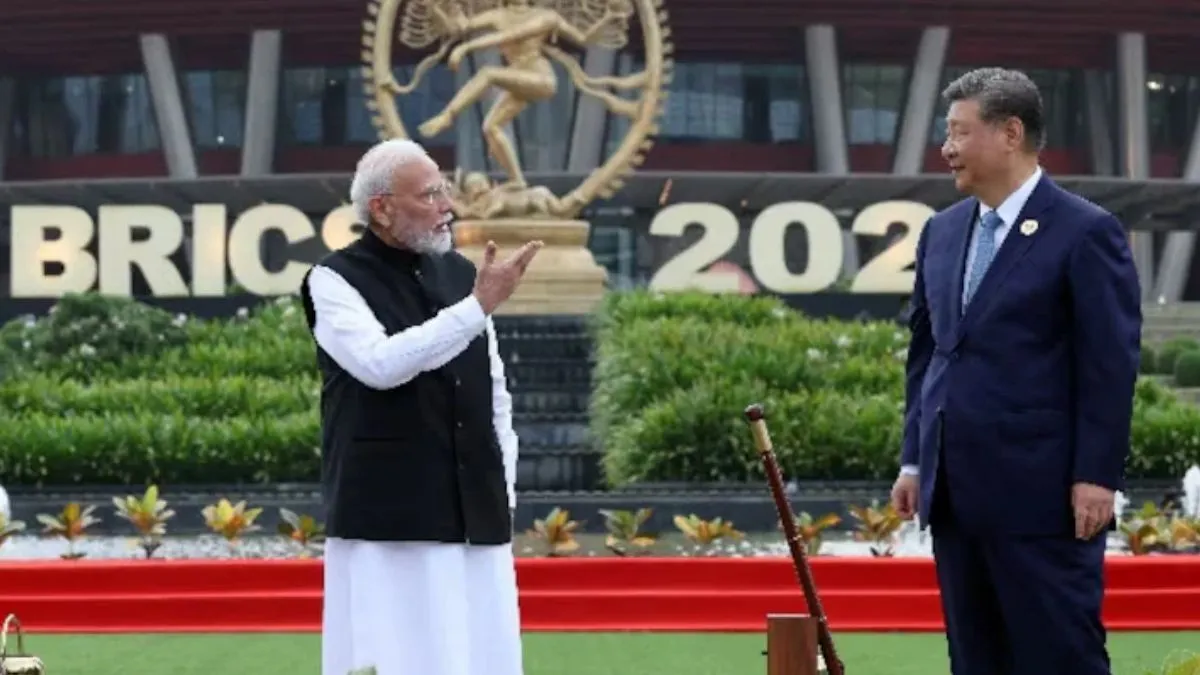
The fresh tensions were reported weeks after Chinese President Xi Jinping visited New Delhi for the BRICS Summit on September 12. The developments highlight a key problem in bilateral relations-- diplomatic engagement has improved, but the border dispute remains unresolved.
Jinping's visit demonstrated a willingness to improve India–China relations, but it did not guarantee peace on the border. The renewed face-offs show that diplomatic normalisation and military stability are two different things. Whether the situation worsens will depend on developments on the ground and how effectively both countries use their military and diplomatic communication channels.
For India, the immediate challenge is to protect its border interests while preventing local confrontations from escalating.
(With inputs from agency)