

- By Ashwini Kumar Singh
- Mon, 15 Jun 2026 06:31 PM (IST)
- Source:JND
Ashwini Singh from Estonia | In May and June, the sun shines in the sky even at 11 or 12 at night. In December and January, darkness begins to fall by 2 PM. This is Tallinn—a centuries-old city with pink-hued roofs and the capital of the European nation of Estonia. It is a small country with a population of around 1.1 to 1.2 million, yet it is far ahead in the digital realm. That is why it is also known as "e-Estonia," a place where all manner of civic services are accessible via a single smart card.
Tallinn attracts tourists; while visitors from European nations are common, tourists from India are also making their way there. Tallinn boasts an ancient civilisation; it possesses history and heritage, and above all, it holds a special place in people's hearts.
A History Marked By Struggle
Estonia has been ruled by Denmark and the Roman Empire, and was once part of Sweden and the Soviet Union. However, when it finally embarked on its journey as a fully independent nation in 1991, it experienced a rapid rise in the digital sector. It is the birthplace of Skype; the coding for the platform was done right here in Tallinn. Everything is digital—from online voting and digital signatures to e-residency. Upon entering Tallinn, the buildings tell the story of its ancient civilisation, while the ruins of towering structures bear witness to the devastation caused by invasions. The Town Hall is located here as well.
Recommended For You




Records of it date back to 1322 AD, while the current building was constructed between 1402 and 1404. Tallinn was a prosperous city then, and it remains so today. The Town Hall itself has a rich history; the Lübeck Law—a legal framework established for municipal administration—was enforced here. Its framework was established in the German city of Lübeck in the 12th century, hence the name. This means the European municipal government system had already taken shape in Tallinn as early as 1248, managed by the city's elected merchants.
The city had the authority to frame its own regulations; this body later came to be known as the Town Council. A court also operated here. The Town Hall still stands today—magnificent and the only one of its kind built in the Gothic style—featuring soaring windows and a tall tower. The entire surrounding area is known as Town Hall Square, paved with stone. It is a UNESCO World Heritage site, home to a triangular building dating back to the 14th century.
Five Beautiful Towers
There are also five beautiful towers—historic landmarks that visitors never forget. They feature intricate woodwork. Thomas, a local guide, explains how the city has preserved its identity despite numerous struggles. The Old Town is its crowning glory, with pink-hued roofs and a history spanning five hundred years; right next to it lies the modern city. Viewed from Toompea Hill, the Old Town—with its pink roofs—resembles the shape of a lotus flower. The Danish King's Garden is also located here, and the Old Town is steeped in many stories.
The society of centuries past was divided into the Upper Town and the Lower Town. Thomas explains that the Upper Town was the residence of the nobility, while the Lower Town was home to the common people. Narrow streets wind through the area. Climbing the steps leads to a massive fortress; the view from there is breathtaking, offering a glimpse of the Baltic Sea. The Old Town is a major attraction, featuring shops and a flower market, while the modern city nearby houses offices, restaurants, shops, and malls. Hormuz Street holds historical significance; on March 9, 1944, hundreds of homes there were destroyed in a Soviet air raid.
Helmen Tower and the Six-Century-Old Pharmacy
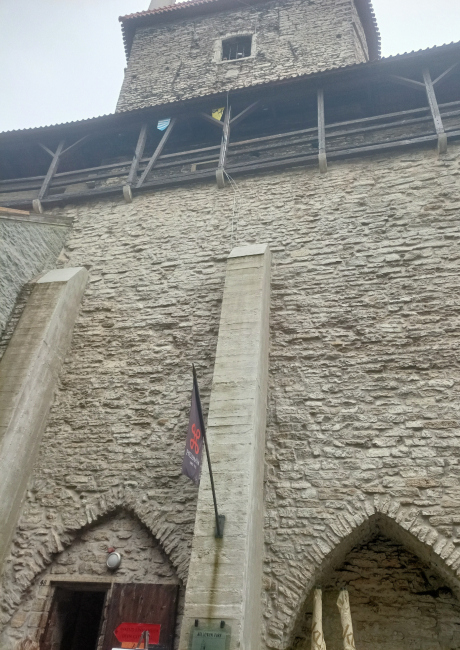
Helmen Tower (Photo Credit: Jagran)
It was built in the early 15th century. A man named Hallman owned a significant amount of land here, and the tower—named after him—eventually came to be known as Helmen. This three-story, three-quarter-circular tower was constructed to protect the Viru Gate. The name "Viru" might surprise Indians; in reality, it was once a gate to the Old Town, though it no longer exists as such. A road led from this gate toward a place called Virumaa, which corresponds to present-day Eastern Estonia.
"Virumaa" eventually evolved into "Viru." Upon entering the Old Town, one immediately catches a glimpse of medieval civilisation; it is a favourite spot for tourists. Visitors can even walk along the walls of the Helmen Tower. Europe's oldest pharmacy, operating since 1422 AD, is located here. The company is named "Apteek" (the Estonian word for pharmacy), and its emblem features a snake coiled around a bowl, with medicinal herbs placed below. The museum houses centuries-old medicine vials, mixing tools, and other artefacts—sights that visitors invariably make a point to see.
ALSO READ: India's First 8-Lane Tunnel To Open On June 20, Cut Delhi-Mumbai Travel Time To 12 Hours | Details
About 50 kilometres from Tallinn lies the Aegviidu Forest, which includes marshy terrain, or wetlands. Karmen, an employee at the Foreign Ministry, notes that it is a popular destination for hiking. One can traverse the marshland along a route spanning approximately five kilometres; wooden walkways have been constructed over the terrain, while grass grows on the marshy ground. Tallinn, the capital of Estonia, offers both the charm of ancient civilisation and the thrill of hiking. There are restaurants serving European cuisine—offering both vegetarian and non-vegetarian options—as well as Indian restaurants where local dishes are available.
ALSO READ: 4 Places Where Snow Falls In Summer
How To Reach
Since it is a member of the European Union, a Schengen visa is required. Flights operate from Delhi to Frankfurt, with a connecting flight from there to Tallinn. The total flight time is 10 to 12 hours. There is a layover of two to three hours, meaning a wait in Frankfurt; you can explore the city during this time. Accommodation options include guesthouses and hotels.
The author is the editor of Dainik Jagran, Patna.