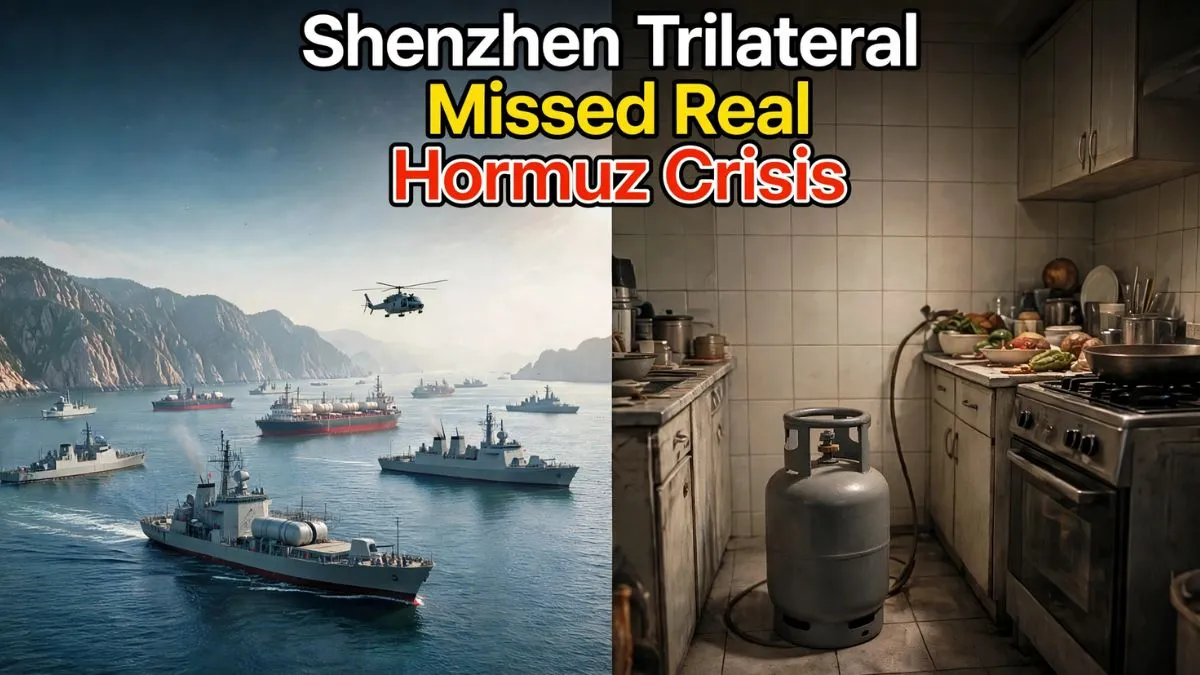
- Trump, Xi, Putin issued joint energy peace declaration with focus on petroleum products.
- The declaration missed Strait of Hormuz and LPG supplies.
- The omission is critical for countries that depend on imported energy dependence.
Shenzhen Trilateral: US President Donald Trump, Chinese President Xi Jinping and Russian President Vladimir Putin issued a joint peace declaration on Thursday after their first-ever trilateral meeting held in Shenzhen, China. The leaders called for greater production and supply of refined petroleum products and stressed the need for stable energy flows. However, the three leaders appeared to miss a crucial part of the global energy crisis, which is the Strait of Hormuz.
Peace Declaration With A Major Blind Spot
Despite calling for the protection of energy supplies and cooperation in petroleum production, the declaration did not specifically mention the waterway, which has become a major concern for global oil shipping amid the ongoing conflict between the US and Iran. While Trump, Xi and Putin spoke about protecting supplies of refined petroleum products such as petrol and diesel, they did not separately address liquefied petroleum gas (LPG), the fuel that millions of households depend on for cooking.
The joint statement, described as a 'Heads of State Declaration toward Peace', said that the three countries planned to increase the production and supply of refined petroleum products for the benefit of all nations. They also reaffirmed the importance of stable energy flows. Petrol, diesel and other refined petroleum products are essential for transport, industries, agriculture and trade, and now it has emerged as an important sector where the superpowers want to cooperate.
Recommended For You
ALSO READ: 'We Spy On Each Other': Trump's Candid Admission Has A Link With Nvidia Spygate Controversy
Hormuz Crisis Ignored
However, the declaration did not clearly explain how these supplies would be protected if major shipping routes like the Hormuz and Black Sea faced disruptions. The Strait of Hormuz is one of the world's most important energy routes, connecting major oil-producing countries in the Persian Gulf to international markets. Any disruption here can affect fuel supplies, push up transportation and insurance costs, and increase prices for countries that depend heavily on imported energy.
The problem is not limited to crude oil as petroleum products, and liquefied petroleum gas also depends on shipping networks that connect producers to consumers. One of the most striking aspects of the declaration is its specific reference to increasing the production and supply of refined petroleum products. But the statement does not give LPG the same clear attention.
This is an important distinction as LPG is not simply another industrial fuel. It is used every day in millions of homes for cooking. India's dependence on imported LPG makes this concern even more important as disruption in the Gulf region or in shipping through the Hormuz could affect the arrival of LPG cargoes and put pressure on domestic supplies.
What The Declaration's Silence Means For India?
For India, the omission is particularly significant as the country depends heavily on imports to meet its energy needs. India reportedly consumes approximately 5.5 million barrels of crude oil every day and imports a large majority of the crude it processes. The country buys crude oil from more than 40 countries, including Russia, Iraq, Saudi Arabia, the UAE and the US.
This diverse supplier network helps India reduce its dependence on any single country. However, having multiple suppliers does not completely protect India from a disruption in shipping routes. Even when crude oil is purchased from different countries, the movement of these supplies depends on safe and reliable maritime routes. While India produces much of its petrol and diesel on its own, the country depends on crude oil, which is largely imported.
Moreover, as India relies heavily on imported LPG to meet domestic demand, any disruption in the movement of gas cargoes through shipping routes can therefore directly affect the availability and cost of cooking fuel. This could eventually affect household budgets, especially if higher import costs translate into increased cooking gas prices
In such a situation, Trump's, Xi's and Putin's call for stable petroleum supplies may address an important part of the global energy challenge. However, without a clear focus on crucial shipping routes and LPG supplies, the declaration leaves a major gap.
You May Also Like To Watch: