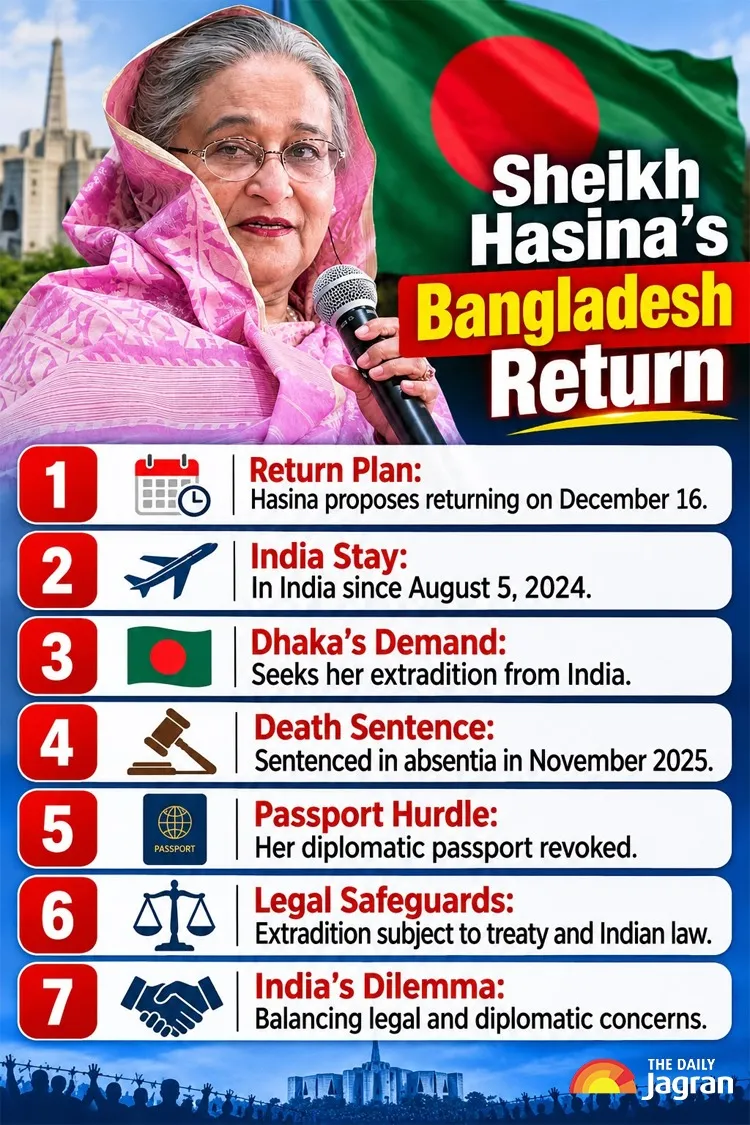
- Hasina wants to return to Bangladesh voluntarily on December 16.
- Dhaka demands her extradition due to a death sentence.
- Revoked passport and legal complexities complicate her return.
New Delhi: Former Bangladesh prime minister Sheikh Hasina's proposed return to Dhaka on December 16 has triggered a fresh diplomatic and legal standoff between India and Bangladesh. While Hasina has expressed her willingness to return home and face legal proceedings, the government in Dhaka insists that she must be handed over by India through the formal extradition process.
Hasina, who has been living in India since fleeing Bangladesh on August 5, 2024, following a student-led uprising that ended her 15-year rule, has reportedly asked the Bangladeshi government to arrange a flight from Delhi to Dhaka aboard its national carrier, Biman Bangladesh Airlines.
Her spokesperson has argued that the government should facilitate her return, pointing out that she had travelled to India aboard a Bangladeshi aircraft when she left the country.
However, Dhaka has rejected the proposal for an ordinary return. State Minister for Foreign Affairs Humayun Kobir has maintained that Hasina can return only through extradition, either in custody or under strict surveillance. The government has also ruled out issuing her a fresh passport.
Recommended For You
Why does Bangladesh want India to extradite Hasina?
The demand is rooted in the criminal proceedings against the former prime minister. In November 2025, Bangladesh's International Crimes Tribunal sentenced Hasina to death in absentia after convicting her of crimes against humanity over the crackdown on protesters during the 2024 student-led uprising.
Hasina has rejected the verdict and questioned the legitimacy of the proceedings, describing the cases against her as politically motivated.
Dhaka, meanwhile, wants her return to take place through the India-Bangladesh Extradition Treaty of 2013. The government considers her a convicted fugitive and wants Indian authorities to formally surrender her rather than allow her to travel back as an ordinary passenger.
The extradition demand also places the responsibility for her transfer on New Delhi, making her return a matter of bilateral legal and diplomatic engagement.
Can Hasina return voluntarily without extradition?
Her willingness to return does not automatically settle the legal question. Under the 2013 India-Bangladesh extradition treaty, requests for surrender are processed through diplomatic channels. Article 10 lays down the documentation and procedural requirements for an extradition request, while Article 16 deals with the actual surrender of the individual.
India's Extradition Act, 1962, provides the domestic legal framework for examining such requests, including provisions for inquiry and the decision to surrender a person.
The treaty does not expressly establish an automatic mechanism through which a person's consent alone can replace the formal extradition process. At the same time, it does not specifically rule out a separate arrangement for a voluntary return.
Therefore, whether Hasina can leave independently would depend on her legal status in India, the availability of valid travel documents and the willingness of Bangladesh to admit her.
Why can't Hasina simply board a flight to Dhaka?
Travel documentation is another major obstacle. Hasina's diplomatic passport was revoked after she fled Bangladesh in August 2024. Her reported efforts to obtain a fresh passport and national identity card have also faced resistance from Dhaka.
Bangladesh's government has made clear that it does not intend to issue her new travel documents and instead wants India to hand her over under the extradition treaty.
Hasina has reportedly asked Dhaka to arrange a flight on Biman Bangladesh Airlines, rather than attempting to return as an ordinary commercial passenger.
The issue is therefore not merely whether she is willing to leave India. She also needs a legally recognised route to travel and enter Bangladesh.
What does the extradition treaty say about political cases?
The 2013 treaty contains safeguards that allow the requested country to refuse extradition in certain circumstances. Article 6 provides for an exception in cases involving political offences, although several serious crimes are excluded from this protection.
Article 8 also provides grounds for refusal, including circumstances in which extradition could be unjust or oppressive or where the request is not made in good faith or in the interests of justice.
India's Extradition Act, 1962, also provides safeguards under Section 31, which restricts surrender in specified circumstances, including certain politically motivated cases.
Hasina has challenged the legitimacy of the proceedings against her. However, her claim that the prosecution is politically motivated does not automatically invalidate Bangladesh's extradition request. Indian authorities would have to examine the relevant legal provisions, the charges and the circumstances of the case.
How does the death sentence complicate the matter?
The death sentence imposed on Hasina in absentia adds another layer to India's decision-making. Her conviction relates to the alleged role of her government in the violent crackdown on protesters during the 2024 uprising. Hasina has denied wrongdoing and rejected the tribunal's verdict.
The possibility that she could face execution after being handed over raises questions about her safety, the fairness of the proceedings and the legal safeguards available to her.
These considerations could become relevant while Indian authorities examine whether the extradition request meets the requirements of the bilateral treaty and domestic law.
Why December 16 matters
Hasina's choice of December 16 is politically significant. Bangladesh celebrates Victory Day on this date to mark the country's liberation from Pakistan in 1971. By choosing this occasion for her proposed return, Hasina is invoking the historical legacy of her father, Sheikh Mujibur Rahman, and the role of the Awami League in Bangladesh's independence movement.
Her proposed homecoming could also have political implications for the country, particularly as the Awami League remains banned from political activity.
What does this mean for India-Bangladesh relations?
The issue presents a diplomatic challenge for New Delhi. Hasina has been residing in India since August 2024, while Dhaka has repeatedly sought her extradition.
India has previously said that Bangladesh's request is being examined through the appropriate legal process. New Delhi must also manage its broader relationship with the government of Prime Minister Tarique Rahman.
The extradition dispute comes at a time when both countries have important interests in trade, regional connectivity, border management and security cooperation.
For now, Hasina's proposed December 16 return remains uncertain. Her willingness to go back, Dhaka's insistence on formal extradition, the absence of valid travel documents and the death sentence together leave the final decision dependent on legal and diplomatic developments in New Delhi and Dhaka.
(With inputs from Reuters)