
- By Vaidika Thapa
- Wed, 15 Apr 2026 11:51 PM (IST)
- Source:JND
The conflict between the United States, Israel and Iran, which initially began as a move to pause Iran’s nuclear ambitions, has now shifted focus to the Strait of Hormuz. This critical maritime chokepoint, which handles 20 per cent of the world’s total oil supply, has become a key issue in negotiations between Washington and Tehran. Due to disruption in the strait, combined with US military blockade, global energy security is also at stake.
Iran’s Untraced Mines In Hormuz
Iran reportedly deployed naval mines in the Strait of Hormuz to restrict shipping activity in the waterway and counter any attack in the region. However, a New York Times report, citing US officials, claimed that Tehran is now facing challenges in managing the situation, as it is unable to locate all the mines it laid. The report added that Tehran also lacks the capacity to safely remove them.
Quiz
Earlier, Iran had carried out attacks on tankers using drones and missiles in the region. After the announcement of a two-week ceasefire, Iran’s Foreign Minister Abbas Araghchi said that ships could still pass through the strait but with “technical limitations,” hinting at continued operational risks in the area. This is also considered a major reason why Iran is not allowing much maritime traffic through the Strait
What Are Naval Mines?
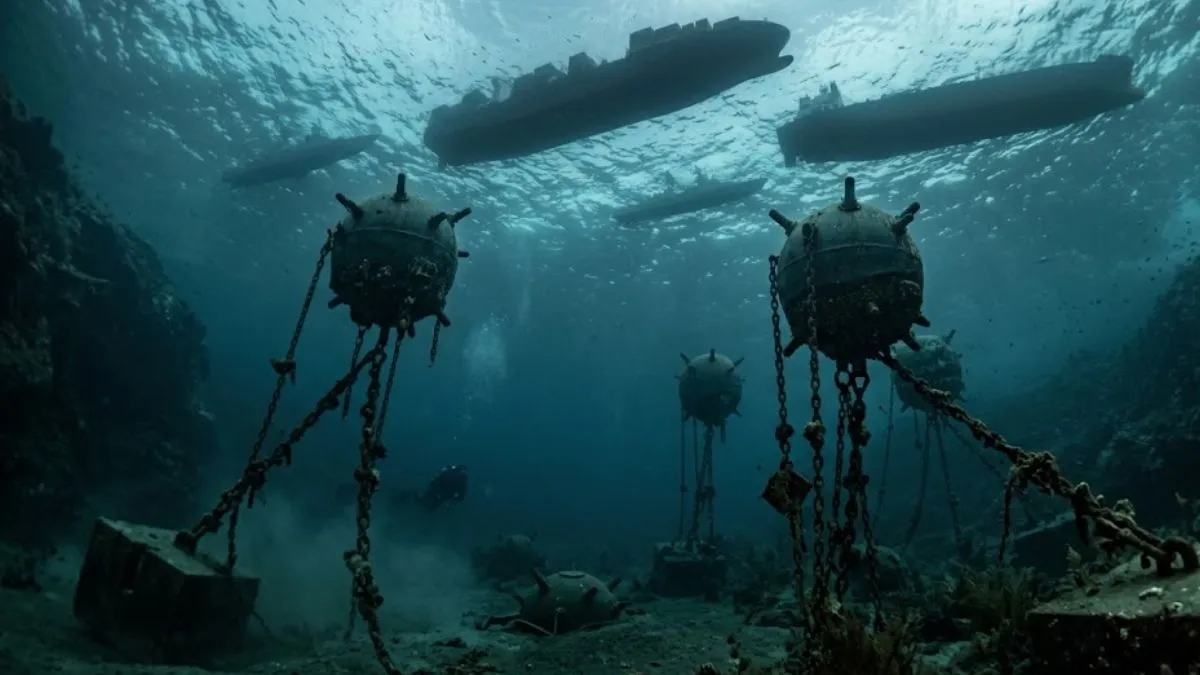
Naval mines are explosive devices placed in water to damage or destroy ships or submarines when they come close. Unlike ground mines, which get triggered by pressure, movement, or tripwires on land, naval mines are activated by the presence of a vessel through contact, magnetic signals, or changes in water pressure. They are laid using specialised ships, submarines, or even an aircraft.
How Are They Set Up?
While mine-laying ships are capable of directly releasing mines into the sea in planned patterns, submarines can deploy them quietly in waters without being detected. Once released, their position is carefully fixed. Mines are either anchored to the seabed or left floating at a specific depth. Naval mines come in different types depending on how they work and where they are placed. Contact mines, influence mines, moored mines and bottom mines are the main types.
Naval mines are often harder to detect and remove as they are hidden underwater. Their ability to drift further makes them a serious threat to maritime routes.
You May Also Like To Watch: