

- Mumbai's AQI frequently comparable to Delhi's levels.
- Five major factors contribute to Mumbai's worsening air quality.
- Bombay High Court expresses shock over city's rising pollution.
Mumbai AQI Nears Delhi: With winter approaching, Mumbai and Delhi are recording almost identical Air Quality Index (AQI) levels, raising concerns over the deteriorating air quality in the national capital. The latest figures show Mumbai's AQI at 164, marginally lower than Delhi's 165, while wind speeds stood at 17.6 kmph in Mumbai and 8.3 kmph in Delhi.
Mumbai's pollution levels have sparked concern, particularly as the city has reportedly recorded AQI readings comparable to or higher than Delhi's for four consecutive weeks.
On Thursday, Delhi's AQI stood at 226, placing it in the 'poor' category, while Mumbai recorded an AQI of 171. Several neighbourhoods in Mumbai reported even higher readings, with some areas crossing 250.
The worsening air quality comes amid unusually high October temperatures in Mumbai. Vehicle emissions, construction dust and open waste burning are among the key contributors to pollution. Weak winds and warmer post-monsoon conditions can further prevent pollutants from dispersing, allowing them to accumulate in the air.
To understand why Mumbai's air quality is deteriorating despite its coastal location, The Daily Jagran spoke to AK Gaur, Chairman of the Expert Committee on Plastic Waste Management under the Haryana government, and Bhavreen Kandhari, environmentalist .
Why is Mumbai recording high AQI levels?
Mumbai is increasingly losing the advantage of its coastal location. The city, which has traditionally benefited from sea breezes that help disperse pollutants, is now recording pollution levels comparable to those in Delhi due to a combination of climatic and human-made factors.
Recommended For You
AK Gaur outlined five major reasons behind the deterioration in Mumbai's air quality.
The first is fossil fuel emissions. According to Gaur, around 60 per cent of Mumbai's air quality deterioration is linked to fossil fuel burning, including emissions from industries, power generation and vehicles.
The second factor is garbage and plastic burning. Gaur said the open burning of garbage and polythene releases carbon monoxide and toxic particulate matter, adding to the concentration of PM2.5 in the air.
The third is vehicular pollution. Heavy traffic contributes directly through exhaust emissions and indirectly through tyre wear and road dust. These pollutants can combine with moisture and contribute to harmful fine particulate matter.
Another factor is the weakening sea breeze, a challenge specific to Mumbai.
Unlike Delhi, Mumbai has traditionally relied on sea breezes to disperse pollutants. However, rising temperatures and changing weather patterns can weaken this natural ventilation, allowing pollutants to remain trapped over the city for longer.
ALSO READ: Why Is Mumbai Witnessing Unusual Heat In October? Will City See Proper Winter This Year?
The fifth factor is a delayed monsoon. Gaur said the monsoon extending into September and October can leave the soil soft and unsettled for longer. Subsequent dry spells can increase the amount of dust suspended in the air, further worsening pollution levels.
Similarly, Bhavreen Kandhari said air pollution is not created overnight in October or November. It is the cumulative result of months of unchecked construction dust, dug-up roads, road excavation, accumulated silt, vehicular emissions, industrial pollution, open waste burning and inadequate enforcement. Even the basic rules governing construction sites, dust suppression and polluting vehicles are not being implemented consistently.
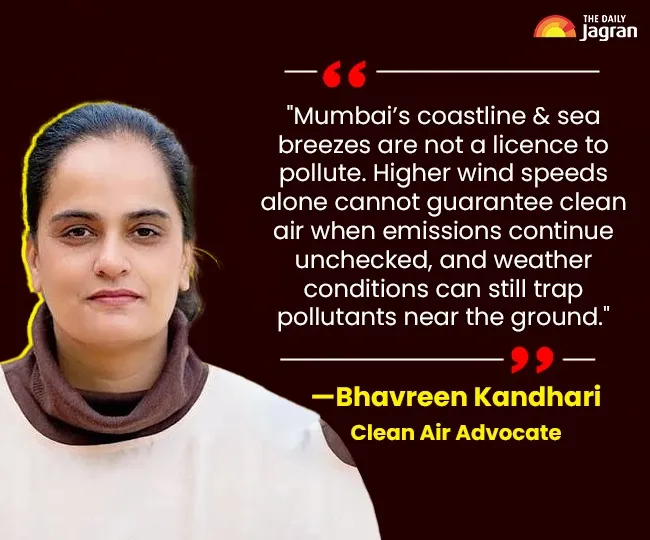
"Mumbai recording an AQI of 164, comparable to Delhi's 165, should be a wake-up call. For a few years now that AQI levels have been overtaking Delhi, we citizens have been saying, 'Ab Dilli Door Nahin'. But then why are we surprised when we have spent the entire year creating the conditions for polluted air?" remarked Kandhari.
'Shocking that Mumbai is surpassing Delhi in pollution': Bombay HC
Amid concerns over deteriorating air quality, the Bombay High Court on Wednesday expressed alarm over Mumbai's pollution levels, calling it shocking that the coastal city was surpassing the national capital in pollution.
A bench comprising Justice Girish S Kulkarni and Justice Neela Gokhale criticised civic authorities, the Maharashtra Pollution Control Board (MPCB) and the police for failing to implement court directives aimed at controlling air and noise pollution during festivals.
“This is shocking. The city has a sea breeze coming, which has a lot of open spaces, the whole openness of the sea. Still, we are facing this... You should see to it that Mumbai skies are clear," the Bench added.
The court also raised concerns about Mumbai recording pollution levels higher than those in Delhi, pointing out that visibility in the city had fallen below 500 metres on Tuesday.
The Bombay High Court further criticised the lack of on-ground police enforcement of its directives to curb noise pollution and firecracker-related pollution. It urged the authorities to take a more proactive approach to tackling the problem.