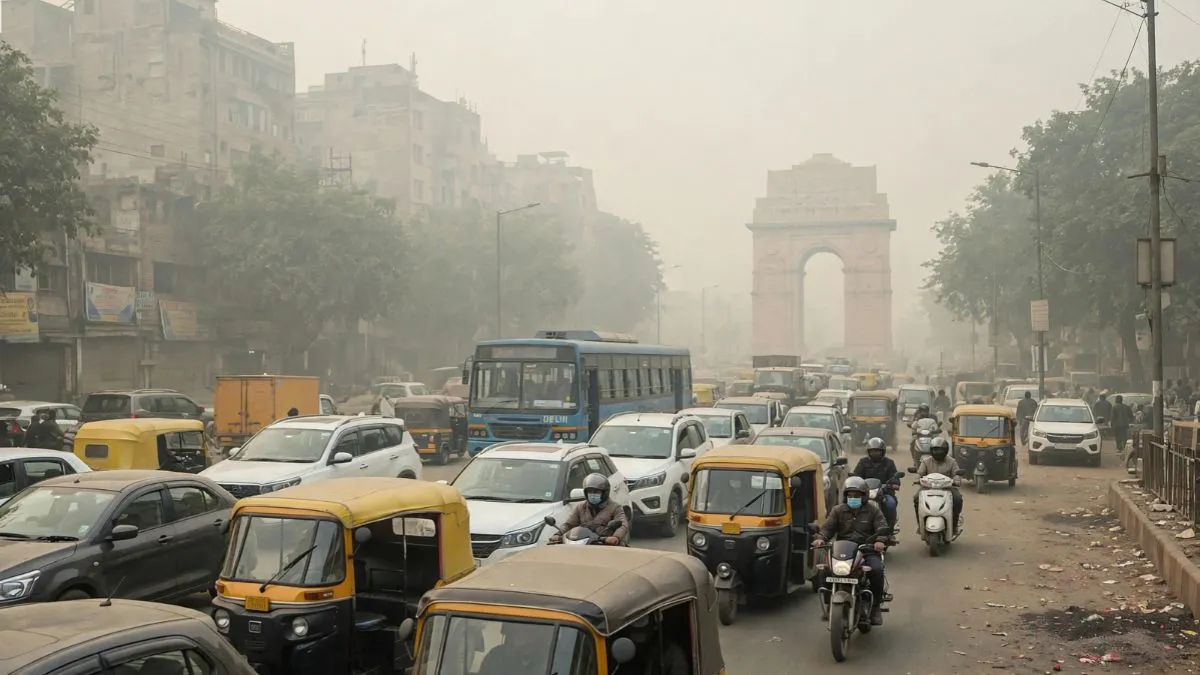
- CSE report identifies vehicles as 52% contributor to Delhi's local pollution.
- GRAP restrictions prove ineffective in easing Delhi's severe traffic congestion.
- Delhi experienced higher pre-winter pollution levels this year compared to previous.
Santosh Kumar Singh, New Delhi: After Diwali celebrations on November 8, Delhi was among the worst-hit cities due to high pollution levels and still continues. A thick layer of smog remains visible across parts of the national capital, affecting air quality and raising health concerns. However, the situation has improved slightly, with Delhi’s overall Air Quality Index (AQI) moving from the ‘very poor’ to the ‘poor’ category, offering some relief to residents.
For most of this week, the air quality remained in the ‘very poor’ category, mainly due to firecrackers and stubble burning.
According to a report by Jagran.com, Delhi’s pollution problem cannot be blamed on stubble burning alone. A new analysis by the Centre for Science and Environment (CSE) highlights that vehicle emissions are the biggest contributor to the capital’s local pollution, accounting for 52 per cent of the total.
Despite the implementation of different stages of the Graded Response Action Plan (GRAP), Delhi’s air quality continues to remain poor. Restrictions on vehicle movement and construction activities are imposed every year, but these temporary measures have failed to address the main causes of pollution.
Recommended For You
The CSE analysis also suggests that Delhi’s air was already more polluted than in previous years, even before Diwali. This raises concerns about the effectiveness of the existing pollution-control measures.
Pollution Levels Higher Than Previous Years
Sharanjeet Kaur, Deputy Programme Manager at CSE’s Urban Lab, said Delhi experienced higher pre-winter pollution levels this year compared to 2025. A slight improvement was recorded towards the end of September, mainly due to rainfall.
Meanwhile, political parties have continued to blame stubble burning in neighbouring states, particularly Punjab, for Delhi’s worsening air quality.
However, the CSE report presents a different picture. It highlights that vehicle emissions and other local sources are major contributors to pollution in the capital.
On November 6, when Delhi’s Air Quality Index (AQI) reached 382, the contribution from stubble-burning smoke was only around 8 per cent .
Traffic Congestion Keeps Pollution Levels High
Vehicle emissions and other local sources remain the main causes of pollution in Delhi. Heavy traffic during morning and evening peak hours, along with still air conditions at night, causes nitrogen dioxide (NO₂) levels to remain high until midnight.
The report also questions the effectiveness of GRAP restrictions, particularly the ban on vehicles that do not meet the BS-VI emission standards.
Despite these restrictions, traffic congestion has not improved significantly. According to the Travel Time Index (TTI), commuters continued to spend 13 per cent to 31 per cent more time on the roads than usual during peak hours.
This shows that restricting certain categories of vehicles alone is not enough to solve Delhi’s pollution and traffic problems.
PM2.5 Levels Nearly Doubled Before Diwali
The average PM2.5 concentration recorded before Diwali was considerably higher in 2026 than in the previous two years.
| Year | Average PM2.5 |
| 2026 | 236 |
| 2025 | 120 |
| 2024 | 179 |
According to the figures, PM2.5 levels increased by 97 per cent compared to 2025 and by 32 per cent compared to 2024.
Vehicles Account for the Largest Share of Local Pollution
The CSE analysis identifies vehicles as the biggest contributor to pollution from local sources in Delhi.
The breakdown is as follows:
Vehicles: 52 percent
Residential activities: 13 percent
Industries on Delhi’s outskirts: 11 percent
Construction activities: 7 percent
Energy consumption: 5 percent
Waste burning: 5 percent
Dust: 4 percent
Other sources: 4 percent
The report also highlights the contribution of pollution entering Delhi from outside the city. Its source-wise figures show the following shares:
Vehicles from neighbouring districts: 54.43 per cent
Local sources: 33.06 percent
Stubble burning: 14.29 percent
CSE Calls for Long-Term Solutions Instead of Temporary Restrictions
Anumita Roychowdhury, Executive Director of Research and Advocacy at CSE, said pollution levels were already much higher than in previous years, even before Diwali.
She pointed out that poor control over pollution sources has contributed to the worsening situation. According to her, if air quality had been better at the beginning of winter and sudden pollution spikes from stubble burning and firecrackers had been controlled, seasonal changes would not have caused such severe pollution.
She stressed that Delhi needs a long-term strategy instead of depending mainly on emergency restrictions.
ALSO READ: Delhi AQI: Will Changing Weather Bring Relief From Toxic Air? What Weather Experts Say
This would require reducing the number of vehicles on the roads, improving public transport and enforcing strict pollution-control measures throughout the year across the entire National Capital Region (NCR).
The India Meteorological Department (IMD) has confirmed that Delhi-NCR is unlikely to receive any rainfall until at least November 15. The lack of rainfall means that harmful pollutants may remain in the air for the next few days, raising serious health concerns.
Without long-term and sustained efforts, Delhi is likely to continue facing the same cycle of severe air pollution every winter.