
- By Vaidika Thapa
- Fri, 05 Jun 2026 07:02 PM (IST)
- Source:JND
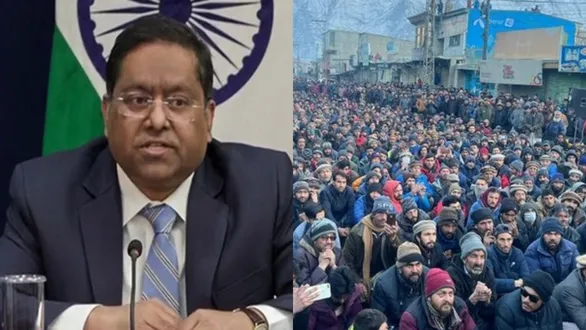
India has strongly objected to Pakistan’s announcement of plans to hold elections for the Gilgit-Baltistan Assembly in territories that India says are illegally and forcibly occupied by Pakistan. The elections are scheduled for June 7.
India Lodges Protest Over Pakistan’s Plan
In a press release, issued on Friday, the Ministry Of External Affairs (MEA) reiterated India’s long-standing position that the entire Union Territories of Jammu and Kashmir and Ladakh, including Gilgit-Baltistan, are an “integral and inalienable part of India.” It said this status is based on the legal and irrevocable accession of J&K to India in 1947.
The government further said that such political exercises by Pakistan cannot hide what it described as serious concerns in these regions, including alleged human rights violations, political repression, economic exploitation, and denial of basic freedoms.
“The Government of India reiterated its well-known position that the entire Union Territories of Jammu & Kashmir and Ladakh, including the so-called “Gilgit-Baltistan”, are integral and inalienable parts of India as a result of complete, legal and irrevocable accession of Jammu & Kashmir to India in 1947,” the statement noted.
India Demands Pakistan Vacate Occupied Areas
India also firmly rejected any attempt by Pakistan to bring changes in areas it says are under illegal occupation. It stressed that these actions do not alter the reality that Pakistan remains in illegal control of Indian territory, which it should “vacate.” The statement added: “The Government of India categorically rejects any attempts by Pakistan to bring material change to areas under Pakistan’s illegal occupation, and underlines that such actions cannot hide the fact that Pakistan illegally remains in possession of Indian territories, which it must vacate.”
MEA says - "The Government of India lodged a strong protest with Pakistan regarding the latter’s plans to hold “General Elections” to the so-called “Gilgit-Baltistan Assembly”, in the Indian territories illegally and forcibly occupied by Pakistan, scheduled for 7 June 2026.
— ANI (@ANI) June 5, 2026
The… pic.twitter.com/7AcUu5oQBL
What Is GBA?
The Gilgit-Baltistan Assembly (GBA) is a unicameral legislature made up of elected representatives from the region. It was created under the Gilgit-Baltistan Empowerment and Self-Governance Order of 2009, which granted limited self-rule and established an elected legislature. The assembly has a total of 33 seats, including 24 general seats, 6 reserved for women, and 3 reserved for technocrats and professionals. The first election was held in 2009.
ALSO READ: How India Handles Deportation Of Illegal Bangladeshi Nationals? Full Process Explained