
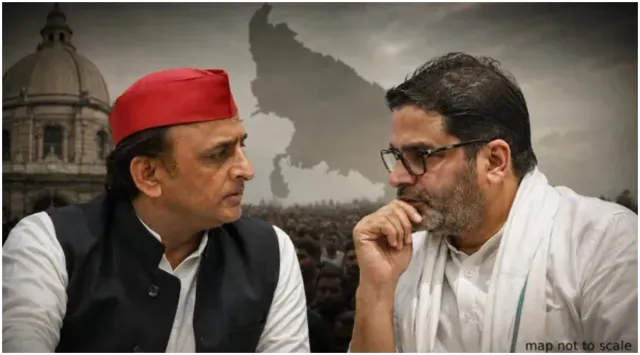
- Akhilesh Yadav seeks Prashant Kishor's support for UP elections.
- SP aims to expand voter base beyond traditional Muslim-Yadav.
- Kishor's strategy focuses on issues, not just caste calculations.
Arvind Sharma: Ahead of the Uttar Pradesh Assembly Elections, Samajwadi Party chief Akhilesh Yadav has intensified his quest for a new social alignment so as to diversify its core voter base to include new cases, especially Brahmins. He has reportedly contacted Prashant Kishor, founder of Jan Suraj Party, seeking his support after the latter decimated the BJP's fort in Bankipur bypoll in Bihar.
After coining a new definition of PDA, Yadav's outreach to Kishor is seen not just as an attempt to seek electoral advice, but to craft a new narrative.
Prashant Kishor's electoral model, which he presented by demolishing the BJP's seemingly unbeatable stronghold in Bankipur, has caught the attention of opposition parties.
Strategic support from Prashant Kishor
According to sources, Akhilesh Yadav spoke with Prashant Kishor over the phone and discussed the possibility of working together in Uttar Pradesh. The initial conversation has been positive. If the dialogue progresses, it will not only represent PK's strategic support but also signal a shift in the Samajwadi Party's political thinking, as the recent elections in Bihar have made it clear that relying solely on traditional vote banks is no longer enough to reach power.
ALSO READ: UP Politics: SP Bets On 'Simple Dimple' To Woo Women Voters; How Can It Help Akhilesh Yadav?
The RJD has paid the price for limiting itself to the Muslim-Yadav (MY) equation. Before the assembly elections, the RJD had 77 MLAs, but that number has now dwindled to 25.
Learning from Tejashwi Yadav's plight, Akhilesh is seeking to expand his base. To this end, he recently included Pandits in the PDA's definition. It's clear that he's also eyeing 'upper-caste' votes. The grand celebration of Janeshwar Mishra's birth anniversary is also indicative of this strategy.
Recommended For You
Created an environment for issues like public representation
This is where PK's electoral model becomes crucial for Akhilesh. In Bankipur, he didn't allow the election to be limited to caste calculations. By raising issues like employment, education, local development, corruption, and better public representation, he created an environment in which the BJP's traditional polarisation was weakened.
The biggest challenge before SP
In Uttar Pradesh, the SP's biggest challenge isn't just competing with the BJP. In the post-2024 political environment, it will have to reach out to the youth, the urban middle class, first-time voters, and a segment of the 'upper caste' community. This requires building caste alliances and creating a narrative that can dent the BJP's vote bank.
This shift is significant because, until a few months ago, Akhilesh Yadav held a different view on the role of election strategists. Following the TMC's defeat in the Bengal elections, he refused to hire PK's former company, IPAC.
At that time, SP was considering contesting the elections solely on the strength of its own organisation rather than relying on outside strategists, but the situation appears to be changing after the Bankipur results.
ALSO READ: Nitish Kumar Meets PM Modi Day After Prashant Kishor Breaches BJP's Bankipur Bastion
Organisation building and direct politics
Kishor's political experience is no longer as highly regarded as it once was. His 2017 experiment with the Congress in Uttar Pradesh was unsuccessful, but he has since gained new experience in Bihar through extensive foot marches, organisation building, and direct political engagement. The Bankipur victory has also strengthened the perception that he is no longer seen as an election strategist, but as an expert leader with the ability to win elections on the ground.