
- By Ajeet Kumar
- Wed, 03 Jun 2026 02:26 PM (IST)
- Source:JND
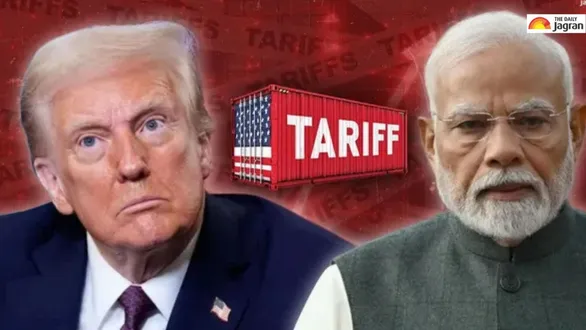
- USTR report alleges India's failure to enforce forced labor laws.
- Section 301 investigation could lead to US tariffs.
- India engaging with US on concerns, pursuing trade agreement.
New Delhi: The Trump administration on Wednesday released a report tactically that alleges India of not invoking labour properly. The report released by US Trade Representative (USTR) came at a time when the trade officials from America are in New Delhi for the finalisation of the proposed Bilateral Trade Agreement (BTA).
What USTR report claims
The Office of the United States Trade Representative launched two separate Section 301 investigations on March 11 and 12, 2026, covering 60 economies over concerns related to forced labour and excess industrial capacity. The USTR on June 2 issued its findings in the forced labour investigation.
"In sections III.A.7 and III.B.7, USTR found that India has failed to impose and effectively enforce a forced labour import prohibition. In section IV, we found that the failure to impose and effectively enforce a forced labour import prohibition is unreasonable. In section V, we found that the failure to impose and effectively enforce a forced labour import prohibition burdens or restricts US commerce," according to the USTR finding report listed on its website.
Why US released USTR report now
Although the investigation have been going on for the past two months, the timing of the findings raised eyebrows. Earlier last year, Trump imposed a massive 50 per cent tariff on India. However, US Supreme Court had ruled out the tariffs as illegal. Since then, the Trump administration were reportedly exploring ways to impose higher tariff on New Delhi. Then it had opened an investigation under Section 301 of the US trade act that allows the administration to bypass the court ruling and impose a fresh tariffs.
What is Section 301?
Section 301 is a rule in the US Trade Act of 1974. It is a powerful tool that allows the United States to fight against what it sees as unfair trade practices by other countries. It gives the USTR the power to investigate foreign governments. If the investigation finds that a country is hurting American businesses or trade, the US can take action, most commonly by putting extra tariffs on goods imported from that country.
When can Section 301 be used?
The US can start a Section 301 investigation if it believes a foreign country is doing any of these: breaking international trade agreements, stealing intellectual property (like patents or copyrights), forcing American companies to share technology, restricting access to its markets, giving huge government subsidies that create too much supply, or violating labor rights, such as using forced labour.
If the investigation proves unfair practices, the US can impose tariffs or take other measures to protect its interests.
How did Indian government respond to USTR report?
India is engaged with the US on the Section 301 investigations over concerns related to forced labour and excess industrial capacity, the government said on Wednesday. The country is also "parallelly" engaged with the US for finalisation of an interim trade agreement, a framework for which was announced through a joint statement on February 7.
"As per the report, the proposed tariffs are not yet final and stakeholders can submit requests to participate in public hearings by 22 June 2026. Written comments can be submitted until 6 July 2026. Public hearings will be held on 7 July 2026. The USTR will consider the comments and testimony received before taking a final decision on the proposed measures," read the statement.
Will India face tariff heat?
The USTR on June 2 issued its findings in the forced labour investigation and proposed additional tariffs on imports from 60 economies. The proposal includes a 10 per cent tariff on imports from Canada, Ecuador, the European Union, Indonesia, Mexico, and Pakistan, and a 12.5 per cent tariff on imports from 54 other economies, including India and China.
Pakistan and Indonesia are India's competitors in the trade front. The measure remains a proposal and has not yet been finalised. "India remains engaged with the U.S. on the matter as a part of Section 301 proceedings. India is also parallelly engaged with the US for finalisation of a framework agreement as was announced on 2nd February 2026 and in accordance with the joint statement released on 7th February 2026," the commerce ministry said.
You may also like to watch