

- By Ajeet Kumar
- Wed, 17 Jun 2026 02:54 PM (IST)
- Source:JND
- USINDOPACOM renamed to US Pacific Command (USPACOM) on Tuesday.
- Change restores historical identity; mission and area unchanged.
- "Indo" removal sparks debate on US-India ties, China strategy.
The Department of War announced on Tuesday (local time) that the US Indo-Pacific Command (USINDOPACOM) will officially restore its name to the US Pacific Command (USPACOM). Originally established on January 1, 1947, by Former US President Harry S Truman, the command operated under the USPACOM banner for over 70 years, standing as the oldest and largest of the United States' unified combatant commands.
What is USINDOPACOM?
USINDOPACOM stands for the United States Indo-Pacific Command, the largest and oldest US military combatant command. Headquartered in Hawaii, it oversees US military operations across a vast region stretching from the US. West Coast to India's western border, covering both the Pacific and much of the Indian Ocean. It is responsible for coordinating with allies and partners such as India, Japan, Australia, South Korea and others.
What happened just now?
USINDOPACOM was the US military command for the Indo-Pacific region; it has been renamed back to USPACOM primarily as a restoration of its historic name, though the move is attracting geopolitical scrutiny because of the symbolism attached to the word "Indo."
Why was it called "Indo-Pacific"?
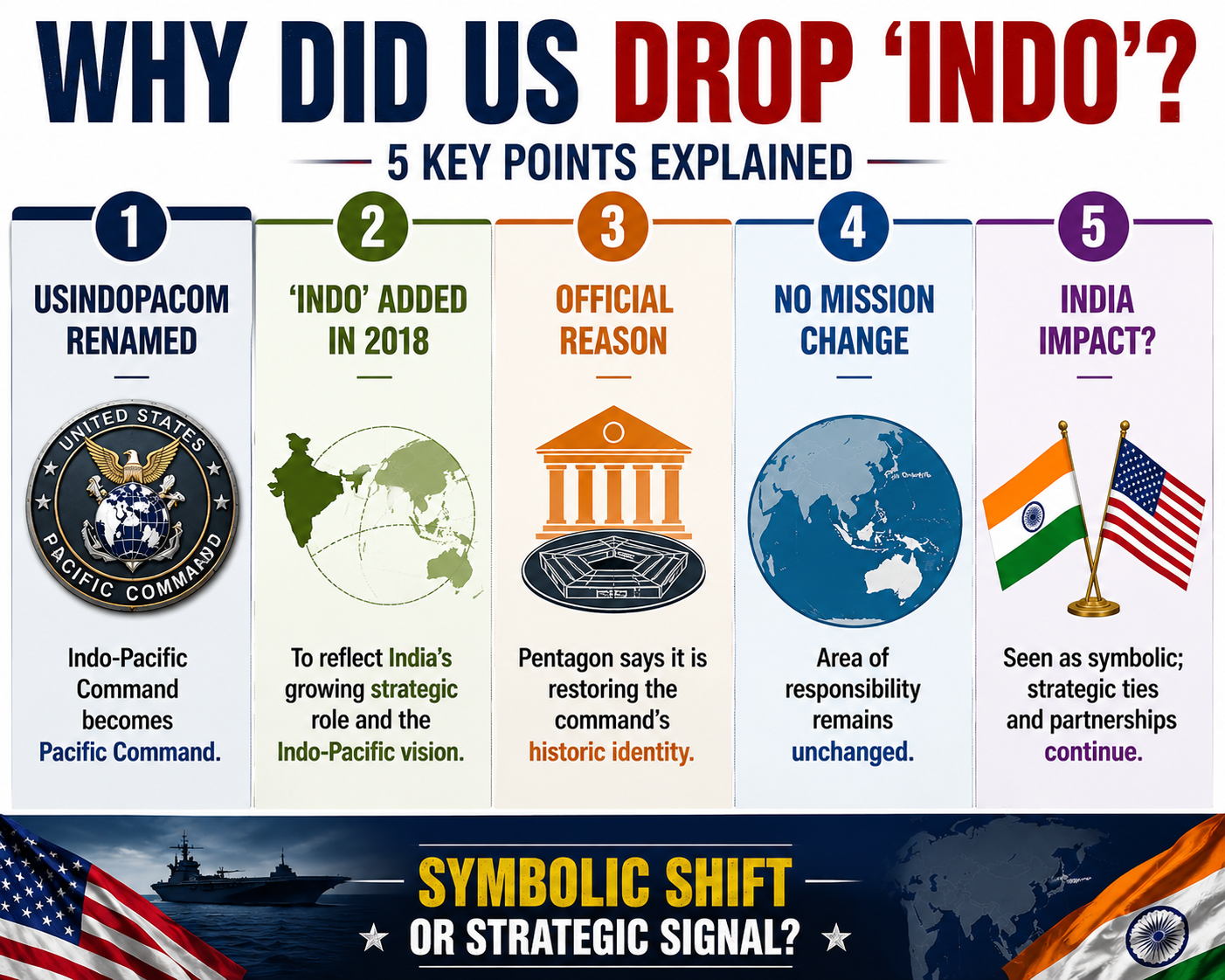
In 2018, the US renamed the US Pacific Command (USPACOM) to US Indo-Pacific Command (USINDOPACOM). Then-Defence Secretary James Mattis said the change reflected the growing strategic connection between the Indian and Pacific Oceans and recognised India's increasing importance in regional security. The move was widely seen as a symbolic nod to India and part of Washington's broader Indo-Pacific strategy, especially amid concerns about China's rise.
Why has it been renamed again?
The US administration announced that USINDOPACOM would revert to its old name, US Pacific Command (USPACOM). Officials said the change was intended to "restore the command's legacy" and historical identity, noting that it operated under the USPACOM name for more than 70 years. The Pentagon also stated that the command's area of responsibility and mission remain unchanged.
Does this mean the US is distancing itself from India?
Not necessarily. The official explanation emphasises heritage and branding rather than a change in military responsibilities. The command will still cover the same geographic area, including the region up to India's western border, and its partnerships and operations are expected to continue as before.
However, because the term "Indo-Pacific" became closely associated with stronger US-India strategic cooperation and balancing China's influence, some analysts view the removal of "Indo" as a symbolic shift in messaging. Whether it reflects a deeper policy change remains unclear.
"PACOM is back, and yes it’s silly that Trump 1.0 changed it to INDOPACOM and then Trump 2.0 reversed his own decision, but I think there’s more happening here: Trump 2.0 is actively rethinking “Indo-Pacific” as a geostrategic frame," Derek J Grossman, a geopolitical analyst said in a social media post, X. "Indeed, it has already used “Asia-Pacific” several times in official readouts. This strongly suggests a less hawky approach toward China in favor of greater engagement," he added.
(With inputs from agencies)