
- By Nidhi Giri
- Tue, 07 Apr 2026 12:09 PM (IST)
- Source:JND
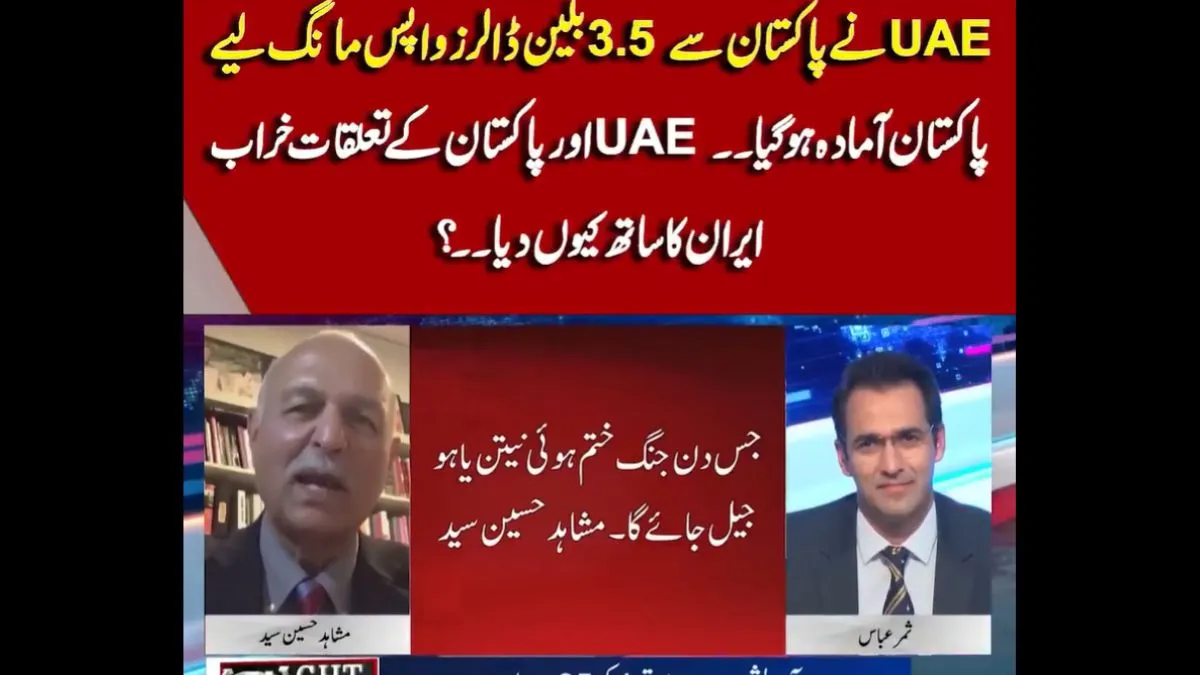
During a televised interview, Pakistani senator Mushahid Hussain stirred controversy after making remarks about the United Arab Emirates (UAE), a nation that has historically provided financial aid and support to Pakistan. While speaking to a news channel, the Pakistani senator described the UAE as "bechara" and "majboor". He also expressed that he was "glad" Pakistan chose to repay its longstanding loans, claiming that the UAE itself was "majboor" and in need of support.
The senator also highlighted Pakistan’s role in UAE’s development and how it has always stood by Gulf countries. "Pakistan has a hand in making the UAE," he said.
Pakistan Senator Talks About India-UAE Relations
The Pakistani Senator was also heard cautioning UAE on the Gulf nation’s growing Indian population.
“I want to give a piece of advice to the UAE. You have a 10 million population, of which 4.3 million are Indians. Please take care. Your increasing friendship with India… be careful that you do not become part of Akhand Bharat," Hussain remarked.
Pakistani Senator Mocks UAE Over Loan Repayment – Exposes "Aishan Farmosh" Mentality!
— RB. (@rahul4bisht) April 6, 2026
Check out this Pakistani Senator Mushahid Hussain on an a TV show, mocking the UAE when they asked Pakistan to return their loans. He smugly claims Dubai "needs money because Iran destroyed its… pic.twitter.com/Ek4YeXUi9V
Pakistan’s Dependence On Other Countries
Pakistan's chronic dependence on external debt reflects decades of fiscal mismanagement, entrenched elite capture and failure to broaden the tax base or restructure loss-making state-owned corporations, a report said on Monday.
According to a report in the "Khalsa Vox', Pakistan has announced to repay USD 3.5 billion in debt to the United Arab Emirates (UAE) by the end of April 2026, projecting the decision as an "act of sovereign pride".
UAE Seeks Immediate Repayment Of Loans
It added that Abu Dhabi had sought the immediate repayment of funds originally extended in 2019 to help stabilise Pakistan's balance of payments.
The report argued that Islamabad's narrative of "dignity" rings hollow when confronted with the facts. Pakistan had actively sought a two-year rollover and a reduction in interest rates from 6.5 per cent to around 3 per cent, citing improved credit ratings and lower global borrowing costs. The UAE refused.
What Islamabad presents as a principled stand is, in reality, acquiescence to a creditor's demand amid regional turbulence, the UAE's own liquidity needs heightened by Middle East tensions following the US-Israel-Iran conflict, the report detailed.
"For decades, Gulf deposits have functioned as de facto lifelines; their abrupt withdrawal reveals how fragile that dependence remains. This episode underscores a deeper contradiction in Pakistan's foreign policy: a persistent desperation to project global standing while its economic reality tells a different story," it added.