
- By Ajeet Kumar
- Mon, 11 May 2026 01:11 PM (IST)
- Source:JND
- Munir called India conflict a "battle of ideologies."
- Claimed Pakistan's strategy was "superior" to India's.
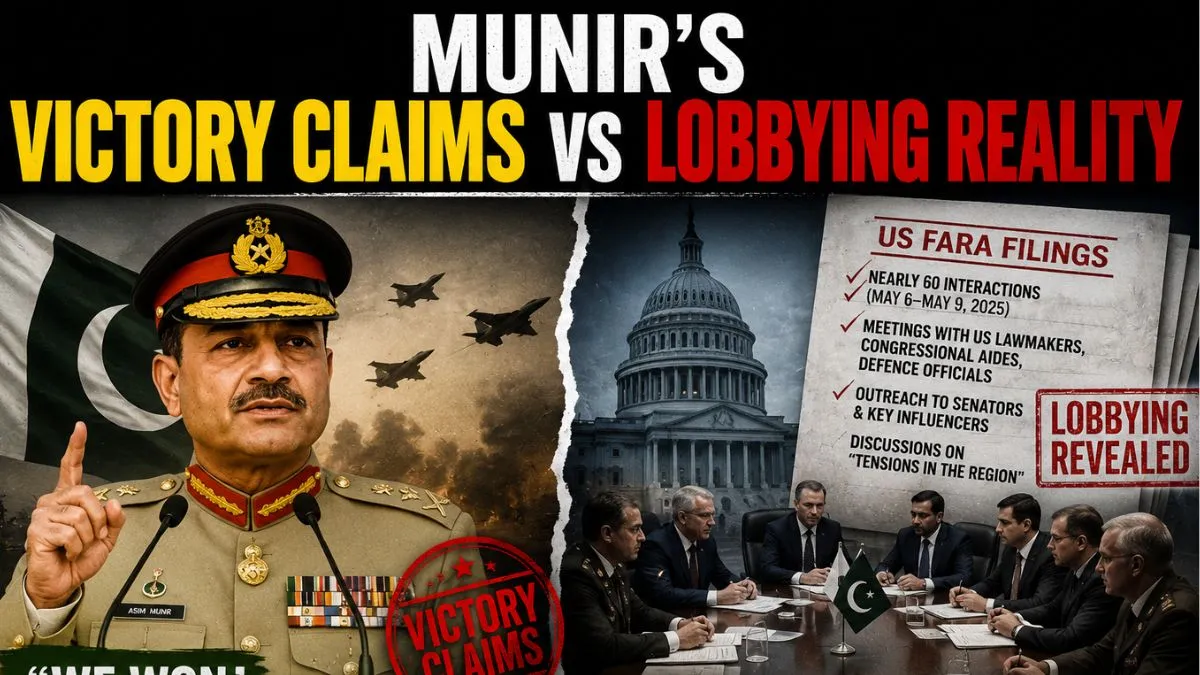
- US filings show Pakistan lobbied during India's operation.
Pakistan's Chief of Defence Forces Field Marshal Asim Munir on Sunday termed last year's conflict with India as a "battle between two ideologies." Addressing a ceremony at General Headquarters in Rawalpindi to mark the first anniversary of 'Marka-e-Haq', the name given by Islamabad to the four-day conflict with India, Munir also claimed that Pakistan's strategy was "superior" to that of India during the conflict.
Addressing Sunday's event, Munir alleged that India "violated the sovereignty and territory" of Pakistan between the night of May 6-7 and May 10 last year, and said Pakistan responded, "with full national unity and military force".
"Marka-e-Haq was not merely a traditional war fought between two countries or militaries, but in reality, it was a decisive marka (battle) between two ideologies," he said.
Munir gave no proofs
Munir claimed that Pakistan had struck 26 targets during the conflict. He, however, did not provide any evidence in support of his claims. He also claimed that India had sought a ceasefire through the US and that Pakistan agreed to it "in the interest of peace".
India maintains that the understanding to stop military actions was reached directly between the two sides.
What does evidence suggest?
Munir's latest claim that India approached the United States for a ceasefire appears at odds with American lobbying disclosures showing Islamabad mounted an intense diplomatic and defence-linked outreach in Washington after India launched Operation Sindoor.
However, filings made under the US Foreign Agents Registration Act (FARA), reviewed by ANI, show that between May 6 and May 9 2025, alone Pakistan logged nearly 60 interactions involving US lawmakers, congressional aides, defence-linked personnel, Treasury officials, national security advisers and journalists.
ALSO READ: Pakistani Army Spokesperson Gets Trolled Over ‘Why English?’ Remark On Indian Army Media Interaction
The records indicate that Islamabad was actively engaging influential political figures in Washington as India launched Operation Sindoor in response to the Pahalgam terror attack and carried out strikes on terrorist infrastructure across Pakistan and Pakistan-occupied Jammu and Kashmir (PoJK).
The contacts included personnel linked to the Senate Armed Services Committee and influential figures in US defence and security matters, including Representative Mike Rogers, Senator Richard Blumenthal, Senator Roger Wicker and Senator Tom Cotton.
The documents show that by May 7 and May 8, Pakistan's focus was now on discussing "tensions in the region."
The filings also show a difference in the activities of India and Pakistan in Washington during the escalation period. The filings reviewed by ANI do not show comparable Indian diplomatic or defence-linked activity in Washington after the launch of Operation Sindoor and before the cessation of hostilities.
Pakistan's filings, on the other hand, show sustained engagement with top US political leadership, congressional offices, defence-linked personnel and national security circles during the period when India targeted terror infrastructure in Pakistan.
(With inputs from agencies)
You may also like to watch