
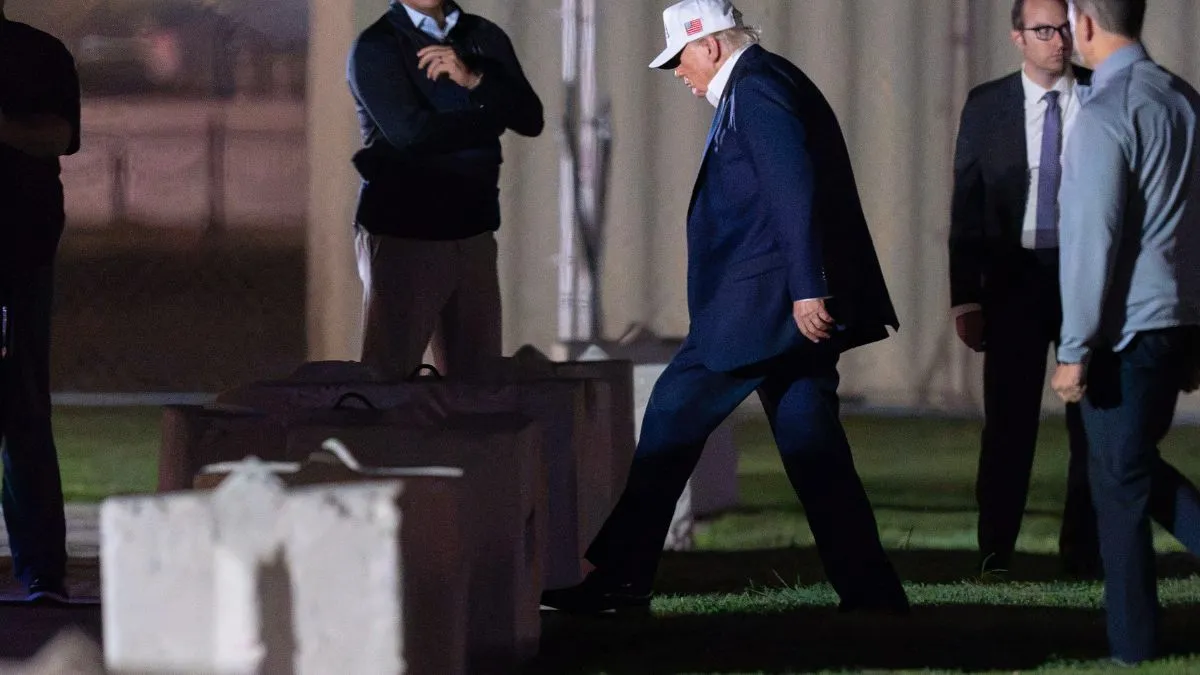
- Trump returned early from Camp David due to Middle East crisis.
- Houthi forces launched missile and drone attacks on Riyadh.
- US issued urgent security warnings for Americans in the region.
A major escalation in the Middle East is on the brink, with multiple news breakdowns pointing out a series of “unusual” incidents reported in the past 12 hours. Several geopolitical experts raised alarm for the "worst situation" as US President Donald Trump abruptly cut short his weekend at Camp David and returned to the White House on the evening of Saturday, one day ahead of schedule, news agency Reuters reported. Marine One landed at the Ellipse around 8 p.m. ET with no official explanation provided for the change.
#WATCH | Washington DC: US President Donald Trump returned abruptly to the White House from Camp David on Saturday evening, amid heightened tensions and ongoing developments surrounding the conflict with Iran.
— ANI (@ANI) September 20, 2026
(Source: US Network Pool Via Reuters) pic.twitter.com/Xc3As2xflo
Is US planning a full-scale airstrike on Houthis?
The unscheduled departure occurred amid a sharp escalation involving Iran-backed Houthi forces in Yemen and Saudi Arabia, coupled with fresh US security warnings for Americans across the Middle East. According to a repport by CNN, Trump is planning a massive attack on Iran-backed Houthis amid a series of attacks on Saudi Arabia in the past week.
Saudi Arabia's capital under attack
Hours earlier, the Houthis claimed missile and drone strikes on "sensitive" sites in Riyadh, the Saudi capital, their first reported direct hit attempt on the city in the current phase of fighting that intensified in July. Video and photos showed a large plume of black smoke near King Khalid International Airport, with flames visible near what appeared to be fuel infrastructure. The Saudi-led coalition reported intercepting a ballistic missile headed toward Riyadh and foiling other attacks on cities including Yanbu, a key oil export hub. Saudi authorities had issued overnight civil defence alerts for Riyadh and Al-Kharj before clearing the all-clear Saturday morning.
BREAKING: For the first time in four years, Yemen's Houthis have struck Saudi Arabia's King Khalid International Airport in Riyadh with drones, hitting the main jet fuel tanks, with flames and a massive plume of black smoke over the airport, per Reuters.
— The Hormuz Letter (@HormuzLetter) September 19, 2026
Saudi Arabia lost its… pic.twitter.com/DZq4KrcMOX
Emergency alerts for Americans in Middle East
In response, the US State Department and multiple embassies issued security alerts. Americans in the region were told to exercise heightened vigilance due to the “potential for unforeseen escalation,” possible flight cancellations, airspace closures, and travel disruptions. The advisory specifically noted Iranian-supported Houthi hostilities against Saudi civilian airports and infrastructure, urging those outside the Middle East to “seriously reconsider travel to and through the region.” US diplomatic facilities and interests more broadly were also flagged as potential targets.
These developments unfold against the backdrop of the broader US-Iran conflict that began with American and Israeli strikes in late February. Concurrently, Iranian Supreme National Security Council secretary Mohsen Rezaei announced that Tehran had transmitted seven conditions for ending hostilities via Qatari mediators, including a full cessation of fighting, release of frozen funds, and lifting of the U.S. naval blockade. Iran is awaiting Trump’s response.
Separately, a NORAD F-16 intercepted a general aviation aircraft that violated restricted airspace near Camp David while the president was present, deploying flares during the incident. Ongoing U.S. fighter rotations to the Middle East continue amid readiness pressures from the prolonged conflict, and Washington recently advanced a major F-35 sale to Saudi Arabia.
What reports indicate
The convergence of Trump's early return, the Houthi-Saudi flare-up, State Department warnings, and Iranian diplomatic messaging signals a precarious moment. While no direct causal link has been confirmed between the Camp David schedule change and regional events, the timing has fueled speculation about crisis management or evaluation of next steps.
The risk of rapid wider escalation remains real: further Houthi strikes could disrupt Red Sea shipping and oil flows already strained by the Strait of Hormuz situation, while any US response carries broader war risks. Americans in or near the region face tangible travel and security uncertainties. Diplomatic channels via Qatar remain open, but the margin for miscalculation is narrowing as military postures stay elevated. Vigilance and careful de-escalation efforts will be essential in the days ahead.
(With inputs from Reuters)