
- By Shubham Bajpai
- Thu, 21 May 2026 06:38 PM (IST)
- Source:JND
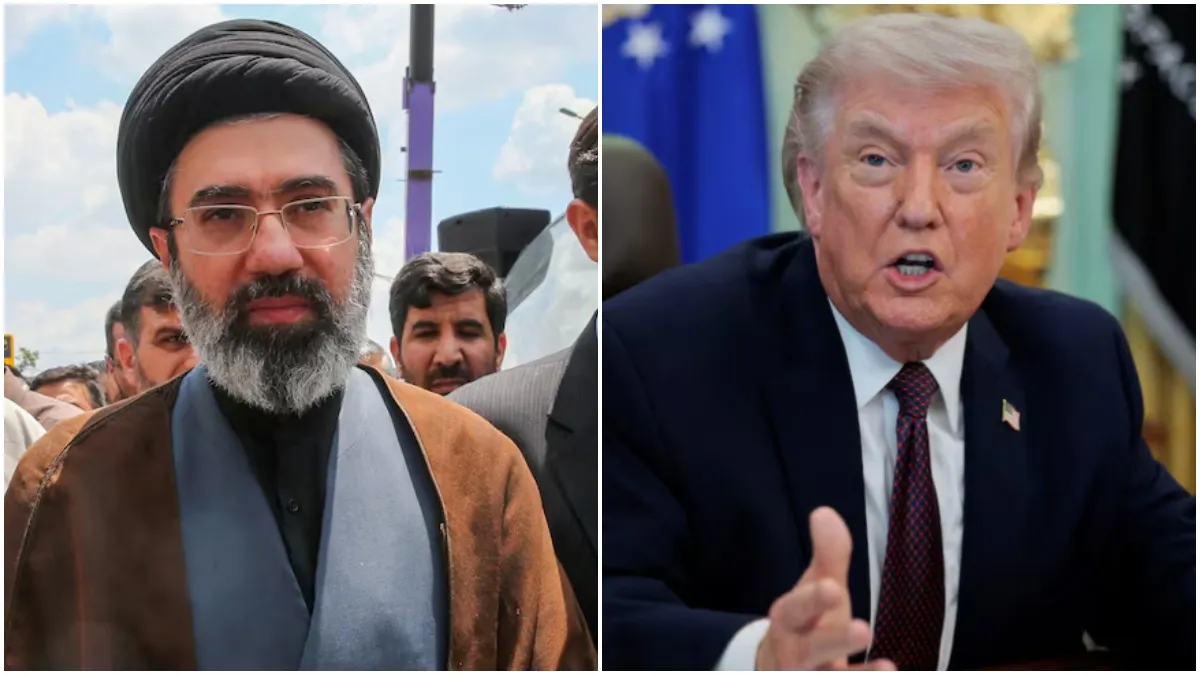
Iran's Supreme Leader, Mojtaba Khamenei, has issued a directive that no enriched uranium will be sent to the United States and, in fact, will remain with the country, marking a sheer refusal to one of the key demands raised by the Donald Trump administration during the peace talks.
Iran's semi-official Fars News Agency said that the US has demanded 400 g of highly enriched uranium, a limit to Iran's nuclear operations to just one facility, along with acceptance of the US' denial of any compensation for war-related damage.
News agency Reuters cited Iranian sources saying, "The Supreme Leader's directive, and the consensus within the establishment, is that the stockpile of enriched uranium should not leave the country."
The uranium clause in the peace deal is considered to be most crucial, as Israeli sources, cited by Reuters, said that Trump has assured Israel that taking out the stockpile of highly enriched uranium, needed to make an atomic weapon, from Iran would be a required clause for any peace to happen.
This comes as the US President Donald Trump has threatened to end the ceasefire if a peace deal is not achieved. A massive deployment of the US Navy, Air Force, and missile defence systems has started in the Middle East.
According to an Atlantic Council tracker, this campaign demonstrates America's strength, but it is also increasing pressure on its long-term military preparedness and global security capabilities.
Heavy deployment of naval forces and warships
The US Navy has deployed two of its three available aircraft carriers, the USS Abraham Lincoln and the USS George HW Bush. The Pentagon has also postponed the planned retirement of the USS Nimitz until 2027, while the USS Gerald R Ford has returned from a long mission.
The US Navy has also deployed 18 Arleigh Burke-class destroyers to the region, representing approximately one-third of its total fleet.
Amphibious warships such as the USS Tripoli and USS Boxer have also been deployed. Mine-sweeping ships and littoral combat ships have also been deployed in response to the threat of Iranian seaborne mines in the Gulf region.
ALSO READ: Trump Gives Iran 'A Few Days' To Respond On Peace Deal, Says Waiting For 'Right Answer'
The US has also deployed significant force on the air front, with around 15 B-1 Lancer bombers flying missions from Britain. This represents approximately 60 per cent of the US's total B-1 fleet.
The US has also deployed stealth B-2 bombers to the operation, although the exact number has not been made public. Six E-3 Sentry AWACS aircraft, used for surveillance and control, are also deployed, representing about three-quarters of the US fleet of this class.
More than 100 KC-135 and KC-46 air tanker aircraft, essential for long-range operations, have also been deployed to the region.