

Indian device makers will have another option for cellular connectivity when Sensorise brings its Wega M1 module to market next year. Unveiled at India Mobile Congress (IMC) 2026, the 4G module is designed and manufactured in India and is intended for connected products ranging from electricity meters and electric vehicles to payment terminals and industrial equipment.
Union Minister for Communications Jyotiraditya Scindia unveiled the module at the event. Sensorise plans to begin commercialising Wega M1 in the first quarter of 2027, with deployments initially planned alongside selected anchor customers.
Scindia welcomed the development of a locally made component that connects devices to telecom networks. He described it as a bridge, or 'SETU', between the two. The launch comes as India looks to strengthen its domestic electronics manufacturing capabilities and address concerns around cybersecurity and control over data.
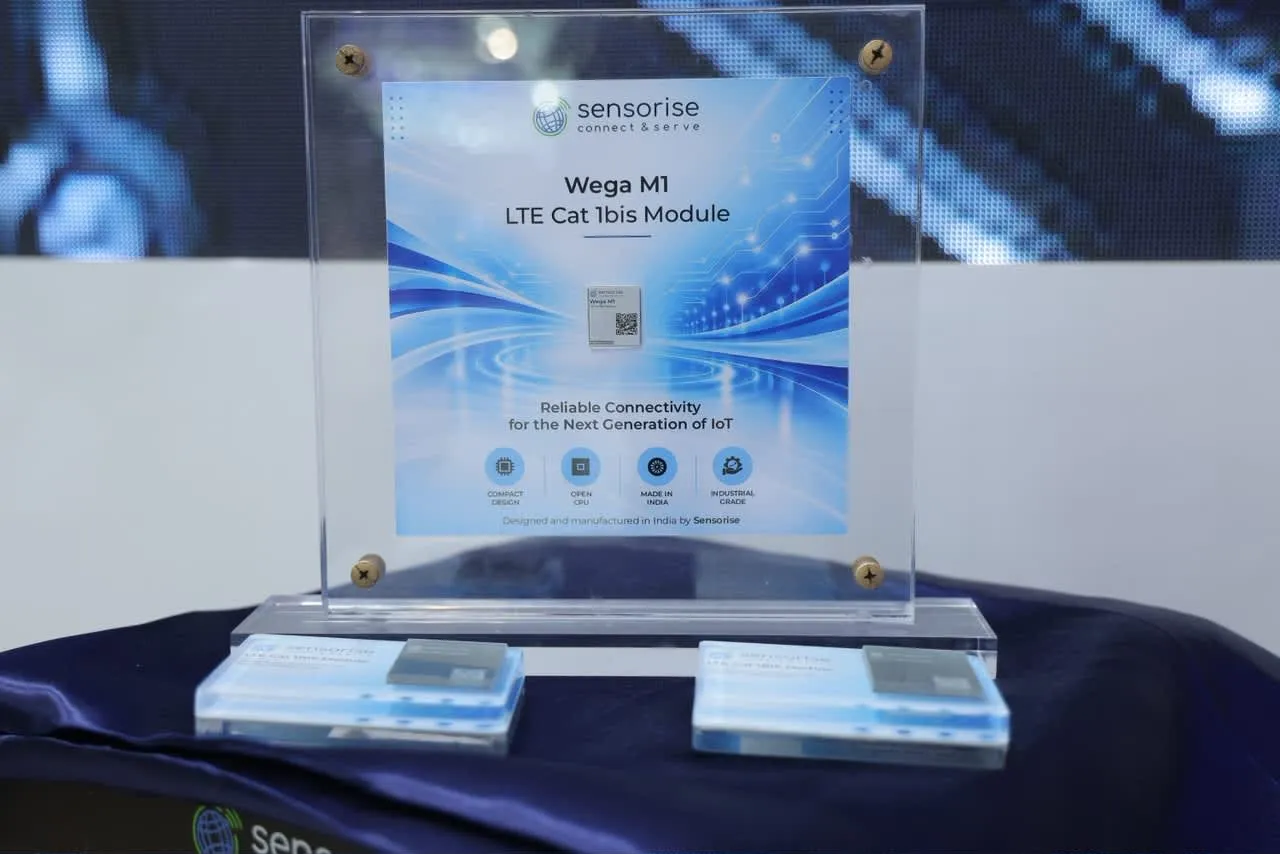
Sensorise wants to offer an alternative to imported modules
Cellular modules are a key component in connected devices, allowing equipment to communicate over mobile networks. Sensorise says the market in India is currently dominated by global suppliers, creating a need for a locally developed option that takes domestic requirements into account.
The company said security incidents involving modules have added to concerns about data sovereignty and cybersecurity. It sees Wega M1 as a way to bring another part of the connectivity supply chain within India's domestic manufacturing ecosystem.
Sensorise says Wega M1 fits into India's push to keep more of its telecom infrastructure and SIM-related processes within the country. The company believes a locally developed module could help manufacturers meet relevant regulatory requirements while supporting the Department of Telecommunications' policies on SIM personalisation and homegrown network components.
Under the hood, Wega M1 uses Qualcomm's 216 LTE IoT Modem. Sensorise has also opted for a pin-compatible design, allowing manufacturers to switch from existing cellular modules with fewer hardware changes. This could make adoption easier for businesses that want to move to the new module without having to redesign their devices from scratch.
Smart meters, EVs and industrial devices in focus
Sensorise is targeting several categories of connected equipment with Wega M1. These include smart electricity meters, electric vehicles, point-of-sale (POS) machines, asset tracking systems, logistics equipment and industrial Internet of Things (IoT) applications.
The module supports LTE connectivity alongside multi-operator and Multi-IMSI capabilities. These features are aimed at providing better flexibility when it comes to how devices connect to mobile networks. It also supports eSIM technology and GSMA-compliant remote SIM provisioning (RSP), allowing SIM profiles to be managed remotely.
Another feature is QoSIM integration, which provides connectivity monitoring and analytics. Sensorise has also specified a 10 to 15-year product lifecycle, addressing the needs of businesses that deploy connected devices and expect to use them for many years.
The company says Wega M1 has been developed with applicable DoT, MTCTE/TTC, information security and data-governance requirements in mind. Its positioning combines domestic manufacturing with connectivity management and support for long-running IoT deployments.
Qualcomm backs the development
Qualcomm is supplying the modem platform for Wega M1. Manmeet Singh, Business Head, Automotive, Connectivity, Broadband & IoT, Qualcomm India Pvt. Ltd., said:
“Qualcomm is committed to enabling reliable, power-efficient cellular connectivity for a wide range of IoT applications. We are pleased to support Sensorise as it brings an India-developed module to market and contributes to the continued growth of the IoT ecosystem in India,” said Manmeet Singh, Business Head, Automotive, Connectivity, Broadband & IoT, Qualcomm India Pvt. Ltd.
Sensorise sees scope for bundled eSIM and 4G products
Wega M1 is also looking forward to opening up a new business avenue for Sensorise, which is looking forward to pairing its eSIM services with 4G modules. By offering both together, the company hopes to give businesses a simpler way to connect their IoT devices and manage network connectivity.
Karn Nagpal, President, Sensorise, said:
“This launch is an important milestone in our vision to build trusted connectivity infrastructure for India. With the government’s impetus on data sovereignty and cyber security, the Wega M1 launch and proliferation will be an important compliant product for the Indian market. We are building a strong future roadmap for the product to cater to network enhancements and use cases in the market. While troubleshooting a customer problem, we had greater clarity on the need for such a product. Also, given our installed and growing base, we see bundled eSIM and 4G modules as a great opportunity area for Sensorise and the industry. The future of IoT/M2M will be plug-and-play Made-in-India components supporting the government’s vision of 1 billion IoT/M2M devices, said Karn Nagpal, President, Sensorise.
The company plans to expand the module's capabilities as network requirements and IoT use cases evolve. Its longer-term ambition is to support the growth of India's machine-to-machine (M2M) and IoT ecosystem with locally developed hardware that can work alongside its connectivity services.
Q1 2027 could see the launch of the Wega M1 module. Its adoption will depend on how the module fits manufacturers' technical and commercial requirements, as well as the rollout of initial customer deployments.