
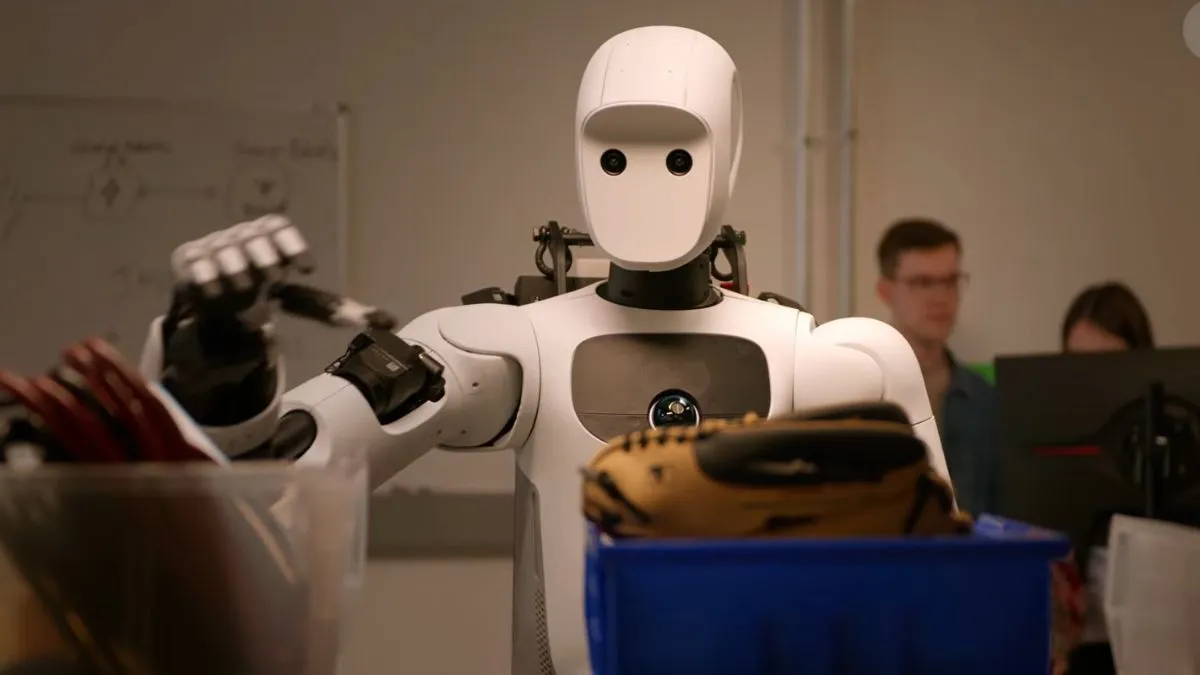
One of the major limitations of robots has been the fact that they have been, for a long time, limited to monotonous tasks, and adaptation is something which had not taken the front seat yet. But it seems like Google wants to turn that around. This new development comes from Google's DeepMind labs, which has now introduced Gemini Robotics 2, which is essentially new Artificial Intelligence (AI) model which will power the humanoid robots. This will essentially function as a brain that will translate reasoning abilities and tasks for a robot in the physical realm and help it complete complex tasks.
ALSO READ: OnePlus N6x Debuts In India With 7,000mAh Battery, Dimensity 6360 Apex SoC: Check Price And Features
Gemini Robotics 2 is being designed to help robots that are usually fixed with just mundane and monotonous tasks get an extra edge where they can think and reason and also understand their surroundings and, in turn, perform complex physical tasks. Google is of the opinion that this will be an extra layer of intelligence that will make a robot's interaction much more natural.
In an official post, the company said, "Think of Gemini Robotics ER 2 as a high-level brain for robots. It allows robots to chat with humans, understand the physical world and plan multi-step tasks. It then hands off motor execution to any given lower-level vision-language-action (VLA) model,"
Recommended For You
Gemini Robotics 2 Will Let Robots Think
Google says that one of the major drawbacks of robotics is that it is usually pre-planned and pre-programmed to do just a few things, and/or it can be remotely controlled. Their functioning is smooth in a pre-planned or predictable environment, but as soon as there is a need to adapt, it runs into problems. It is also a challenge to transfer one robot's skills to another, which has a different design and body.
With its new Gemini Robotics 2, Google plans to make changes exactly here. The company is conjuring models that can adapt to different types of robots and help them in reasoning about movement rather than just following a few steps or instructions. This would also mean that robots might be able to perform a wide array of tasks without being programmed manually every time for any situation.
One of the biggest things about Gemini Robotics is full-body control, unlike the previous version that could only work on the upper body. This model can control the whole humanoid, enabling it to walk, bend, balance, crouch and also use its hands while performing all these tasks. Google says the latest update also makes its robots much better at handling objects. The new five-finger robotic hands are now capable of performing delicate tasks such as tying knots, sealing zip-lock bags and picking up small items with far greater precision. For industrial settings, the system also works with simpler two-finger grippers that can handle jobs like tightly packing boxes in warehouses.
Gemini Robotics ER 2 acts like the robot's brain
Google has also introduced Gemini Robotics ER 2, a model designed to manage more complex jobs. Instead of controlling every movement, it focuses on planning and decision-making. It can understand spoken instructions, break them into smaller steps, keep track of what has already been completed and change the plan if something doesn't go as expected.
The company says this allows robots to carry out long, multi-step tasks that involve hundreds of decisions. It also enables multiple robots to work together and coordinate their actions while sharing the same workspace.
Gemini Robotics On-Device 2 can work without an internet connection
Another addition is Gemini Robotics On-Device 2, which runs directly on the robot rather than relying on cloud servers. That means robots can continue working even when there is no internet connection. Google also says developers can adapt the model for different types of robots in just a few hours using fewer than 200 training examples.
Together, these three AI models are designed to help robots move more smoothly, complete more challenging tasks and work alongside other robots more efficiently.
Safety remains a major focus
Google says safety has been built into the platform from the ground up. Gemini Robotics 2 combines traditional physical safety measures with AI-powered checks to help robots make safer decisions.
The company has also introduced a new benchmark called ASIMOV-Agentic to test how robots respond in situations where safety is critical. It evaluates whether a robot can refuse unsafe instructions, recognise when human assistance is needed and avoid actions that could be dangerous. The robots are also designed to detect when a person comes too close, stop automatically and resume work only after the area is safe