
- By Aditya Sinha
- Wed, 25 Feb 2026 12:54 PM (IST)
- Source:JNM
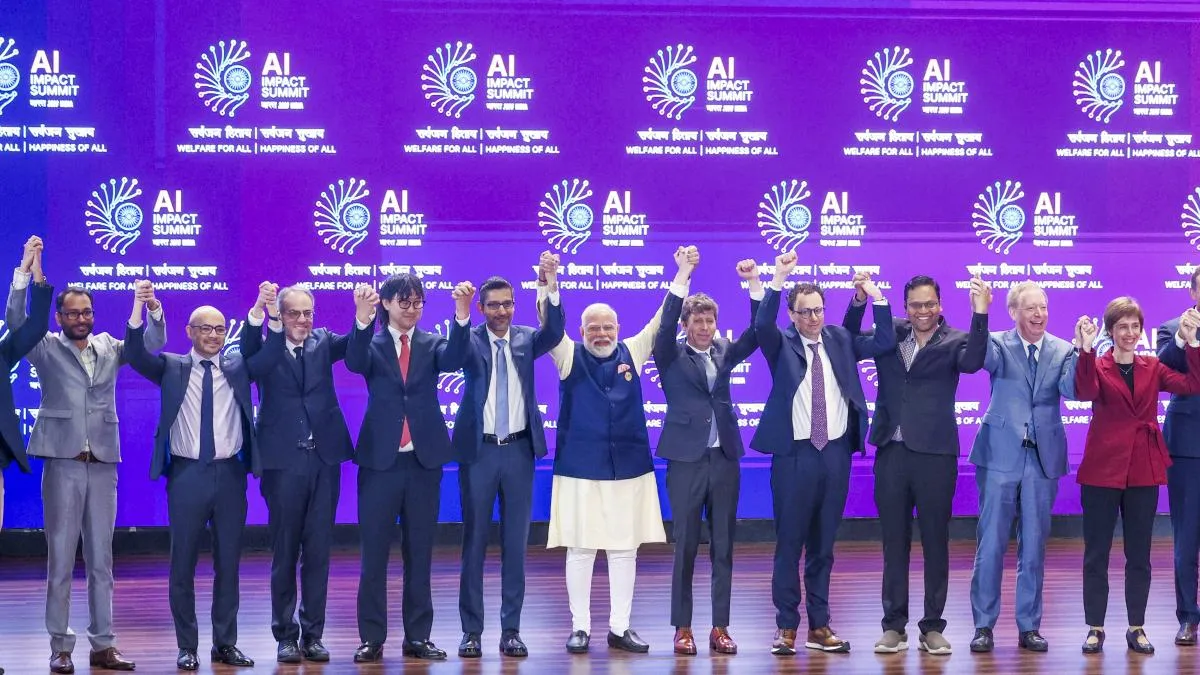
When 88 countries and international organisations signed the New Delhi Declaration at Bharat Mandapam, the India AI Impact Summit 2026 became more than a high-profile conference. It became a marker of how the global conversation around artificial intelligence is changing. The shift is geographical, political and psychological.
Over the past three years, global AI gatherings were largely shaped by concerns about safety, existential risk and regulation. The first major meeting at Bletchley Park in the United Kingdom was explicitly called the AI Safety Summit. By the time the forum reached New Delhi, it had been renamed the AI Impact Summit. That change captures what India accomplished. It did not reject safety. It reframed the debate. It asked a more immediate question. Before we regulate the most advanced forms of AI, who gets to access AI at all?
ALSO READ: Why Is PM Modi's Trip To Israel Facing Headwinds From West Asian Geopolitics? Explained
This reframing is tied to what many observers now call the AI divide. Surveys by EY, Ipsos and KPMG show that countries such as India and China register nearly 88 percent positive sentiment toward AI. In contrast, public opinion in parts of Western Europe and the United States is more cautious. In advanced economies, AI threatens established white-collar professions and stable career paths. In developing economies, AI is often viewed as opportunity. For a lawyer in London, AI may signal disruption. For a farmer in rural India, AI-enabled diagnostics or crop intelligence may represent first-time access to modern services. Prime Minister Narendra Modi captured this divergence clearly when he said that while some see fear in AI, India sees its future in it.
India’s optimism is rooted in experience. Over the past decade, Digital Public Infrastructure such as Aadhaar and UPI has transformed daily life by reducing friction in payments, identification and welfare delivery. Millions have experienced how technology can lower costs and increase access. When technology has delivered visible benefits, public confidence in the next wave is naturally higher. At the summit, this was framed as combining Digital Public Infrastructure with AI to scale inclusion across health, agriculture, education and governance.
The New Delhi Declaration reflects this orientation. Unlike previous summits that prioritised frontier safety debates, the declaration emphasises robust digital infrastructure, affordable connectivity and workforce training. It recognises that meaningful AI participation requires computing power, internet access and skilled people. It also endorses open-source AI where appropriate, acknowledging that many countries cannot afford to build proprietary systems from scratch. In doing so, India shifted the focus from abstract risk to practical access.
The scale of participation matters. Eighty-eight countries and international organisations signed the declaration, more than at any previous AI governance summit. The United States and the United Kingdom, which had declined to sign at last year’s Paris summit, joined in New Delhi alongside the European Union, China and Russia. In a fragmented geopolitical climate, that convergence is significant. The declaration is not legally binding, but global governance often begins with shared principles before hard law follows.
The summit also demonstrated economic credibility. Investment commitments reportedly crossed 400 billion dollars, including infrastructure pledges exceeding 250 billion dollars and deep-tech capital around 150 billion dollars. Artificial intelligence depends on compute capacity, data centres, semiconductors and power systems. India signalled seriousness by announcing plans under an expanded India AI Mission to scale toward 100,000 GPUs by the end of 2026. Without compute, AI ambition remains theoretical. With compute, ecosystems can grow.
Another important contribution was the articulation of the M.A.N.A.V. framework, which stands for Moral systems, Accountable governance, National sovereignty, Accessible AI and Valid systems. This human-centric approach attempts to balance optimism with responsibility. It emphasises that AI systems must be explainable, lawful and aligned with democratic values. The summit launched voluntary frameworks such as a Charter for the Democratic Diffusion of AI, a Global AI Impact Commons to replicate successful use cases, and a Trusted AI Commons to share tools and benchmarks. These initiatives create institutional pathways that can mature over time.
Artificial intelligence is a general-purpose technology similar in importance to electricity or the internet. It will affect jobs, healthcare, agriculture, logistics, finance and national security. Countries that shape its norms will influence how benefits and risks are distributed. If AI remains concentrated in a few companies or countries, inequality may deepen. If it becomes accessible infrastructure, opportunity can expand.
The summit’s success lies in three areas. First, it built the broadest coalition yet in AI governance. Second, it aligned policy ambition with substantial investment commitments. Third, it introduced a narrative that links innovation with inclusion rather than setting them in opposition.
The future implications are substantial. India’s ability to convert pledges into operational data centres and semiconductor capacity will determine whether optimism translates into capability. Scaling workforce training will decide whether AI adoption creates jobs or displaces them. Embedding safety frameworks in practice will test whether responsible AI remains more than a slogan.
Optimism can be a competitive advantage because it accelerates adoption and attracts capital. Yet optimism without safeguards can be risky. The challenge ahead is to maintain fast innovation while enforcing strong accountability. If India can sustain that balance, the India AI Impact Summit 2026 may be remembered as the moment when the centre of gravity in global AI governance began to shift toward broader participation.
(Note: The author is a public policy analyst and the views expressed in the article are his own.)