
- By Lt Gen (Retd.) Raj Shukla
- Fri, 30 Jan 2026 02:33 PM (IST)
- Source:JND
The Trump Corollary to the Monroe Doctrine, made popular through the recently released American National Security Strategy, is going to drive geopolitics of the near and distant futures. Its precise import and possible trajectories, therefore, need to be analysed threadbare.
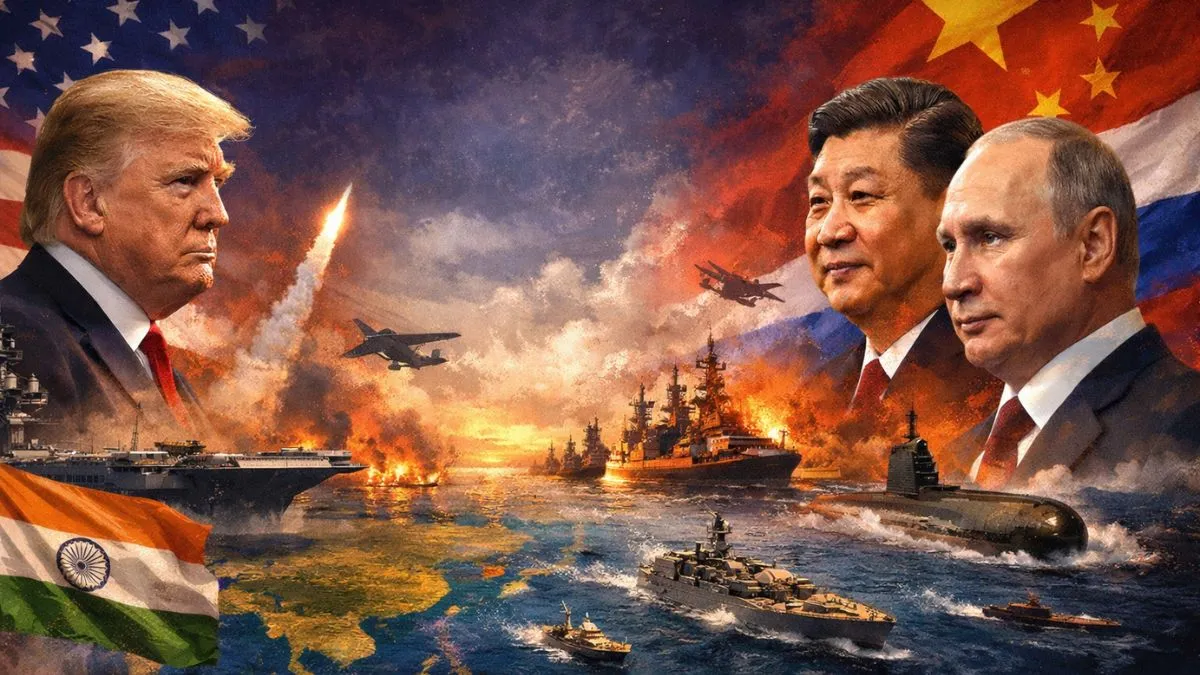
It does appear that the doctrine lies at the heart of an intensifying Cold War 2.0 between the USA and the Dragon-Bear (China & Russia). While the near-term focus of the doctrine may be the Western Hemisphere, its distant gaze is on the Indo-Pacific, because the primary objective of MAGA is to prevent Chinese hegemony in Asia. The Western Hemisphere is being secured in terms of control of access to resources as well as command of the strategic-military metrics in the Arctic - but the ultimate aim is to project power into the Indo-Pacific to deter the Chinese juggernaut.
It is in the aforementioned context that the Doctrine also seeks to create a new hemispheric balance. Trump is more interested in being the hegemon of the Western hemisphere than the leader of the Western world. The Western Hemisphere in the Trumpian view must be exclusively American – resident powers (Venezuela, Cuba, Colombia) and trespassers (China, Russia, Iran) alike, need to take note.
The Trans- Atlantic order is also being re-framed, in terms of new metrics and nuances: Greenland is non-negotiable even if it alienates a dependable ally – Denmark and endangers NATO, because Chinese and Russian submarines & destroyers must be kept out; Russia will be left largely to the Europeans to deal with, apart from some clandestine assistance for the occasional pokes in the eye like Operation SPIDER WEB (the Ukrainian drone strike on Russian nuclear assets in May 2025) or the more recent (December 2025) strike on the Putin compound in Valdai.
So, the Russian bear continues to be in the American cross-hairs, but only peripherally; the rich Europeans must assume primary responsibility for the military burden in terms of both blood and treasure.
In West Asia, having knocked out the Axis of Resistance, the USA is looking to the signatories (and would-be signatories) of the Abraham Accords to unleash a new strategic discourse: one that distances itself from oil and Islamic fundamentalism, while embracing modern conversations on AI, data centres, renewables, rivieras and real-estate deals.
The design of the Dragon-Bear, on the other hand, is to combine Chinese techno - economic might with Russian military capacities to collectively challenge American power. In the techno-economic domain, in fact, China is remarkably resurgent; it may even have the clear edge: in the recent trade war between America and China, the Chinese not only absorbed the tariff blows but hit back with a rare-earth embargo that was stunning – Trump was forced to sue for peace.
In a recent net assessment of the current capacity differential between China and the USA, noted academic Rush Doshi observed that the metrics were decisively in China's favour: in steel production, Chinese capacities are 13 times larger, in cement production, the lead is 20 times, in ship building it is 200 times, in warship production, Chinese capacities are 3 times larger.
China produces about half the world's chemicals, 67-70% of the world's electric vehicles, more than three-quarters of the world's batteries, 80% of the world's consumer drones, 90% of the world's solar panels, and 90% of the world's refined rare earths.
On current evidence, the American military, however, seems to be outperforming Sino-Russian capacities by a long way – recent events in Syria, Iran and Venezuela appear to confirm the hypothesis.
As the competition in the New Cold War peaks, while other theatres will be significant, the argument will finally be settled in the Indo-Pacific. In that sense, it will be an error to view Trump as an isolationist; he is a globalist, caressing and preparing American statecraft to meet the stated eventuality. Tariffs were the first arrow in the quiver of Donroe statecraft – Liberation Day and a host of accompanying measures have raked in USD 18 trillion, claims the President. Trump has now pledged a staggering USD 1.5 trillion to rebuild his military as the centrepiece of the DONROE doctrine.
The success of Operation ABSOLUTE RESOLVE (the American military operation in Venezuela to extract Maduro) has snuffed out cries of de-dollarisation, helped to enact one of the world's greatest energy re-alignments with a significant proportion of the 300 billion barrels of Venezuelan oil (18% of global oil reserves) now under the American belt.
In high-end frontier AI, America seems to be dominating – daily investments in AI in the USA are 1 billion dollars and will touch 3 billion dollars by 2030 – in capital, compute and agentic AI, the USA seems to be the global front-runner. So, while the battle is evenly poised, Donroe could tilt the scales and help the USA regain the lead.
And finally, how should India respond – in the light of Donroe, what are the strategic and tactical adjustments that India needs to make? Are there any points of favourable intersection? If the purpose of Donroe is indeed to checkmate Chinese hegemony in Asia, long-term Indo-American interests are congruent.
China, after all, is pretty clear that there can be only one tiger atop the Asian hill. The only way to allow two tigers on either slope is through homegrown deterrence and the smart, external balancing of China. If we could successfully navigate the pinpricks in the way of a trade deal with the USA, could we strike a larger strategic bargain in terms of technological partnerships, capacity building, market access and deterrence building?
Given the massive swivel in global geopolitics towards hard power and the hardball, and the fact that technology seems to be driving national security like never before, India needs to fire on two cylinders concurrently. One, we need to take aggressive, decisive steps towards mastering the technologies/capacities of the fourth industrial revolution – AI, quantum, robotics, autonomy, energy, data leveraging, et al. Two, we need to resource the instrument of force with far greater vigour - an order of magnitude must accelerate the ongoing national security makeover.
(Note: The author is a retired Lieutenant General.)