
- By GN Bajpai
- Fri, 06 Feb 2026 12:54 PM (IST)
- Source:JND
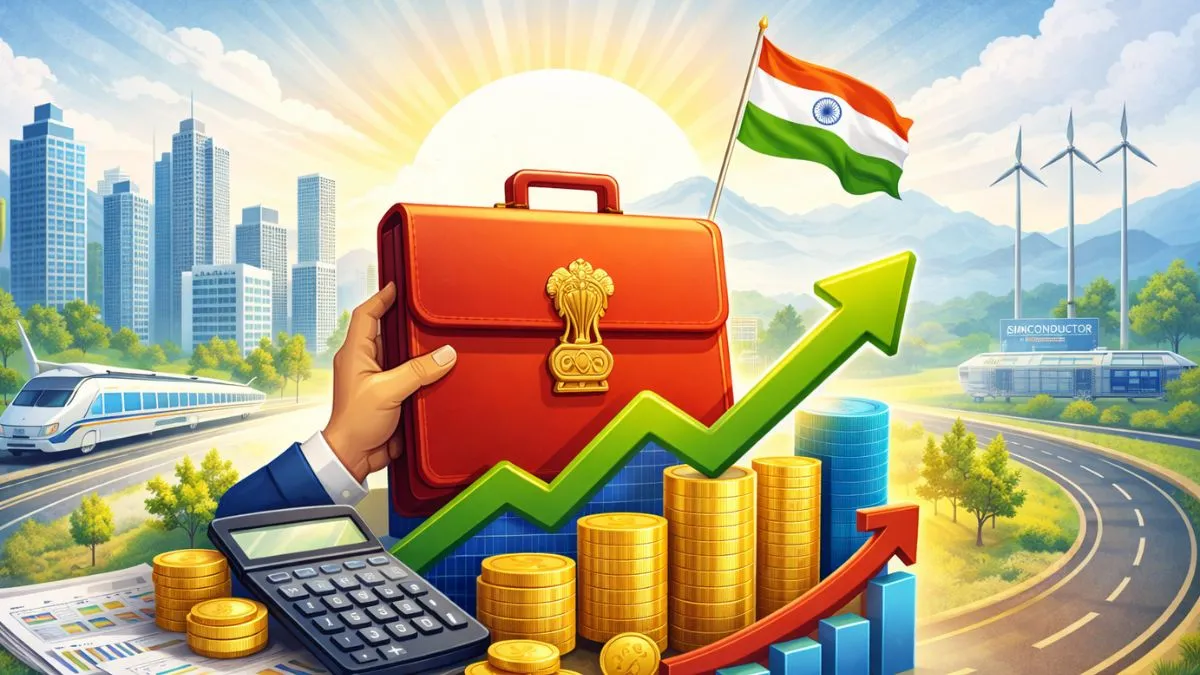
On 1st February, Union Finance Minister (FM) Nirmala Sitharaman presented the 9th consecutive budget, the longest such streak in Indian history, marking a watershed moment in India's economic journey towards Vikshit Bharat 2047.
The Union Budget is one of the most comprehensive annual economic exercises of the Government of India. It serves multiple purposes: it reflects the government's economic priorities, sets taxation and expenditure policy, and lays down the map for social and developmental spending.
The budget influences GDP growth, investment, inflation, and employment, which, in turn, shape citizens' sentiments. Therefore, the budget is analysed and interpreted by various groups considering their goals and priorities.
The budget, which covered all aspects of the economy that contribute to building and enhancing India's productive capacity, can be summed up as a stepping up of the march toward Vikshit Bharat. The pivot on six distinguishing features-fiscal policy, infrastructure and capital expenditure, manufacturing and strategic sectors, MSME and entrepreneurial support, taxation measures, and social, health, and agriculture initiatives validate the surmise.
This Budget was presented in the 'Goldilocks' period (a la the Reserve Bank of India), experiencing a rare, ideal combination of robust GDP growth (7-8%) and a low and stable inflation scenario and external stability (Forex Reserves at USD 700 Billions) akin to the economic story book of 'not too hot', 'not too cold'. However, FM had to navigate a complex global landscape defined by poly-crisis-geopolitical shifts, trade volatility, and technological disruption.
'Goldilocks' has been enabled by macro-economic stability assiduously built over the decade of the current political leadership in coordination with the Monetary Authorities. The Budget steadies fiscal consolidation, lowering the fiscal deficit to 4.3% and the debt-to-GDP ratio to 55.6% in 2026-27.
The budget outlines a path to reduce the debt-to-GDP ratio to 50% by 2031, indicating a commitment to reducing fiscal deficits while continuing to fund the country's key developmental needs, preserving the Goldilocks period. At a realistic nominal GDP growth rate of 10%, the budget balances the need for massive public investment by keeping the interest burden in check.
The thrust on infrastructure building is continued with an allocation of Rs 12.2 lakh crore, equal to 3% of GDP. Major new projects include 7 high-speed rail corridors linking cities across states, the construction of new dedicated freight corridors, the building of 20 new national waterways, a Coastal Cargo Promotion Scheme, and the development of 7 City Economic Zones.
The budget strongly focuses on manufacturing, especially sectors considered strategically important for global competitiveness. Semiconductor Mission 2 will focus on domestic chip manufacturing, supply chain resilience, and architecting technology value chains. The schemes have been outlined to strengthen biopharma production and electronics manufacturing capabilities. The rare-earth corridors (Odisha, Andhra Pradesh, Tamil Nadu, and Kerala) reflect a granular understanding of future bottlenecks.
The Biopharma SHAKTI mission (Rs 10,000 crore) and the Carbon Capture, Utilisation, and Storage (CCUS) (Rs 20,000 crore) highlight a strategic focus on frontier technologies. By reviving 200 legacy industrial sectors and establishing dedicated chemical parks, the government is betting on an ecosystem-driven approach. It plans to move beyond 'Volume Producer' to 'Value Producer', essential to transitioning to a USD 7-trillion-economy by 2030.
A dedicated SME Growth Fund of Rs 10,000 crores, aimed at enhancing access to capital and strengthening the backbone of the Indian economy, is being launched. Measures such as credit guarantees, liquidity improvements via bill discounting, etc., and ease of doing business are supplemental to their growth.
The budget covered several social dimensions. Agriculture, the spine of the Indian economy, received an allocation of Rs 1.6 lakh crore. However, there is a shift in focus towards high-value crops, coconut, sandalwood, cashew, and cocoa, alongside traditional cereal crops and technology availability. Bharat Vistaar AI, a multilingual, AI-driven platform, is being launched to provide customized advisory support to farmers, integrating weather data, soil health, and market prices.
'She-Mart scheme, leveraging on the success of 'Lakhpati Didis', aims to transform rural women from credit seekers into business owners.
The establishment of five Regional Medical Hubs will help in establishing India as a global medical tourism destination. Additionally, training 1.5 lakh multi-skilled caregivers addresses the growing demand for health care services. A high-level Education to Employment and Enterprises (E2E) Committee was announced to bridge the gap between academic output and industry requirements.
The focus on tourism per se, including 50 significant destinations, the restoration of ancient archaeological sites, and the training of guides, etc., will boost the tourism economy and generate massive employment.
There has been no radical transformation of the taxation framework, strengthening predictability. With the launch of GST 2 and the New Income Tax Code earlier, and with stable tax slabs, the emphasis was on making the system simpler and taxpayer-friendly. However, minor tweaks to customs duty rates and a reduction in Tax Deducted at Source to 2% on overseas packages and under the Liberalised Remittance Scheme are to aid comfort.
Critics might argue that the budget lacked "big bang" measures and dramatic tax cuts. FM has chosen to build 'industrial muscle' rather than provide 'instant consumer relief'. The Budget, in the backdrop of what the FM noted, 'the economy is strong, but the global pitch is slippery,' provides comprehensive traction for India to continue as the fastest-growing major economy.
(Disclaimer: The author, GN Bajpai, is the former Chairman SEBI & LIC Author and a Columnist)