
- By Dr Sadhana Kala
- Wed, 02 Sep 2026 05:07 PM (IST)
- Source:JND
In an age when messages travel across the world in seconds, the humble letter may seem like an outdated form of communication. A text message takes only a few taps, an email can be sent instantly, and a video call can connect people separated by thousands of kilometres. Yet, every year on World Letter Writing Day, observed on September 1, we are reminded that writing a letter is about much more than delivering information. It is about slowing down, choosing words carefully, and creating something that can be held, saved, and revisited.
World Letter Writing Day celebrates the timeless art of letter writing and encourages people to rediscover the personal connection that comes from putting thoughts on paper. The occasion is particularly meaningful today, when much of our communication is brief, hurried, and designed to disappear into an endless stream of notifications.
A tradition with a long history
Letters have played an extraordinary role in human civilisation. Long before telephones and computers, letters connected families, lovers, soldiers, leaders, writers, scientists, and communities. They carried news from distant lands, documented historical events, expressed affection, and preserved ideas for future generations.
Some of the world's most important historical records are letters. The correspondence of political leaders, freedom fighters, scientists, philosophers, and artists has helped historians understand not only what happened in the past but also what people thought and felt at the time.
India, too, has a rich tradition of letter writing. From handwritten correspondence between family members separated by migration or employment to letters exchanged by notable individuals during India's freedom struggle, letters have long been woven into the country's social and cultural fabric.
For many generations of Indians, the postman coming to the door was something they looked forward to. A postcard or inland letter could bring news from a son working in another city, a daughter studying far away, a relative living overseas, or a friend who had moved to a distant town.
The emotional power of handwriting
What makes a handwritten letter different from a digital message?
Perhaps it is the evidence of time and effort.
A handwritten letter carries the writer's personality. The handwriting may be neat or hurried, the ink may vary in intensity, and there may be crossings-out, additions, and little imperfections. Those imperfections make the letter human.
A message saying "I miss you" on a smartphone may disappear within seconds. A handwritten letter containing the same words can remain in a drawer for decades.
Letters also encourage reflection. When people write by hand, they generally cannot produce words as quickly as they can type. The slower process can make us think more carefully about what we want to say.
That makes letter writing particularly powerful for expressing emotions that are difficult to communicate in everyday conversation: gratitude, apology, affection, encouragement, remembrance, and hope.
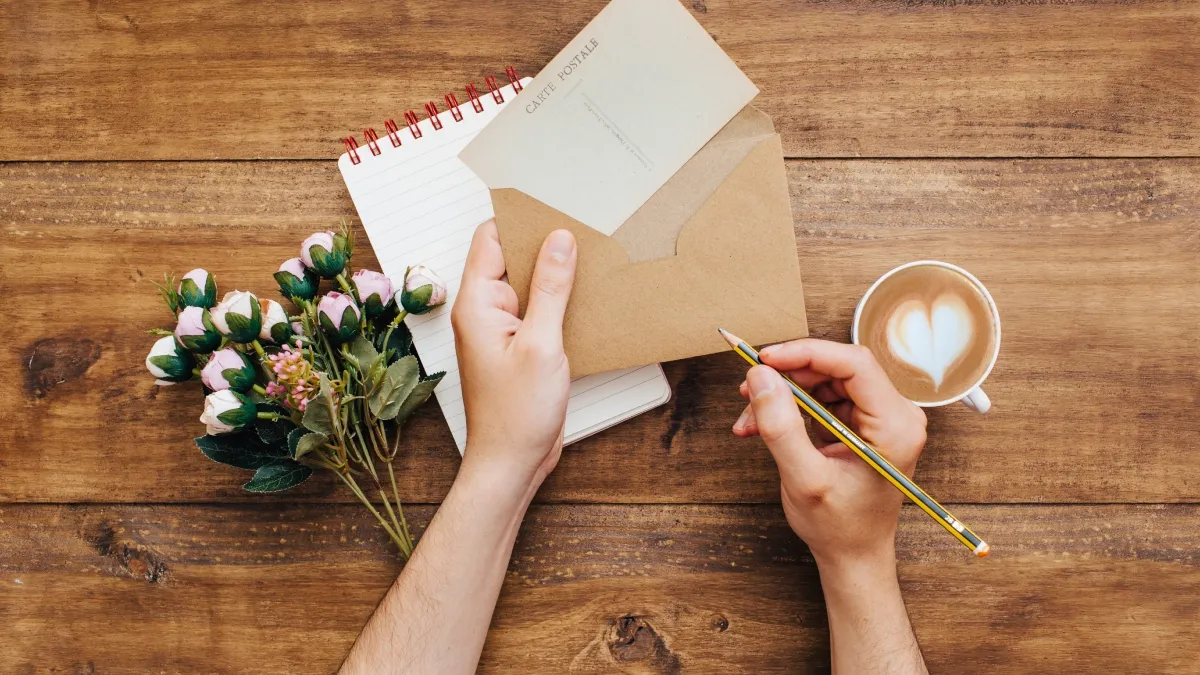
World Letter Writing Day celebrates the timeless art of letter writing (Image:Magnific)
Letters and mental well-being
Writing has long been associated with reflection and emotional processing. Keeping a journal, writing personal notes, or putting difficult feelings into words can help people organise their thoughts.
A personal letter can offer a similar experience, even when the recipient is unavailable or the letter remains unsent. The act of writing can bring clarity. —or when the letter is never sent—the act of writing can bring clarity.
Consider writing a letter to someone who influenced your life. What would you thank them for? What memories would you share? What did you never say to them?
The exercise itself can be meaningful.
For children and young people, letter writing can also develop patience, vocabulary, creativity, and communication skills. Unlike abbreviated digital conversations, a letter encourages a beginning, a sequence of thoughts, and a meaningful conclusion.
ALSO READ: Teachers' Day 2026: Why India Honors Its Educators On Sept 5? Here's You Need To Know
The lost art of waiting
One of the most striking features of traditional correspondence was the element of waiting.
A letter posted today might take several days to reach its destination. The recipient would read it and perhaps write a response immediately, if available. The act of writing can bring clarity, even when the recipient is unavailable, and then begin another wait.
Modern communication has largely eliminated this interval. We expect immediate replies. A message marked "seen" without a response can create anxiety. A delayed email may prompt a follow-up within hours.
Letters teach something that digital communication often does not: anticipation.
Waiting for a letter could make the eventual arrival more special. The envelope itself became part of the experience—the handwriting on the front, the stamp, the postmark, and the knowledge that the sender had physically touched the paper.
Letters as family treasures
Unlike most digital messages, letters can become tangible family archives.
A bundle of old letters can tell the story of a family across generations. It can reveal where grandparents lived, how they met, what they worried about, and what they dreamed of. A faded envelope may preserve a forgotten address. A postcard may provide a glimpse into a holiday taken decades ago.
In this sense, letters are more than communication. They are personal historical documents.
Digital photographs and messages are vulnerable to lost passwords, obsolete devices, deleted accounts, and changing technology. A carefully preserved letter can survive all of these.
This does not mean digital communication is less valuable. Rather, it highlights the unique qualities of physical correspondence.
Rediscovering the letter in a digital world
The beauty of World Letter Writing Day is that it does not require us to reject technology. Instead, it invites us to use both old and new forms of communication thoughtfully.
A phone call can follow a handwritten letter. A digital photograph can accompany a postcard. A scanned family letter can be preserved electronically while the original remains safely stored.
Even workplaces and institutions can benefit from the discipline of thoughtful writing. A carefully composed note of appreciation to a colleague can have an impact that a routine emoji or instant message may not.
The letter can also be adapted for contemporary life. People can write to a friend, a parent, a teacher, a former colleague—or even their future selves.
A simple celebration
Celebrating World Letter Writing Day does not require elaborate preparations.
Take a sheet of paper and write to someone you care about.
Tell a parent what you appreciate about them. Thank a teacher who made a difference. Write to an old friend with whom you have lost touch. Send encouragement to someone facing a difficult period. Write a note to your child describing a memory you hope they will treasure.
Then put the letter in an envelope, address it, add a stamp, and post it.
For those who prefer digital communication, there is another option: write a longer, more considered email rather than a hurried message. The essential idea is not the paper itself but the thoughtfulness behind the words.
Words that outlive the moment
World Letter Writing Day ultimately celebrates something increasingly precious: the willingness to give words time.
Our digital lives are built around speed. We scroll, tap, react, forward, and move on. Letters ask us to pause. They invite us to remember that communication is not merely about transmitting information; it is also about creating emotional connections.
A letter may take minutes—or even hours—to write. It may take days to arrive. But its value can last for years.
Perhaps that is why the letter continues to survive despite every technological revolution.
On World Letter Writing Day, we can rediscover the quiet pleasure of writing something that is meant not merely to be read but to be remembered.
In a world overflowing with instant messages, a thoughtful letter can still feel remarkably personal.
And sometimes, the words we take the time to write are the words that matter most.
ALSO READ: Teachers’ Day 2026: 5 Elegant Short Hairstyles To Pair With Sarees For A Graceful Look
(Note: Dr (Prof) Sadhana Kala is a USA-trained robotic & laparoscopic surgeon, Uppsala University, Sweden, trained fertility specialist, Icon Endoscopic Surgeon of North India, and National Icon Endoscopic Surgeon of India. She is rated as India's Best Gynecologist by Google.)
(Disclaimer: The views expressed in this article are the personal opinions of the author.)