- By Dr Sadhana Kala
- Wed, 19 Aug 2026 01:33 PM (IST)
- Source:JND
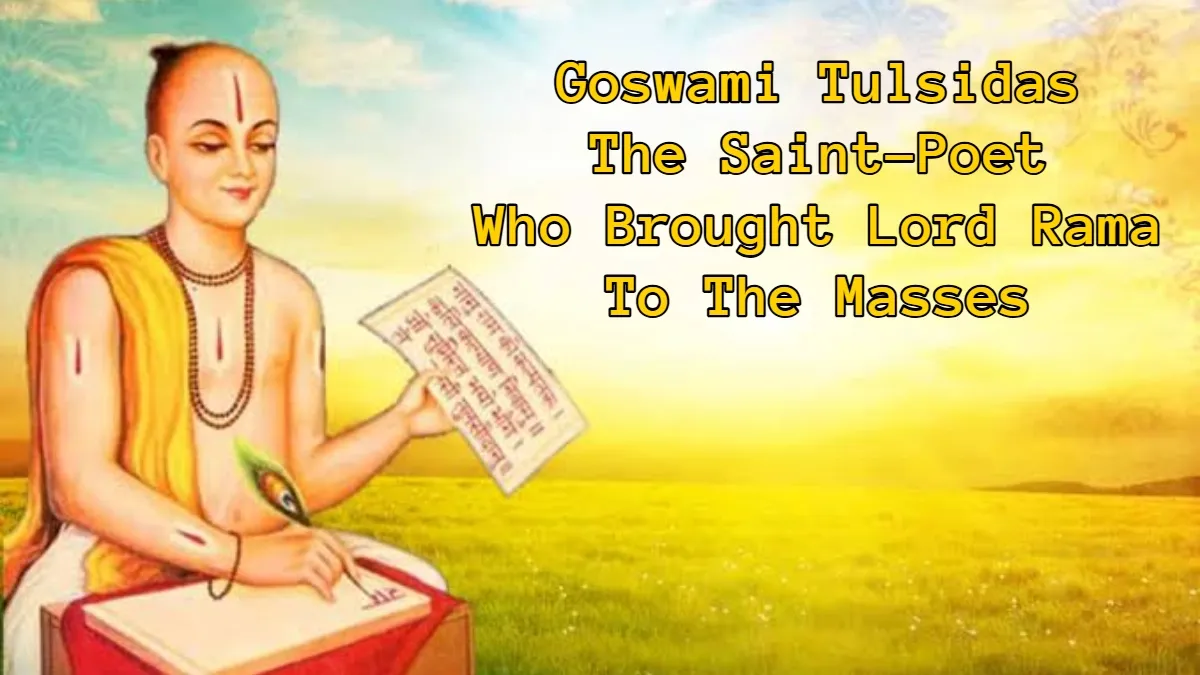
Few literary figures have shaped the cultural and spiritual consciousness of India as profoundly as Goswami Tulsidas. Revered as a saint, poet, philosopher, and social reformer, Tulsidas transformed the religious landscape of North India by making sacred knowledge accessible to ordinary people. His masterpiece, the Ramcharitmanas, remains one of the most influential works in Indian literature, while the Hanuman Chalisa continues to be recited daily by millions worldwide.
More than four centuries after his death, Tulsidas remains a towering figure whose writings continue to encourage faith, morality, and devotion. His life story is a remarkable journey from personal suffering to spiritual enlightenment and from poetic brilliance to cultural immortality.
The Early Life of Tulsidas
The exact year of Tulsidas's birth remains a subject of scholarly debate, but most traditions place it in the 16th century in Rajapur, present-day Uttar Pradesh. He was born as Rambola Dubey to Atmaram Dubey and Hulsi Devi. According to popular legends, the child uttered the name "Rama" immediately after birth, earning the name Rambola.
Stories about his childhood describe a life marked by hardship and abandonment. Orphaned at an early age, he was eventually raised under the guidance of the saint Narharidas, who introduced him to the teachings of Lord Rama and the Bhakti tradition. This spiritual foundation would shape the course of his life and literary career.
A Turning Point: From Worldly Love to Divine Devotion
One of the most famous episodes associated with Tulsidas concerns his wife, Ratnavali. Tradition holds that Tulsidas had a deep attachment to her. When he once travelled a long distance to see her, Ratnavali reportedly rebuked him, saying that if he devoted even half as much love to Lord Rama as he did to her, he would attain spiritual liberation.
Whether historically accurate or not, this story has become central to the popular understanding of Tulsidas's life. It symbolises the transformation of human attachment into divine devotion. Tulsidas, deeply affected by her words, is said to have renounced worldly life and dedicated himself entirely to the worship of Rama.
The Creation of the Ramcharitmanas
Tulsidas's greatest contribution to Indian civilisation is undoubtedly the Ramcharitmanas. Composed in the Awadhi language during the 16th century, it retells the story of Lord Rama from the ancient Sanskrit Ramayana of Valmiki.
What made the work revolutionary was not merely its content but its language. At a time when Sanskrit was largely accessible only to scholars and priests, Tulsidas chose to write in the language spoken by ordinary people. This decision democratised spiritual knowledge and brought the ideals of Rama—truth, duty, compassion, and righteousness—to millions.
The Ramcharitmanas is not simply a translation of Valmiki's Ramayana. It is a poetic reinterpretation infused with Bhakti philosophy, emphasising devotion as the path to salvation. Through lyrical verses and memorable characters, Tulsidas presented Rama not only as a divine king but also as a moral ideal for humanity.
Today, the text is regarded as one of the greatest works of Hindu literature. It continues to be recited in homes, temples, and religious gatherings across India and the global Indian diaspora.
The Hanuman Chalisa and Other Literary Gems
While the Ramcharitmanas is his magnum opus, Tulsidas authored several other significant works. Among them, the Hanuman Chalisa stands out as one of the most widely recited devotional hymns in the world. Comprising forty verses dedicated to Lord Hanuman, it celebrates courage, wisdom, humility, and unwavering devotion.
His literary legacy also includes:
- Vinaya Patrika
- Kavitavali
- Gitavali
- Dohavali
- Janaki Mangal
- Parvati Mangal
- Vairagya Sandipini
These works showcase his mastery over language and his ability to combine philosophy, devotion, and poetry into a compelling literary form.
Tulsidas and the Bhakti Movement
Tulsidas emerged during the Bhakti Movement, a spiritual and social movement that emphasised personal devotion over ritualism. Saints such as Kabir, Mirabai, Surdas, and Tulsidas challenged rigid social hierarchies and stressed a direct relationship between the devotee and the divine.
For Tulsidas, devotion to Rama was the simplest and most accessible path to spiritual fulfilment. His writings repeatedly stress that divine grace is available to everyone, irrespective of social status or educational background.
His message resonated deeply with common people because it combined profound spiritual insights with language they could understand. Through poetry, songs, and storytelling, he transformed theology into lived experience.
A Lasting Cultural Legacy
The influence of Tulsidas extends far beyond literature and religion. His works have shaped North Indian culture in countless ways. The popular tradition of Ramlila—the dramatic enactment of Rama's life—draws heavily from the Ramcharitmanas. These performances continue. The annual Dussehra celebrations across India continue to feature these performances. annually during Dussehra celebrations across India.
Tulsidas is also associated with Varanasi, where he spent much of his life. The famous Tulsi Ghat on the banks of the Ganga bears his name, and he is traditionally credited with establishing the Sankat Mochan Hanuman Temple, one of the city's most revered shrines.
His impact, Tulsidas's influence, extends to Indian music, theatre, folklore, television adaptations, and devotional traditions. Even today, people weave verses from the Ramcharitmanas and Hanuman Chalisa into their everyday lives, transcending regional and linguistic boundaries.
Why Tulsidas Matters Today
In an age marked by rapid technological change and social fragmentation, Tulsidas's teachings remain strikingly relevant. His writings advocate compassion, ethical conduct, humility, and devotion—values that continue to resonate across generations.
The enduring popularity of the Ramcharitmanas demonstrates the power of storytelling to unite communities and preserve cultural heritage. By choosing the language of the people rather than the language of elites, Tulsidas showed that wisdom belongs to everyone.
His life also offers an inspiring lesson about transformation. From personal grief and attachment emerged a spiritual vision that enriched Indian civilisation. His poetry continues to remind readers that faith is not merely a matter of ritual but a path toward inner growth and moral responsibility.
Conclusion
Goswami Tulsidas occupies a unique place in India's cultural and spiritual history. Through the Ramcharitmanas, the Hanuman Chalisa, and numerous other works, he made the ideals of devotion, righteousness, and compassion accessible to ordinary people. His influence spans literature, religion, music, theatre, and public life.
More than a poet, Tulsidas was a bridge between sacred knowledge and the common person. More than a saint, he was a cultural architect whose words continue to guide millions. Four centuries later, his voice remains as powerful as ever, echoing through temples, homes, and hearts wherever the story of Rama is told.
(Note: Dr (Prof) Sadhana Kala is a USA-trained robotic & laparoscopic surgeon, Uppsala University, Sweden, trained fertility specialist, Icon Endoscopic Surgeon of North India, and National Icon Endoscopic Surgeon of India. She is rated as India's Best Gynecologist by Google.)
(Disclaimer: The views expressed in this article are the personal opinions of the author.)