
- By Kamakshi Bishnoi
- Sun, 03 May 2026 01:11 PM (IST)
- Source:JND
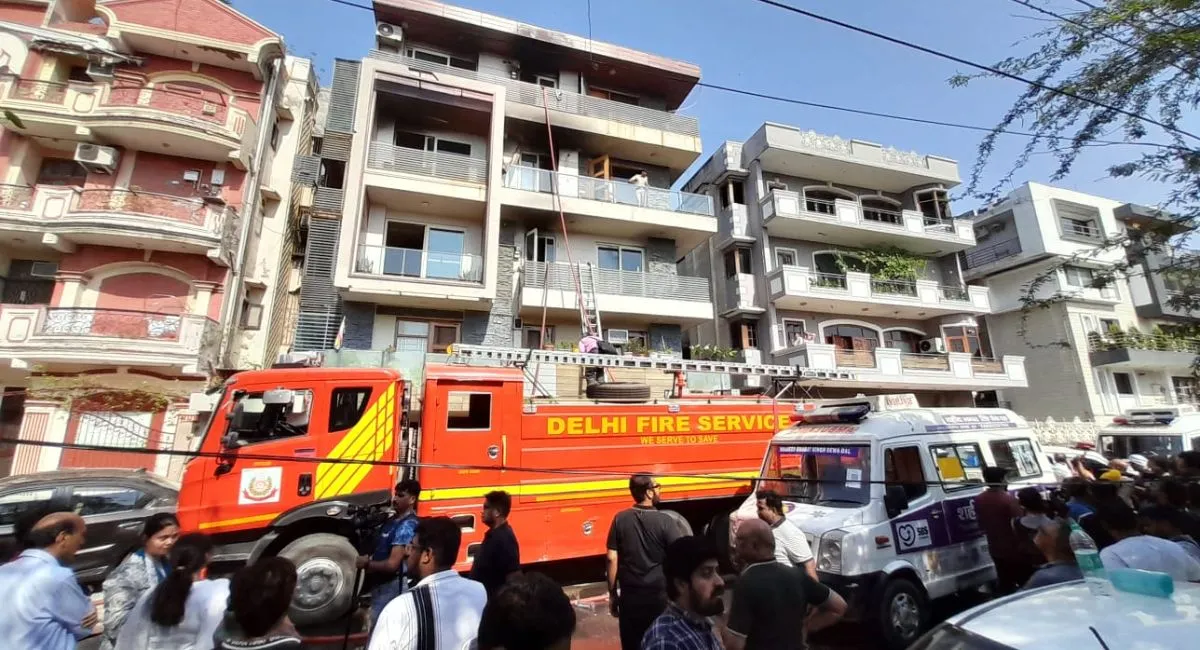
A major fire broke out on Sunday morning at Vivek Vihar, Shahdara, Delhi, killing 9 people and injuring many more. The cause of the fire in a four-story building has yet to be determined, but initial investigations suggest an air conditioning (AC) unit may have caused a short circuit.
In recent years, short circuits have become a more common cause of fires because most of the electrical appliances in Delhi are high-load devices that are used continuously. Short circuits are not usually instantaneous occurrences; rather, they develop over time and are indicative of a larger failure regarding the electrical system as a whole.
Many of the factors that contribute to short circuits, such as poor quality wiring, budget cuts as part of the construction process, and failure to manage load, have existed for an extended period of time and thus increase the likelihood that a short circuit will develop into a fire.
ALSO READ: Greater Noida To Get Direct Link To Ganga Expressway via Hapur Bypass; 105 Metre Wide Road Planned
A short circuit occurs when there is an unintended low-resistance path for current to flow, which results in excessive current flow and heat, which can lead to fires. Both excessive electrical loads and current flowing through unintended low-resistance pathways will generate heat and, if significant enough, will damage the insulation around related conductors, thereby increasing the risk of fire.
Where Does The Negligence Begin?
The most serious negligence begins during the construction of a house or building.
- Compromise in wiring and switches
- Use of cheap and low-quality wiring
- Installation of local or unstandard switches and MCBs
- Underestimating the load capacity
Many people overlook the increasing load on old wiring and switches over time and don't realise the need for replacement. This situation can lead to overheating and short circuits.
In many builder-developed projects, cost-cutting further weakens electrical safety:
- Lack of individual load planning for each flat
- No provision for future appliances (ACs, geysers, inverters)
- Use of substandard wiring materials
As a result, even relatively new buildings can become vulnerable within a few years.
How does a short circuit happen?
According to experts, a short circuit does not happen suddenly, but it is a gradual process.
- Excessive heat generation due to overload in the wiring
- Weakening or melting of the insulation (plastic cover)
- Contact between the phase and the neutral
- Sudden high current flow and sparking
This situation later takes the form of fire.
Why is AC becoming a risk factor?
Air conditioners are not inherently dangerous, but can act as trigger points in faulty systems:
- Continuous high power consumption increases the load
- Absence of dedicated circuits causes overload
- Poor installation may lead to leakage
- Old wiring may fail under sustained load
- Common mistakes made at home
- Running multiple heavy appliances on a single socket
- Use of AC or heater on the extension board
- Putting additional load on old wiring
- Not performing regular electrical checks
- Neglecting floor and load management
- Excessive use of AC on upper floors
- Multiple ACs running on the same floor
- Ignoring the age of the wiring
- Lack of a load-balancing system
This condition gradually leads to overheating and system failure.
Warning Signs Not To Ignore
- Socket or switch heating
- burning smell
- MCB trips frequently
- Light flickering or voltage drop
These are all early warning signs that can be dangerous to take lightly.
ALSO READ: Delhi Fire: Video Shows Debris, Smoke After Blaze Leaves 9 Dead In Vivek Vihar; AC Blast Suspected
Safety precautions
- Separate electrical line for each AC
- Use of correct capacity MCBs and wiring
- Periodic electrical audits
- Get professional installation done only
What not to do
- Do not use overloaded sockets
- Don't put off replacing old wiring
- Don't run heavy appliances on cheap extension boards
- Do not get the work done by local or untrained electricians
According to experts, short-circuits are not a sudden accident, but rather a technical and management failure that develops over the years. Poor wiring quality, cost-cutting in building construction, and neglect of electrical loads combine to turn this into a serious risk. The real solution lies not in simply replacing equipment, but in proper planning, quality, and regular monitoring of the entire electrical system.