
- By Priyanka Koul
- Mon, 07 Sep 2026 04:07 PM (IST)
- Source:JND
- PG collapse exposed unsafe, cramped student living conditions.
- High rents, poor food, and lack of safety features prevalent.
- Proximity to DU forces students into limited, risky options.
Satya Niketan PG Collapse: A day after a multi-storey PG collapsed in Satya Niketan in southwest Delhi on Sunday, killing seven people, the focus has shifted to the living conditions of students in the area. In several paying guest (PG) accommodations, cramped entrances, exposed electrical installations and poor ventilation have raised fresh concerns about safety.
In some buildings, barely three metres of space is available to enter the premises. Electrical installations and other fittings run along both sides of the walls, leaving narrow passages where even a small spark could potentially block the entire route.
According to Jagran.com, large cracks are visible on the roofs of some buildings, while dampness and water leakage can be seen at several places. Such conditions are not uncommon among PG accommodations located near the site of the collapse in Satya Niketan.
For students living in the neighbourhood, the incident has brought renewed anxiety about the safety of the buildings they call home. It has also raised a larger question-- if the conditions are so poor, why do students continue to choose PG accommodation in the area?
The answer is simple--the location. Satya Niketan’s proximity to Delhi University’s South Campus has made it a popular residential hub for students. The area has more than 200 PGs housing students, with its narrow lanes packed with PGs, messes, shops and cafes. The metro station and several colleges are also within easy reach.
For many students, however, convenience comes with limited choices. Hostel accommodation is unavailable at several colleges and remains limited even at institutions where it exists. As a result, students often have little option but to turn to private accommodation.
Students fear returning to PGs after collapse
The collapse has left many students in Satya Niketan shaken. Several said they are now worried about the structural safety of the buildings in which they live.
Some students have not yet returned to their PGs because of the recent festive holidays, while others have started searching for alternative accommodation.
Natasha, who lives with four other girls in a PG consisting of a room and kitchen, said, “We pay a total of Rs 98,000 for one month, including the room rent, broking and security deposit. Food and electricity bills are separate.”
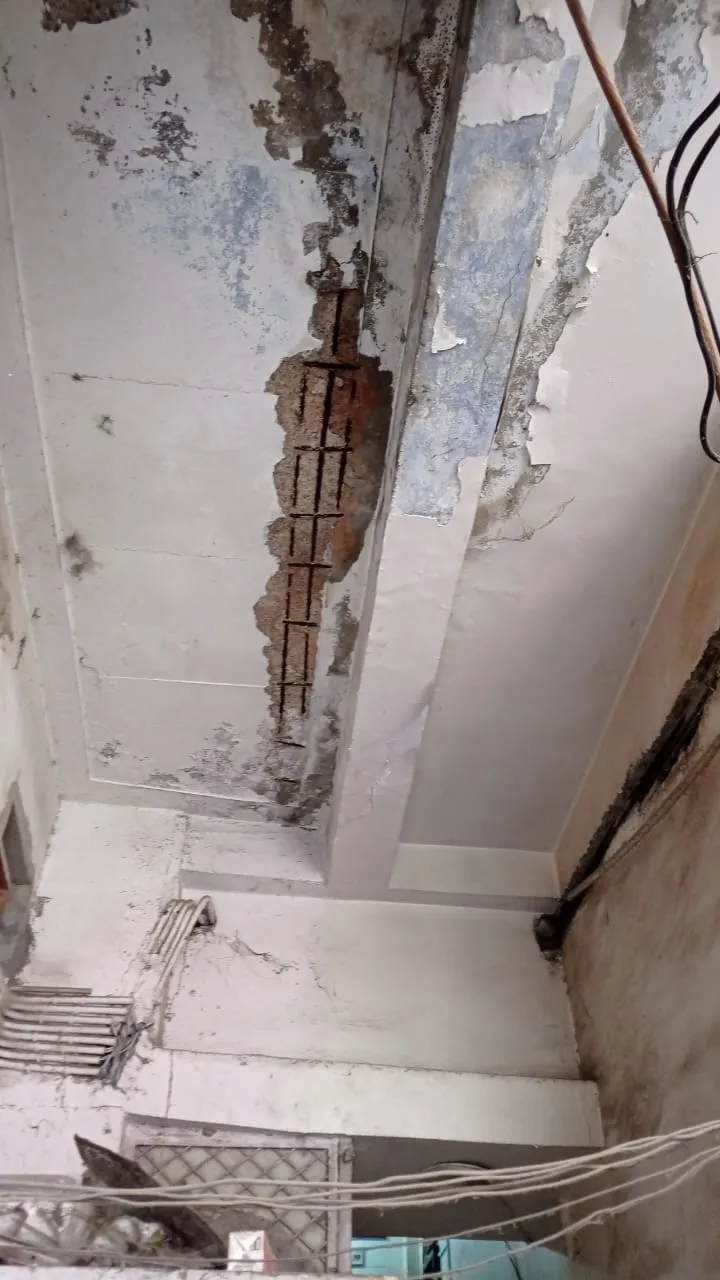
She said the building has only one entry and exit route, which is so narrow that only one person can pass through at a time. There is no emergency exit.
“If an accident happens, we simply won’t be able to escape,” she said.
Her family has already asked her to look for another PG. Nandini said she, too, has decided to move out.
Laxita, who lives in a PG in Saty Niketan, said she pays Rs 15,000 in rent for a single room.
“There has been an atmosphere of fear here since the incident. We will also shift to a flat soon,” she said.
Shambhavi, another student living in a PG in Saty Niketan, said she spent last night at Venkateshwar College out of fear. She said the incident has increased her family’s concern, and they are advising her to shift elsewhere.
She added that the problem is not confined to Satya Niketan, saying that PG accommodations in North Campus are in a similar condition.
Inside Satya Niketan's cramped PG maze
For students sharing rooms, space itself comes at a premium. A bed in a triple- or four-sharing room without a balcony and with little or no ventilation costs around Rs 10,000-Rs 12,000, students said. A double-sharing room with better ventilation or a balcony costs around Rs 15,000 or more, while a single room can cost as much as Rs 25,000.
"I am from Lucknow, and I pay around Rs 15,000 for a shared room. But even a room without proper ventilation or a balcony can cost Rs 10,000 to Rs 12,000. If you want a single room, it can go up to Rs 25,000. You keep paying more for a little more space or a balcony," said Roshan Pal, 18, a first-year student of Deen Dayal Upadhyaya College from Lucknow.
What students see when they first visit a PG can also be very different from what they experience after moving in.
"Every academic session, PG buildings are repainted. When parents come to see the place, the building looks new and well maintained. If there is a balcony or some ventilation, you naturally get attracted to that room. You think, ''This is a good place.'' But after you start living there, you find that the fridge does not cool properly, the induction does not work, and the washing machine may not work," Roshan said.
-1788769561336_v.webp)
For students sharing a room, even basic day-to-day living can become difficult.
"The rooms are so small. Three people can be living in a room, and sometimes six people are staying in spaces where there should not be that many people. You are studying, sleeping and keeping all your things in the same small space," said Abhinav Raman Sinha, 18, a first-year student of Atma Ram Sanatan Dharma College from Uttarakhand.
Ventilation, students said, is one of the few amenities that can significantly push up the rent.
But the problems do not end with the room. Food, which is usually included in PG packages, is another source of dissatisfaction. Students said they are often required to pay for meals even when they do not eat there.
"As for the food in all these PGs, it is extremely sub-standard. When you first arrive, they will serve you very good food, but after that they degrade the quality so much that sometimes you will not even find lentils in the dal, just water," said Abhishek Mishra, a first-year law faculty student.
"Sometimes you will spot an insect or pest in the food, and then you stop eating it altogether. But students do not have the option of saying that they only want the room. Food is mandatory. You have to pay for it whether you eat it or not," Mishra said.
Another student said the promise of unlimited food does not necessarily mean students will always get enough to eat.
"They say it is unlimited food, but sometimes the food gets finished within half an hour. You tell them that the food is over, but what can you do? You have already paid for it," he said.