
- By Raju Kumar
- Thu, 09 Apr 2026 10:29 PM (IST)
- Source:JND
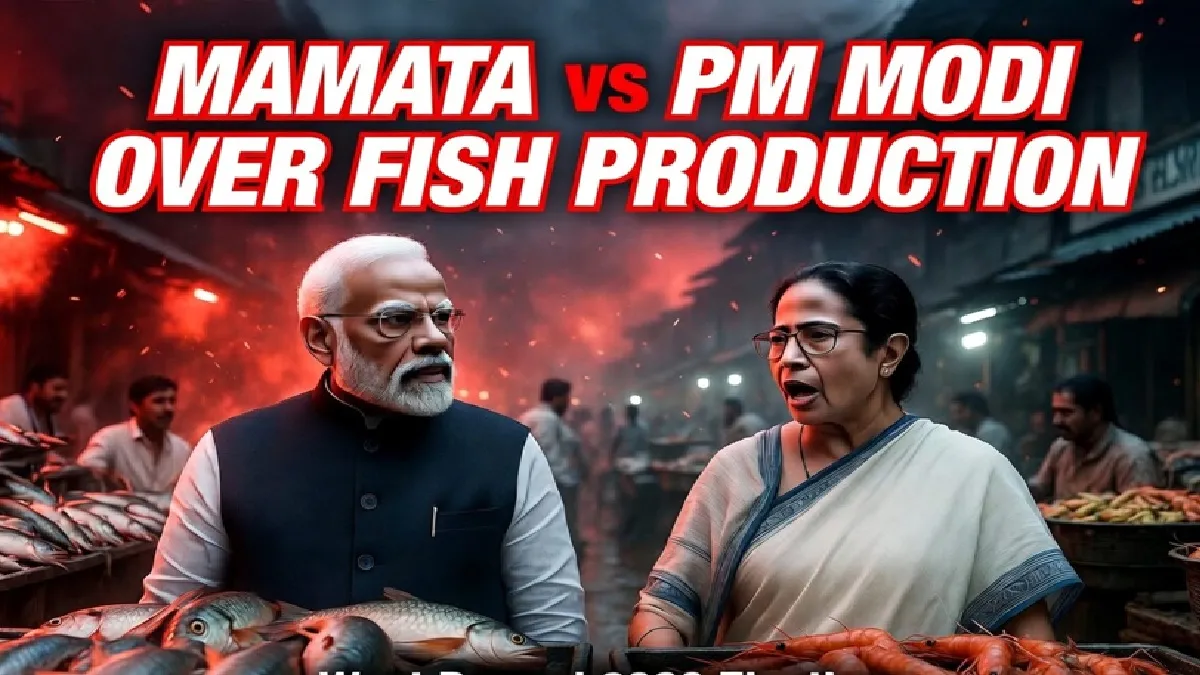
West Bengal Elections 2026: Fish is not just a seafood for people in West Bengal, but a symbol of deep culture and local economy, which gives employment to lakhs of people. With PM Modi's fierce attack on the Mamata Banerjee-led Trinamool government over fish production in the state, the seafood became the latest flashpoint between the ruling party and the Opposition Bharatiya Janata Party amid intense campaigning for the upcoming April 23 and 29 assembly elections.
Bengal Has To Import Fish Under TMC Rule, Alleges PM Modi
Fish jumped from the plate to the BJP's rally early in the day, when PM Modi, while delivering his speech at a public rally in Haldia, alleged that the TMC government failed to match fish production with its high demand in the state.
"Bengal imports fish from other states. In the last 15 years, the TMC government has taken no worthwhile step to enhance supply and attain self-sufficiency in fish production," he said.
The Prime Minister said that the BJP, after coming to power in the state, would make the state self-sufficient in fisheries and the seafood sector.
ALSO READ: PM Modi Announces '6 Guarantees' For Bengal, Warns 'TMC Goons' Of Action Under BJP Rule
TMC has totally ignored the fisheries sector. In contrast, the NDA government at the Centre has worked to strengthen this vital sector. pic.twitter.com/XffpKO25ji
— Narendra Modi (@narendramodi) April 9, 2026
Check Your Facts: CM Mamata Hits Back At PM Modi
Hours later, Chief Minister Mamata Banerjee strongly refuted PM Modi's allegation, saying her government is self-sufficient in fish production, and accusing him of misrepresenting facts.
Mamata, addressing a public rally at Agarpara in North 24 Parganas district, alleged that people are not allowed to eat non-vegetarian food in BJP-ruled states.
"I heard that today, he (PM) said that there is no fish production in Bengal, while Bihar is producing more and exporting. But you do not allow people to eat fish in Bihar. Here we purchase fish from markets and eat," the TMC supremo said.
Earlier, Bengal used to import fish from Andhra Pradesh, but that has been stopped, Banerjee said, and urged Modi to keep track of these developments.
"You (the Centre) export meat from here (Bengal). You export beef from here to Oman. If you are allergic to fish and meat, why do you do that?" she asked.
"We produce fish in our ponds. Fish is available in every market... People here are free to eat as per their choice. We do not interfere with that. People in BJP-ruled states are not allowed to eat eggs, fish and meat," she said.
Balagarh, West Bengal: Chief Minister Mamata Banerjee says, "Voting for BJP means restrictions on eating eggs, meat, fish and also restriction on freedom of speech...because there brain is blind..."
— IANS (@ians_india) April 8, 2026
(Source: Mamata Banerjee Facebook) pic.twitter.com/SwSJqQ6heo
What Is The Status Of Fish Production In West Bengal?
According to the latest government data, Andhra Pradesh stands at the top with 55.39 lakh tons of fish production with 25%-28% total share, followed by West Bengal with 23.74 lakh tons of production with a market share 12%.
West Bengal is endowed with six agro-climatic regions with diverse aquatic resources, with more than eight lakh hectares of inland water bodies and a coastline of 158 km. There is great diversity in the fishery sector, from cold water to marine and everything in between (inland, brackish water, wetland).
The state produced 20.45 lakh metric tons of fish and 27 billion of fish seeds during 2022-23. In addition, it also exported 1.17 lakh metric tons of fish (mostly frozen shrimp) worth more than Rs. 5000 crore. If all the water bodies are gainfully utilised, the total fish production in the state can reach around 33 lakh MT per year. The average productivity in inland fisheries is around three tons per hectare, which can be increased to six to eight ton per hectare through scientific fish farming. This policy is being proposed to create an enabling ecosystem which will trigger private sector participation in this sector, including those of the self-help groups and Fish Production Groups (FPG).
(With Agencies Inputs)