
- By Raju Kumar
- Wed, 22 Apr 2026 04:45 PM (IST)
- Source:JND
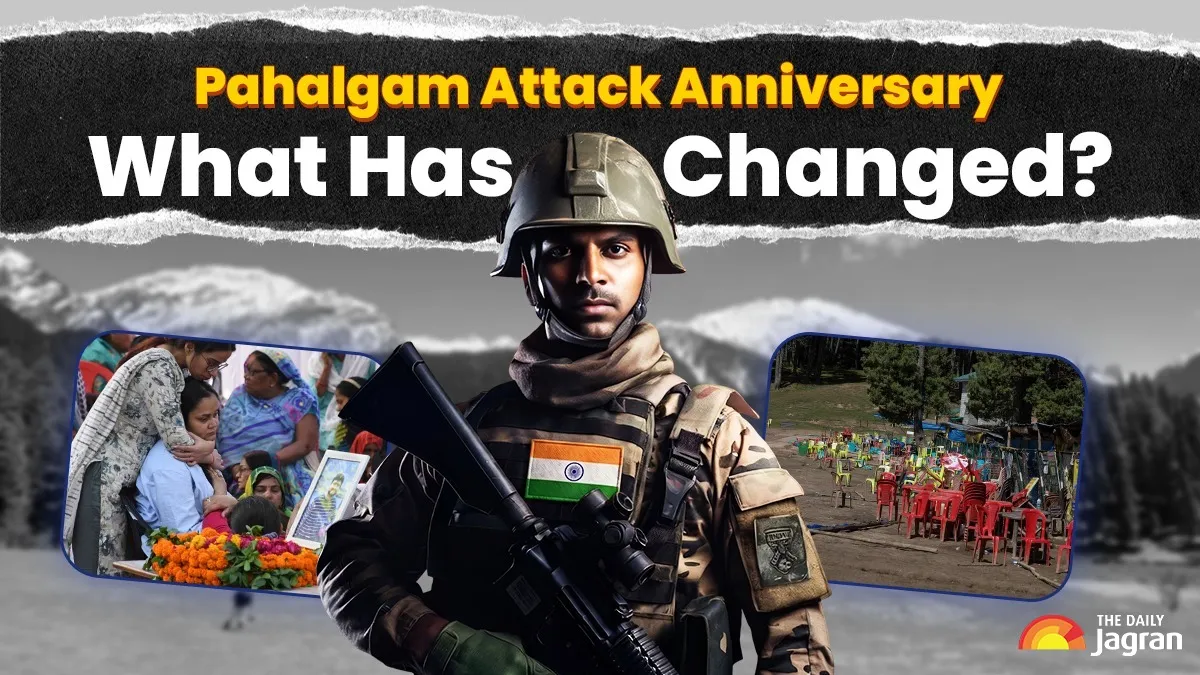
Pahalgam Terror Attack Anniversary: On the first anniversary of the deadly Pahalgam terror attack, India on Wednesday reaffirmed its steely resolve to fight against terrorism. A group of three Pakistan-backed terrorists carried out a militant operation at the iconic tourist place, Pahalgam in South Kashmir on April 22 last year, killing 26 people, mostly tourists. The dastardly act had shaken the nation and drawn condemnation from across the world. India retaliated by launching a military operation codenamed 'Operation Sindoor' early on May 7 and decimated multiple terror infrastructure in Pakistan and Pakistan-occupied Kashmir (PoK), eliminating over 100 terrorists.
Remembering the innocent lives lost in the gruesome Pahalgam terror attack on this day last year. They will never be forgotten. My thoughts are also with the bereaved families as they cope with this loss.
— Narendra Modi (@narendramodi) April 22, 2026
As a nation, we stand united in grief and resolve. India will never bow to…
The Pahalgam terror attack turned out to be another black chapter in the relationship between India and Pakistan, exposing Islamabad's ill-intention to destabilise Jammu and Kashmir. The attack showed spiral effects on the domestic as well as global levels.
ALSO READ: Pahalgam Terror Attack: One Year Later, How The Investigation Has Progressed And What's Ahead?
Quiz
Here Top Impacts Stemmed Out From The Pahalgam Terror Attack
Operation Mahadev: Operation Mahadev, a joint counter-terror operation by the Indian Army, CRPF, and Jammu and Kashmir Police, was launched on May 22 to neutralise three Lashkar-e-Taiba (LeT)'s ‘A’ category terrorists responsible for the Pahalgam attack. On July 29, Union Home Minister Amit Shah informed the Parliament that all terrorists involved in the Pahalgam attack — Suleman alias Faizal Jatt, Hamza Afghani, and Zibran - were killed.
Indus Treaty Revoked: Following the attack, India revoked the Indus Water Treaty with Pakistan on April 23. The government asserted that the Indus Water Treaty of 1960 with Pakistan will be held in abeyance with immediate effect until Islamabad credibly and irrevocably abjures its support for cross-border terrorism. The treaty is considered Pakistan’s vital water lifeline as it provides nearly 79-80% of the Indus Basin's total water.
Visas Suspended: Following the terror attack, India suspended all SAARC visas of all Pakistani citizens, and they were sent back to their neighbouring country.
Security Enhanced: In the wake of the terror attack, the government carried out several initiatives to tighten the security at the tourist places across Jammu and Kashmir. Checkpoints, QR code verification, drone surveillance, and strict vigilance in high-altitude areas were brought into place.
Revival of Tourism: Tourism activity in Pahalgam and the wider Kashmir Valley has shown clear signs of revival in the last one year after the ghastly attack. The return of domestic tourists has driven a steady rise in visitor numbers. Improved occupancy rates in hotels and transport services reflect strengthening demand, while local markets are gradually regaining their dynamism. Despite numerous challenges, more than 17 million tourists visited the Kashmir Valley in 2025. While this number is lower than the 23.6 million tourists who visited Kashmir in 2024, it is still 11 million more than the number of tourists who visited Kashmir in 2021. In 2021, 11.3 million tourists visited Kashmir, compared to 18.9 million in 2022 and 21.2 million in 2023.
Local Economy: According to the Jammu and Kashmir Economic Survey 2025-26, the startup ecosystem grew from 69 startups in 2020 to 1,255 startups by December 2025, including 434 women-led startups spanning the agriculture-related, IT, services, and manufacturing sectors. To encourage the startup culture, the state government has formulated a Startup Policy for 2024-27, promoting financing through venture capital funds, loan guarantee programs, seed funding, patent support, and mentorship.
Investments Of Rs 5,260 Crore: In just nine months of the 2025-26 fiscal year, Jammu and Kashmir has achieved Rs 5,260 crore in investment, 14 times more than the Rs 377 crore for the entire 2021-22 year. Furthermore, there is a large pipeline of proposed investments under Central Sector Schemes. An investment of Rs 2,153 crore was made in 2023.
आकाश मिसाइल सिस्टम, ब्रह्मोस, आकाशतीर एयर डिफेंस कंट्रोल सिस्टम और अन्य कई प्रकार के स्वदेशी उपकरणों व प्लेटफ़ॉर्म्स ने ऑपरेशन सिंदूर के दौरान अपना पराक्रम दिखाया।
— Rajnath Singh (@rajnathsingh) October 27, 2025
हमारे स्वदेशी उपकरणों की सफलता ने न केवल क्षेत्रीय बल्कि अंतरराष्ट्रीय स्तर पर भी भारत की साख को बढ़ाया है। pic.twitter.com/stzL5vIBUB
Impact On Geopolitics: Post-operation Sindoor, Pakistan became a sycophant of the US as it saw an opportunity to get financial aid from the world's richest country. US President Donald Trump claimed that he played the role of a peace broker during Operation Sindoor, which was rejected by India. Also, Türkiye and Azerbaijan supported Pakistan, drawing India's ire.
Self-Reliance In Defence: India displayed a self-reliant defence capacity during the operation Sindoor. The performance of indigenous technology against hostile threats, including drones, rockets, and missiles, drew the international community's attention. India's BrahMos supersonic cruise missile created headlines for destroying terror camps in Pakistan.
(With Agencies inputs)
You May Also Like To Watch