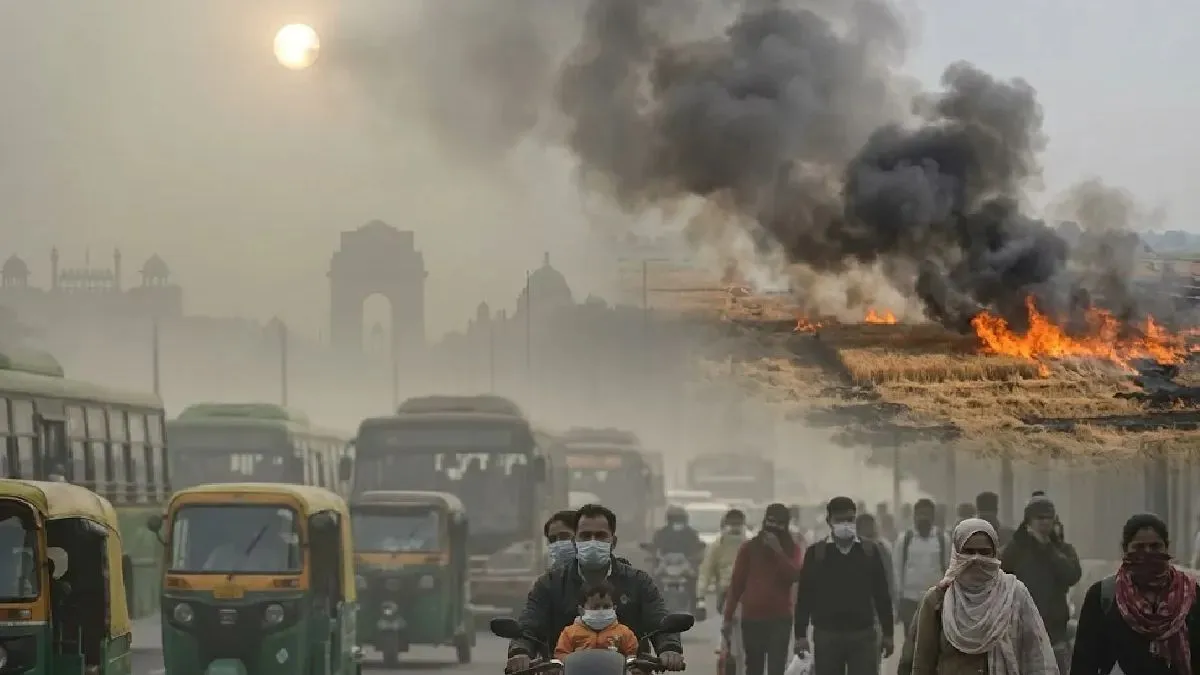
- Stubble burning incidents fell over 90 per cent in six years.
- Central government's mechanization scheme drove the decline.
- Farmers saved Rs 600 crore through residue incorporation.
Arvind Sharma, New Delhi: Farmers in Punjab and Haryana, long held responsible for Delhi-NCR's air pollution, are turning away from stubble burning. Satellite data from the Indian Council of Agricultural Research (ICAR) shows a steep decline of over 90 per cent in stubble burning incidents across both states over the past six years.
Stubble Burning Incidents In Punjab And Haryana: What Satellite Data Shows
Between 15 September and 8 November, stubble burning incidents fell by 93.4 per cent in Punjab and 94.6 per cent in Haryana compared to 2020.
Punjab recorded 67,654 fires in 2020, which came down to 4,459 in 2026. However, Punjab experienced a slight increase this year compared to 2025's figure of 3,622 incidents. Haryana maintained a steady downward path, lowering its figure from 3,253 incidents in 2020 to 175 in 2026.
Dr Rajbir Singh, Deputy Director General (Agricultural Extension and Engineering) at ICAR, said that brief spikes around Diwali stem from local weather and harvesting schedules, emphasising that single-day data should not overshadow long-term progress.
Year-By-Year Stubble Burning Incidents (15 September To 8 November)
- 2020: Punjab recorded 67,654 incidents; Haryana recorded 3,253 incidents.
- 2021: Punjab recorded 42,475 incidents; Haryana recorded 4,536 incidents.
- 2022: Punjab recorded 33,090 incidents; Haryana recorded 2,624 incidents.
- 2023: Punjab recorded 22,981 incidents; Haryana recorded 1,649 incidents.
- 2024: Punjab recorded 6,029 incidents; Haryana recorded 935 incidents.
- 2025: Punjab recorded 3,622 incidents; Haryana recorded 266 incidents.
- 2026: Punjab recorded 4,459 incidents; Haryana recorded 175 incidents.
What's Behind The Decline?
The primary reason behind this is the central government's mechanisation scheme launched in 2018 for crop residue management. Farmers were given subsidies for machines that mix and remove stubble. Seeders, including Happy Seeder, Super Seeder, Smart Seeder, and Surface Seeder, allow farmers to sow wheat directly without clearing paddy stubble by fire.
Recommended For You
- Machinery Distribution: By 2025-26, over 345,000 machines were distributed across the country. Of these, Punjab has nearly 148,000 machines.
- Custom Hiring Centres: To support small farmers, 43,276 custom hiring centres were set up, including 25,917 in Punjab and 6,775 in Haryana.
- Input Cost Savings: In-field residue incorporation (11.4 million tonnes in Punjab during 2025-26) yielded savings of approximately Rs 600 crore (Rs 6 billion) for farmers.
Meanwhile, approximately 7.85 million tonnes of straw was used in industrial boilers, biomass and thermal power plants, animal feed, brick kilns, and biofuel production. This has also increased the commercial use of straw.
Dr ML Jat, Director General of ICAR, stated that the combination of agricultural science, targeted subsidies, and direct farmer participation has proved decisive in stubble management.