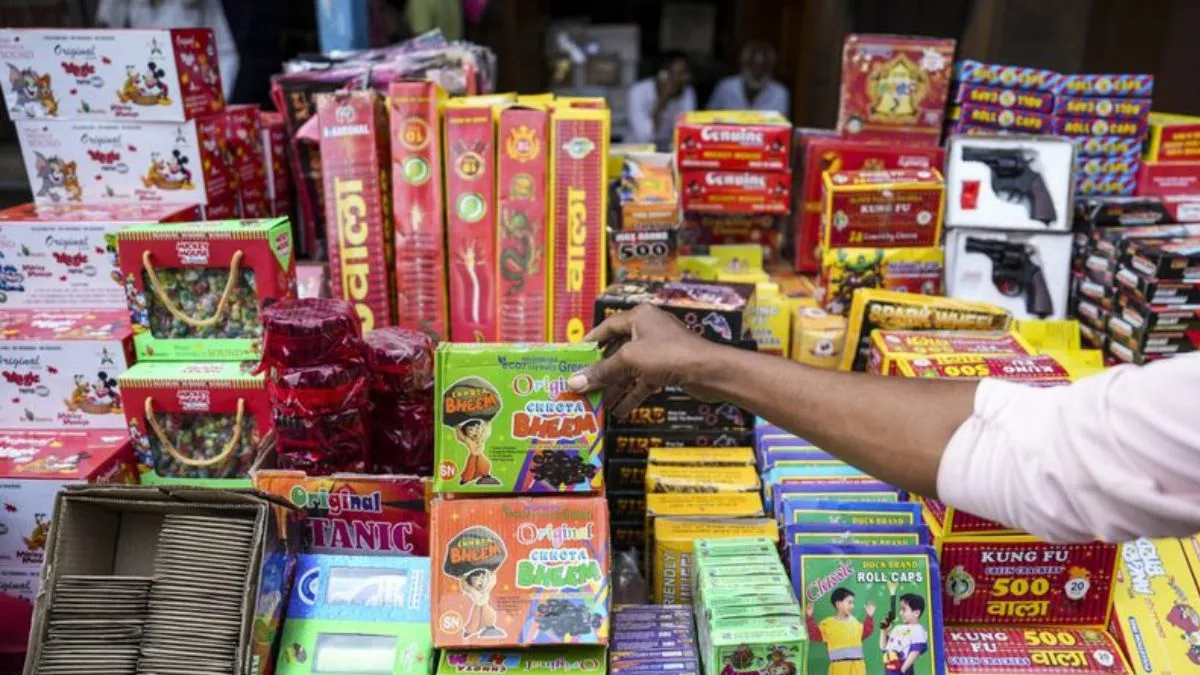
- SC permits green crackers with strict conditions for Diwali.
- Green crackers reduce pollutants but are not pollution-free.
- The CSIR-NEERI QR code ensures the authenticity of green crackers.
The Supreme Court on Monday permitted the bursting of certified green crackers on November 7 and 8, between 6 am and 7 am and again from 8 pm to 10 pm. While the order brings relief to locals and traders, it comes with rigid riders: an outright ban on barium-based formulations and mandatory CSIR-NEERI QR certification. Yet the relief raises an essential question, does switching to green crackers actually protect the capital's already toxic winter air?
What Are Green Crackers?
You often tend to think that green crackers are the firecrackers exclusively designed to produce no pollution. However, the reality is different. These green firecrackers are made to release fewer pollutants than conventional fireworks.
The crackers developed by the CSIR-NEERI are made using chemical compositions, reducing the quantities of certain raw materials and additives that enhance combustion efficiency and help in lessening particulate emissions.
The changes to the making of firecrackers can be in various ways. One can reduce the size of the shell, discard ash-producing materials, lower the use of conventional chemicals and introduce materials such as zeolites and iron oxide.
What Are The Needed Requirements For Becoming One?
Green crackers must meet specific criteria to be identified as an environmentally friendly firecracker. The crackers should produce at least 30 per cent lower particulate matter emissions compared with conventional crackers of the same category. Alternatively, they must reduce particulate matter emissions by at least 20 per cent along with a minimum 10 per cent reduction in gaseous emissions.
Recommended For You
ALSO READ: Supreme Court Allows Green Crackers In Delhi-NCR On November 7-8 For Diwali, Sets Conditions
Does It Really Reduce Pollution?
Researchers said that the green crackers reported a reduction of 30-60 per cent in particulate matter and barium emissions in the tested products. A study published in the journal Environmental Pollution wrote that the additives helped alter the composition and characteristics of the particles released during combustion.
Analysts say that conventional fireworks can release metals, including barium, alongside fine particulate matter. Barium compounds have traditionally been utilised in fireworks to produce green-coloured flames and can pose environmental and health concerns. The researchers also pointed out that the explanations are based on the specific formulations which were tested. The results would not apply for all fireworks sold as green crackers.
ALSO READ: Delhi Diwali Firecracker Ban: SC Allows Green Crackers Only Across NCR; Check Timings And Date Here
The research clarified that the after-emissions would only apply when a considerable amount of firecrackers would be used. If you burn excessive amounts of green crackers, the emission would produce more pollutants. Lower emissions per cracker do not automatically translate into cleaner city-wide air.
The green crackers too contribute to the pollution load, although their emissions may be lower. The impact can be especially significant in Delhi during Diwali, when stubble burning, vehicular emissions and unfavourable weather conditions already contribute to poor air quality.
How to Identify a Green Fire Cracker?
A greencracker would carry a specific logo of CSIR-NEERI and would also have a QR code. Upon scanning the QR code, customers and safety agencies would be able to examine the product’s authenticity and certification details. CSIR-NEERI also maintains a list of registered manufacturers. Its official website says that only certificates and test reports issued through its authorised system are valid.
While the label "green" typically implies a product is completely harmless to the environment, "green" fireworks are merely less harmful, not entirely pollution-free.