
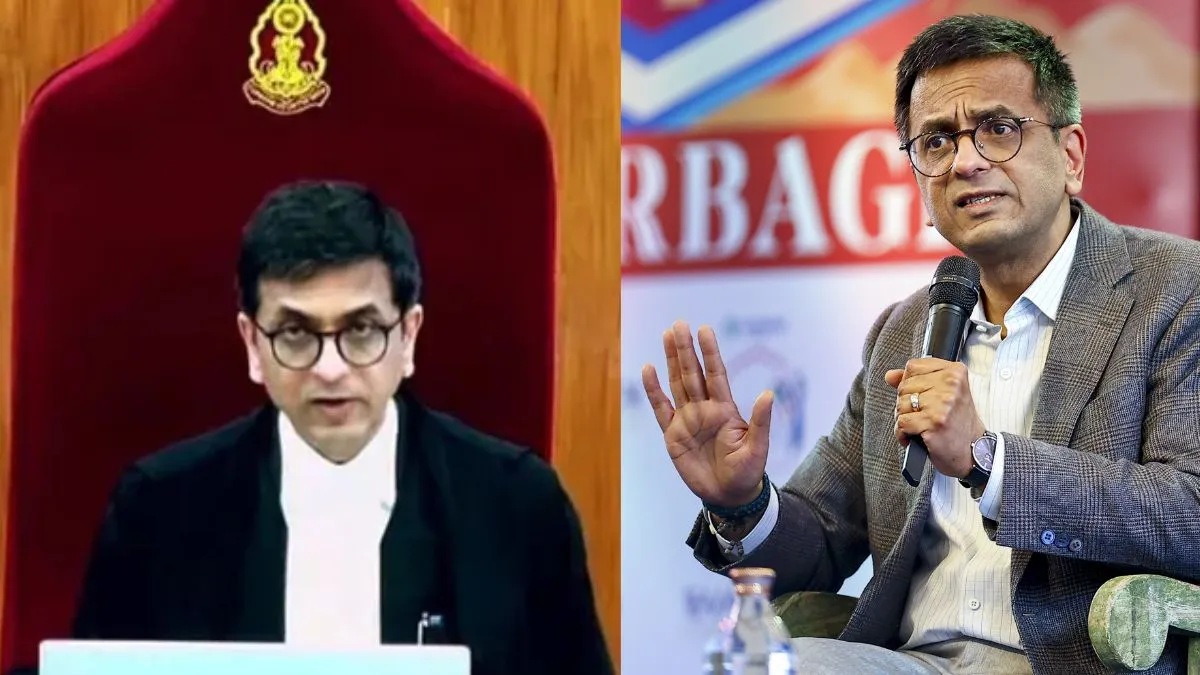
- Kaul's memoir criticizes ex-CJI Chandrachud's judicial appointment approach.
- Alleges Chandrachud was "too deferential" to government on appointments.
- Raises concerns over executive consultation before Collegium decisions.
Former Supreme Court judge Justice Sanjay Kishan Kaul has raised serious concerns regarding former Chief Justice of India (CJI) DY Chandrachud's approach to judicial appointments, alleging that he was "too deferential to the government".
In his forthcoming memoir, 'Without Fear or Favour', Justice Kaul expressed concern over consulting the executive about candidates before formal Collegium deliberations take place.
Recounting a specific Collegium meeting held to fill six Supreme Court vacancies, Justice Kaul said that five names had already been agreed upon in advance when Justice Chandrachud introduced a sixth candidate and considered seeking the government's view on the appointment.
ALSO READ: Russia Appoints India's Ex-CJI DY Chandrachud In Dispute With Ukrainian Bank Over War-Lost Assets
"The Chief Justice drew me aside into a separate room and wondered aloud whether he should telephone out to check the government's view," Kaul wrote in his memoir.
Tensions Over Last-Minute Candidate And Executive Consultations
Speaking to The Wire, Justice Kaul emphasised that the Collegium must resist executive pressure to safeguard judicial independence.
When asked whether Justice Chandrachud was trying to please the executive or seeking prior approval, Kaul said, "I don't think it was a question of pleasing the government, but what had happened was that he had discussed the names with me earlier. We had agreed on five names, and I thought the collegium would be quite okay with the other members of the collegium, and this (sixth) name was propped up at the last minute with me while going to the collegium meeting. I said that name is not acceptable to me and will not be acceptable."
He said that Justice Chandrachud sought his support for the additional candidate, but he believed that the broader Collegium would oppose it.
"And well, he wanted me to collaborate and go ahead with the name. I said even if I do that, the others will not. I believe, and that's what happened in the meeting. I told him this will not get through because I know the views of the other collegiate members. Maybe he had already taken some kind of approval for the other names, including the sixth name," Kaul added.
Recommended For You
Justice Kaul, who served on the Collegium under Justice Chandrachud from June 2022 until his retirement in December 2023, said that differing perspectives on managing executive relations created strain between them. He said that informal pre-approvals set a risky precedent for future Chief Justices, especially those with shorter tenures.
"So this has become, unfortunately, a practice of names being discussed in some kind of a previous discussion with the government. It has been happening, I think, before and after, which is what troubles me. That's why I have written that when the government introduced the NJAC (the National Judicial Appointments Commission) in 2015, we would at least have sat across the table and discussed it. It could have been fine-tuned. It could be modulated," Kaul said.
"There is a difference between consultation and what I came to regard as pre-approval, seeking the government's nod before the collegium had even formally deliberated," Kaul wrote in his memoir.
"Well, he believed that this is how it had been happening, and I was of the view that you, with a chief justice like you, and with two years' tenure, and with your own merit and the trust, if you do this, the successors would have a problem in not following this practice because they have shorter tenures. And the government would get used to a particular methodology before appointments to the Supreme Court were made, and that's why I endeavoured to discourage him from discussing everything beforehand," Kaul explained.
Congress Raises Concerns Over Judicial Independence
This sparked immediate political reactions, with the Congress party raising serious concerns over the independence of the judiciary under the PM Modi-led government. The party asserted that the institution tasked with upholding the Constitution must remain free from the pressures of those in power.
Congress general secretary in-charge of communications Jairam Ramesh shared a media report of the pre-publication manuscript of Justice Kaul's memoir on social media.
In a post on X (formerly Twitter), Ramesh said, "A book by former Supreme Court judge Justice Sanjay Kishan Kaul has raised serious questions regarding the independence of the judiciary during the tenure of the Modi government."
(With Inputs From Agencies)