

- Cyclone Arnab set to intensify further and make landfall on October 28.
- Heavy to very heavy rain likely over coastal Andhra Pradesh and Odisha.
- Mass evacuations underway; NDRF, SDRF and ODRAF teams deployed.
Cyclone Arnab Live Tracker: The India Meteorological Department (IMD) has said that the deep depression over the east-central and southeast Bay of Bengal has already intensified into cyclone 'Arnab.' By midnight, the storm will move west-northwestward and turn into a severe cyclone over the west-central Bay of Bengal. By October 27, the storm will further intensify into a 'very severe' cyclone, before making landfall on October 28 between Bapatla and Visakhapatnam.
Where Is Cyclone Arnab Now?
According to IMD's latest update, cyclonic storm Arnab (pronounced Ornab), which formed over the east central and adjoining west central Bay of Bengal, has moved westwards at a speed of 15 kmph over the past six hours. As of 8:30 AM today, it was still over the same region, which is, 580 km southeast of Gopalpur in Odisha, 610 km east-southeast of Visakhapatnam, 620 km northwest of Sri Vijaya Puram in the Andaman Islands, 690 km east-southeast of Kakinada, 790 km east-southeast of Machilipatnam, and 860 km east-southeast of Bapatla in Andhra Pradesh.
Sub:Cyclonic Storm “Arnab” [Pronunciation: Ornab] over Eastcentral and adjoining Westcentral Bay of Bengal [Cyclone Warning for Andhra Pradesh and adjoining South Odisha coasts—Red Message]* The cyclonic storm *““Arnab” [Pronunciation :Ornab]”*over Eastcentral and adjoining Westcentral Bay of Bengal moved westwards with a speed of 15 kmph during last 6 hours, lay centered at 0830 hrs IST of today, the 26th October, 2026 over the same region near latitude 15.4°N and longitude 88.5°E, 580 km southeast of Gopalpur (Odisha), 610 km east-southeast of Vishakhapatnam (Andhra Pradesh), 620 km northwest of Sri Vijaya Puram (Andaman Islands), 690 km east-southeast of Kakinada (Andhra Pradesh), 790 km east-southeast of Machilipatnam (Andhra Pradesh) and 860 km east-southeast of Bapatla (Andhra Pradesh). It is very likely to move west-northwestwards and intensify further into a severe cyclonic storm over westcentral Bay of Bengal by midnight of today, the 26th October and into a very severe cyclonic storm over the same region on 27th October. Thereafter, it is very likely to move northwestwards and cross Andhra Pradesh & Yanam coasts between Bapatla and Visakhapatnam close to Yanam as a very severe cyclonic storm with the maximum sustained wind speed of 115-125 kmph gusting to 140 kmph by forenoon of 28th October, 2026.
— India Meteorological Department (@Indiametdept) October 26, 2026
What Is The Meaning Of The Name 'Arnab'?
In Bengali, the meaning of Arnab is 'ocean'. The name was suggested by Bangladesh for the tropical cyclone naming list.
Recommended For You
How Are Cyclone Names Listed?
The naming list of cyclones is managed by the IMD and WMO (World Meteorological Organisation). The IMD names cyclones in the North Indian Ocean from a list of 169 names provided by 13 countries. Cyclone Arnab was suggested by Bangladesh and is part of the list introduced in 2020 by the World Meteorological Organisation and the United Nations Economic and Social Commission for Asia and the Pacific (UNESCAP). The names are used in a fixed order.
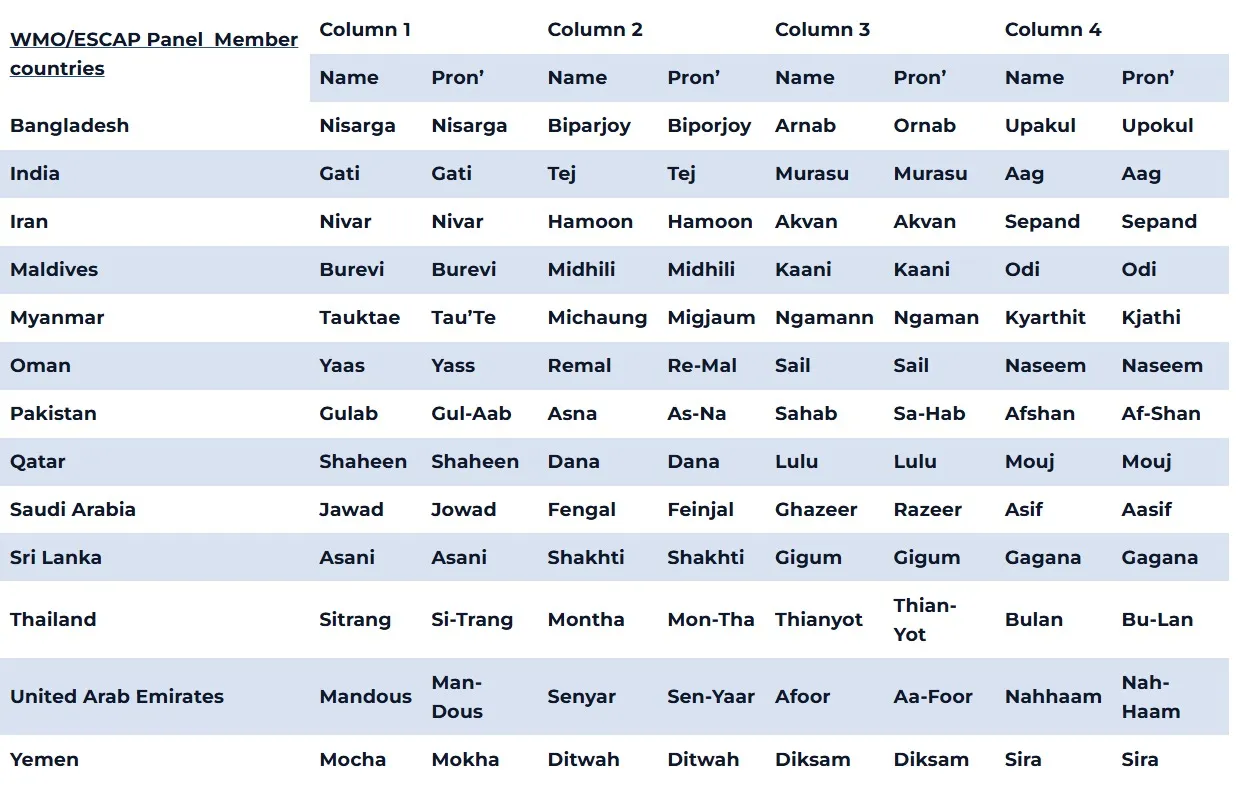
Image Credits: wmo.int
Which States Will Be Affected?
Cyclone Arnab will mainly affect the states of Andhra Pradesh and Odisha. Heavy to very heavy rainfall likely in coastal Andhra and Yanam from October 27 to October 29.
Coastal Andhra Pradesh, Yanam and Rayalaseema will also witness thunderstorms along with lightning. Several areas of Odisha are also to witness severe weather. The state government has already started deploying assistance and preparedness measures to cope with the disaster.
Andhra, Odisha To Begin Evacuations
The authorities of both states began preparing for the upcoming storm, with mass evacuations to begin this evening. The Andhra government has identified 570,000 people in high-risk areas. They will be evacuated to safer zones. Under CM N. Chandrababu Naidu order, 10 NDRF and 11 SDRF teams have been kept on standby. Control rooms and relief centres have also been arranged as part of preparedness measures.
In Odisha, evacuations have already begun across risk-prone southern districts. Around 60 ODRAF teams, 17 NDRF teams, and 225 Fire Services teams have been deployed to look after the process. Meanwhile, schools and colleges have also been closed from Tuesday till Wednesday.
In Bengal too, certain areas including Purba Medinipur, Paschim Medinipur, North 24 Parganas, South 24 Parganas, Jhargram, Kolkata, Howrah and Hooghly are likely too face moderate rainfall due to the impact of the cyclone.