

- By Priyanka Koul
- Tue, 16 Jun 2026 03:56 PM (IST)
- Source:JND
NEET UG Paper Leak 2026: The National Testing Agency (NTA) on Tuesday welcomed the Ministry of Electronics and Information Technology’s (MeitY) decision to restrict access to Telegram in India ahead of the NEET (UG) 2026 re-examination. The move has triggered a strong online response, with opinions split between those backing the action as necessary and others calling it excessive.
Why has Telegram been restricted?
Following reports of a NEET UG 2026 question paper leak, the NTA moved to tighten security for the upcoming re-examination scheduled for June 21. Acting on its recommendation, the Centre has temporarily restricted access to Telegram across India until June 22, 2026.
In its statement, the NTA said it supports the Ministry of Electronics and Information Technology’s (MeitY) decision, saying the restrictions would help maintain the fairness of the examination and protect candidates from organised fraud.
As per the directive, Telegram access will remain restricted until June 22, covering the exam day and the immediate aftermath. In addition, MeitY has instructed the platform to disable its message-editing feature in India until June 30.
NTA STATEMENT REGARDING THE ACTION ON TELEGRAM PLATFORM IN INDIA
— National Testing Agency (@NTA_Exams) June 16, 2026
1. The National Testing Agency (NTA) welcomes the directions issued today in respect of the Telegram platform in India. The directions, issued on recommendations of NTA are calibrated and bounded in time:
(a) a…
The agency also highlighted the role of the Indian Cyber Crime Coordination Centre (I4C) under the Ministry of Home Affairs in coordinating action against Telegram-based fraud networks and misinformation targeting NEET aspirants. Based on inputs from the NTA, state police, and its own monitoring systems, I4C helped take down multiple Telegram channels, groups, and bots allegedly involved in fraudulent activity.
According to the NTA, these coordinated efforts helped limit the impact of such networks even before the decision for platform-level restrictions was taken.
According to the NTA, earlier steps such as removing individual channels did not fully stop the circulation of fake claims, leading to the decision for broader platform-level restrictions.
The agency also flagged multiple Telegram groups using names like "PAPER LEAKED NEET", "Re-NEET 2026", "Private Mafia" and "REE NEET MAFIAA", which allegedly attempted to extort money from candidates by falsely claiming access to exam papers.
It further stated that disabling Telegram’s message-editing feature was aimed at preventing the manipulation of posts to create false “paper leak” proof after examinations, as edited messages can retain original timestamps and mislead users.
What did the NTA DG say?
National Testing Agency (NTA) Director General Abhishek Singh said the step was necessary to counter the spread of fake papers and fraud targeting students.
"We had to take this drastic step because scammers and fraudsters were constantly misusing the Telegram platform. They were circulating fake question papers claiming them to be the actual question papers for the upcoming NEET exam and trying to extort money from students by exploiting their anxiety," said DG Abhishek Singh.
He added that more than 200 Telegram channels had already been taken down after coordination with platform representatives and that some groups had even attempted to circulate fake “real papers” ahead of earlier exam dates.
He also advised students to rely only on official NTA communications and avoid rumours circulating on social media, stressing that the measures aim to ensure fairness and transparency in the examination process.
How is the internet reacting?
The decision has drawn mixed reactions across social media. The Internet Freedom Foundation (IFF) criticised the move, calling the restrictions on Telegram and the disabling of its message-editing feature ahead of the NEET-UG 2026 re-exam a “band-aid solution” and a “disproportionate” response to exam fraud.
"Shutting down Telegram is a band-aid solution and is a disproportionate answer to exam fraud. On the NTA's recommendation, the Ministry of Electronics and Information Technology has, under Section 69A of the Information Technology Act, 2000, restricted access to the whole of Telegram in India until 22 June 2026 and has separately ordered the platform to switch off message editing for every Indian user until 30 June 2026."
Statement : Shutting down Telegram is a band aid solution and is a disproportionate answer to exam fraud
— Internet Freedom Foundation (IFF) (@internetfreedom) June 16, 2026
The Internet Freedom Foundation objects to the directions announced today in the National Testing Agency's press release on action against the Telegram platform. On the NTA's… pic.twitter.com/xlpzjcZEnC
Public reactions on social media were also divided. Some users questioned the effectiveness of the ban, while others expressed frustration over recurring exam leak controversies.
“Can’t stop paper leaks, ends up blocking Telegram," posted Nisarga Adhikary, a whistleblower who previously highlighted discrepancies in the testing system. “Blocking Telegram totally isn’t even possible; Telegram is designed in such a way which easily allows people to use proxies and other methods of circumvention."
> can't stop paper leaks
— nisarga (@ni5arga) June 16, 2026
> ends up blocking telegram
blocking telegram totally isn't even possible, telegram is designed in such a way which easily allows people to use proxies and other methods of circumvention. https://t.co/kv0VliWGrC

Another user wrote, "What will happen after blocking Telegram? People will use proxies and VPNs."
A third wrote, "It means NTA is still not sure whether the paper is leaked or not again?
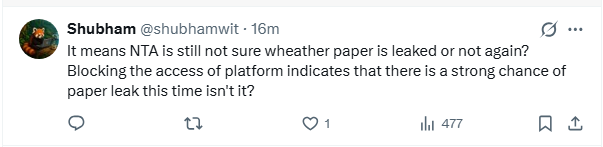
Blocking the access of the platform indicates that there is a strong chance of a paper leak this time, doesn't it?"
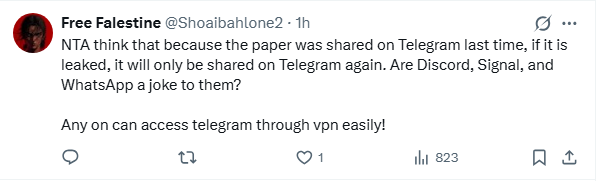
A fourth wrote, "NTA. I think that because the paper was shared on Telegram last time, if it is leaked, it will only be shared on Telegram again. Are Discord, Signal, and WhatsApp a joke to them?
Anyone can access Telegram through a VPN easily!"
Another wrote, "I don't know what is going on right now or what is going to happen. But as you can see now, everything is more chaotic and exhausting. We can't focus on studying after this much chaos. Take time and do more arrangements. It's a humble request; please postpone the exam."
I don't know what is going on right now or what is going to happen. But as you can see now everything is more chaotic and exhausting. We can't focus on study after this much chaos. Take time and do more arrangements. It's a humble request please postpone the exam.
— Muskan Ranjan (@ranjan_mus64421) June 16, 2026