
- By Shubham Bajpai
- Wed, 27 May 2026 10:02 PM (IST)
- Source:JND
Indian Space Research Organisation on Wednesday said that the scientists at the Ahmedabad-based Physical Research Laboratory have identified strong evidence of subsurface ice near the Moon's south pole using data from Chandrayan-2.
The findings of subsurface ice in some of the coldest craters near the south pole are based on Dual Frequency Synthetic Aperture Radar (DFSAR) of Chandrayan-2's orbiter.
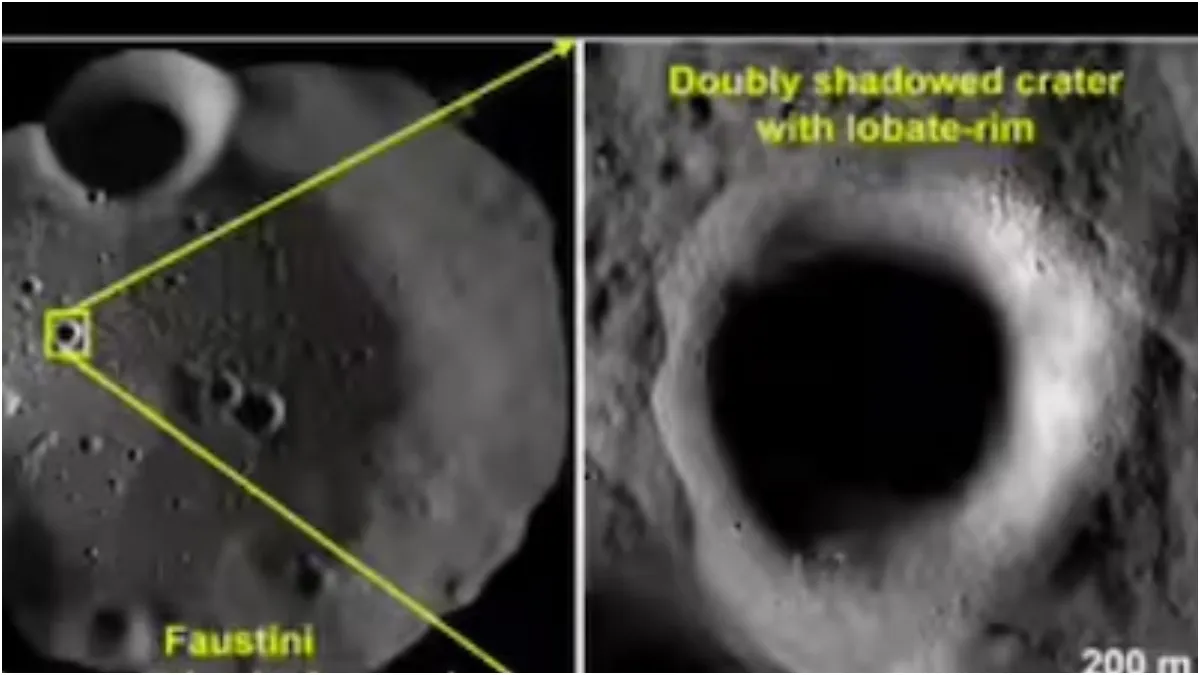
DFSAR is a microwave imaging instrument that can probe beneath the surface of the Moon. Among the craters that ISRO examined, the evidence of subsurface ice is found in a 1.1-kilometre-wide crater located within the larger Faustini crater.
As per researchers, the said crater displayed a "lobate-rim morphology", a distinctive flow-like structural pattern. Researchers say that it may indicate the impact event penetrated an ice-rich subsurface layer.
ALSO READ: Mission MITRA: How Ladakh's 'Moonscape' Prepares India's Astronauts For Moon Missions
The latest discovery is significant in that it adds new scientific evidence that suggests that beneath the lunar polar regions, there may be substantial water and ice reserves.
It's not the first time that Chandrayan-2's data has provided scientific evidence that indicated water presence on the Moon.
ISRO said that the DFSAR instrument on Chandrayan-2 is the first fully-polarimetric SAR which can study the Moon at L- and S-band frequencies.
Earlier studies had identified signatures of water molecules and hydroxyl across sections of the lunar surface. Aimed at locating ice-bearing regions on polar surfaces, the Chandrayan-2 orbiter has generated more datasets that have helped in creating high-resolution polar maps.
ALSO READ: Chandrayaan-4 Mission: ISRO Finalises South Pole Landing Zone For Lunar Sample Return; Here’s Why
ISRO said, "These findings provide important new insights into the distribution of lunar polar volatiles and have significant implications for future lunar exploration missions, including identification of potential ice-bearing regions for future landing and in-situ resource utilisation (ISRU) activities."