
- By Shubham Bajpai
- Thu, 21 May 2026 10:15 PM (IST)
- Source:JND
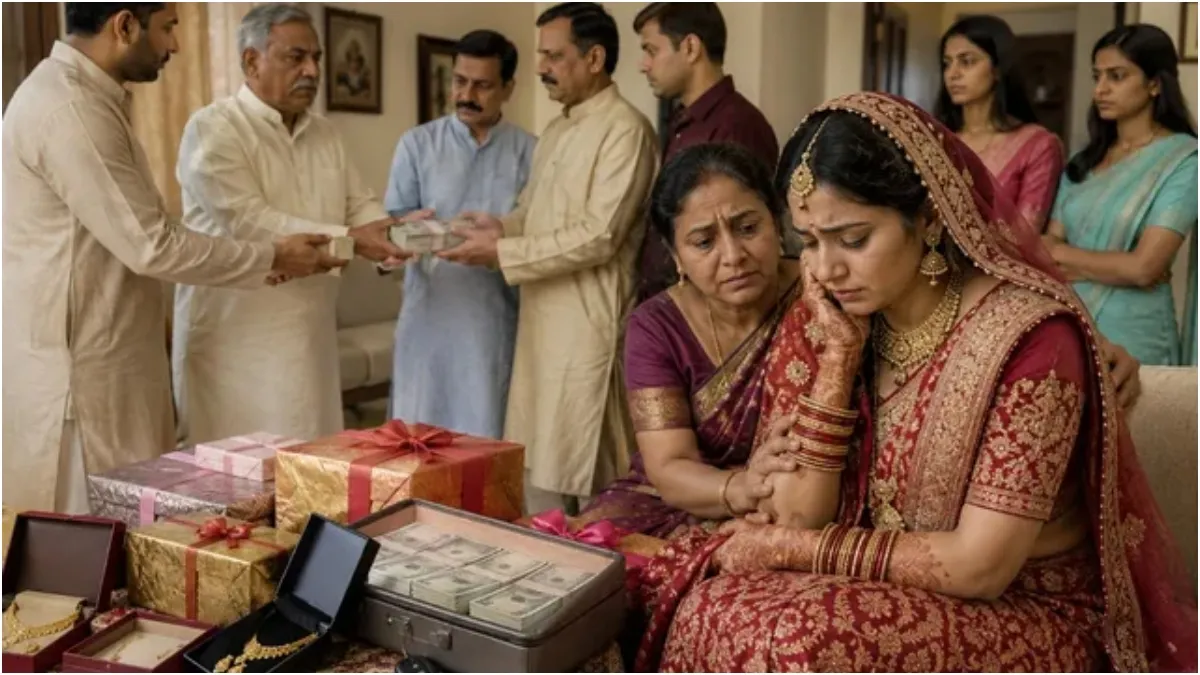
Over the past two weeks, several cases of dowry harassment and suspicious deaths have surfaced in India. Incidents from states like Karnataka, Madhya Pradesh, Uttar Pradesh, and Odisha have once again raised serious questions about the evil of dowry and the atrocities against women.
Each case has a different story, but the allegations are largely the same: dowry demands, mental and physical torture, and suspicious death.
In Karnataka's Ballari district, 24-year-old Aishwarya allegedly committed suicide. According to police, in her suicide note, she accused her husband and in-laws of mental torture and harassment over dowry. She had been married for only about a year and a half.
In Greater Noida, 24-year-old Deepika died after falling from the roof of her in-laws' house. Her family alleges that she was beaten and thrown to make the incident appear like an accident. Family members said she was being demanded various dowry items, including a Fortuner car, and that she also had injuries on her body.
Different states, same story
In the case of the death of 21-year-old Palak Rajak in Gwalior, Madhya Pradesh, the family has accused her in-laws of harassing her over demands for a vehicle. According to the father, the daughter frequently reported being beaten and humiliated.
Police exhumed the body of 21-year-old newlywed Pramila Das in Odisha's Jajpur district. Her father alleged that she was murdered for dowry and then cremated without informing him.
In Amroha, Uttar Pradesh, 19-year-old Pushpendra Devi called her father hours before her death, saying, "Papa, they will kill me." That very night, she was found hanging. The family has accused her husband and in-laws of demanding 10 lakh rupees and staging the murder as a suicide.
NCRB data raises concerns
According to the National Crime Records Bureau (NCRB), 5,737 cases of dowry deaths were registered in the country in 2024. These cases were registered under Section 80 of the Indian Penal Code and the earlier IPC Section 304B.
Uttar Pradesh recorded the highest number of dowry deaths at 2,038, followed by Bihar at 1,078. Both states also had the highest dowry death rates relative to their female population. Dowry deaths continue to be reported even in major cities like Delhi. This clearly demonstrates that this problem is not limited to rural areas or poor families.
Dowry demands do not end but rise after marriage
According to experts, dowry today is no longer limited to cash or jewelry. After marriage, new demands emerge, such as cars, flats, business finances, and expensive goods. In many cases, women are advised to compromise. Families, fearing social stigma, are reluctant to bring their daughters back home.
Under this pressure, many women endure violence for longer periods of time. According to lawyer Chetan Anand, dowry has not disappeared in modern India, but rather has changed its form. Now it is presented as a 'gift,' 'support,' or 'status.'
Why does the dowry system survive despite economic development?
According to a study by American researchers Jeffrey Weaver and Gaurav Chiplunkar, dowry demands have increased in India with economic growth and better jobs for men. Educated and well-employed men are increasingly demanding higher dowries.
Research has found that between 1950 and 1999, dowry transactions in India reached nearly a quarter trillion dollars. Marriage gradually became a matter of social prestige and economic bargaining. Sociologists believe that even today, many families view daughters as a financial burden and sons as assets. This mindset continues to perpetuate the dowry system.
Laws exist, but punishment difficult
The Dowry Prohibition Act was enacted in India in 1961. Later, Section 304B of the Indian Penal Code (IPC) was enacted to address dowry deaths, and now Section 80 of the Indian Penal Code.
According to the law, if a woman dies under suspicious circumstances within seven years of marriage and if dowry harassment is proven before that time, action can be taken against the husband and in-laws.
However, legal experts say that gathering evidence in such cases is difficult. Witnesses often turn hostile or families compromise under social pressure. This is why a significant number of cases go unpunished.