
- By Priyanka Koul
- Sat, 16 May 2026 12:47 PM (IST)
- Source:JND
Bhojshala Case: The Madhya Pradesh High Court on friday delivered its verdict in the long-standing Bhojshala-Kamal Maula Mosque complex dispute, bringing legal clarity to the decades-old controversy over the site.
In its ruling, the court held that the Bhojshala complex is to be treated as a temple. It further stated that arrangements for the mosque side will be made separately, including the possibility of allocating alternative land, for which the concerned party may approach the government. The decision effectively means that namaz will no longer be permitted at the site, and only Hindu religious prayers will be allowed going forward.
The High Court also observed that the archaeological interpretation of the Bhojshala complex was “not a matter of assumption, but a multidisciplinary scientific process.” It further noted that the judgment drew from principles laid down by the Supreme Court in the Ayodhya verdict.
The decision was based heavily on findings presented in a 2,189-page report submitted by the Archaeological Survey of India (ASI), which examined the historical and structural origins of the site.
Here are the nine major findings cited by the court while concluding that Bhojshala was originally a temple:
1. Evidence of a Parmar-era Temple Beneath the Structure
According to the ASI report, excavations at the site revealed remains of a 10th–11th century Parmar-era structure beneath the current complex. Massive basalt stones, ancient bricks, and temple-style foundations were discovered during the survey.
2. Inscriptions Referring to ‘Sharada Sadan’ Discovered
Several Sanskrit inscriptions recovered by the ASI referred to the site as “Sharada Sadan.” Sharada is considered a form of Goddess Saraswati. Such references were regarded as highly significant in identifying the site as a religious and educational centre.
3. Reference to Staging of ‘Parijat Manjari’
An inscription linked to the literary work Parijat Manjari was also found within the complex. According to the inscription’s introduction, the play was first staged at this Saraswati temple. The ASI treated this as a key cultural indicator, suggesting that the site was once a major centre for literature, theatre, and learning.
4. 106 Pillars Found in Temple Architectural Style
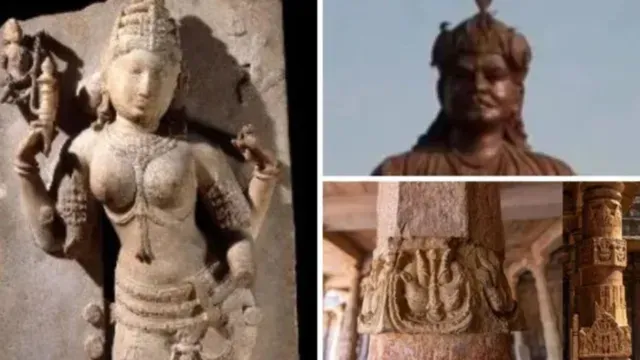
The complex contains 106 pillars and 82 pilasters featuring carvings, deity figures, and designs associated with Hindu temple architecture. The ASI stated that these architectural elements appeared to have been taken from an earlier temple and reused later. Several pillars were found misaligned or placed inconsistently.
ALSO READ: Hindu Devotees Offer Prayers At Bhojshala After MP High Court Declares Site A Temple | Watch
5. Inscriptions Were Defaced, Stones Placed Upside Down
The report stated that multiple Sanskrit and Prakrit inscriptions appeared deliberately erased. Several inscribed stones were embedded upside down or sideways in walls and flooring, making them unreadable.
According to the ASI, stones, pillars, and inscriptions from the earlier structure were extensively reused during later construction without maintaining their original placement or orientation.
6. Sculptures Showed Signs of Deliberate Damage
Many sculptures and deity figures carved into pillars and stones were found damaged. Faces, hands, and religious symbols appeared to have been chiselled away using sharp tools. The ASI viewed this as an attempt to erase the original temple identity of the structure.
7. Sanskrit-Prakrit Inscriptions Older Than Arabic-Persian Ones
The ASI recovered more than 150 Sanskrit and Prakrit inscriptions from the site, compared to around 56 inscriptions in Arabic and Persian. The report stated that the Sanskrit and Prakrit inscriptions were older and more closely linked to the original structure.
8. Craftsmen’s ‘Signature Marks’ Found
Dozens of symbols were discovered on pillars and walls, including 139 chakra symbols, 79 tridents, several swastikas, and other markings. The ASI identified these as construction marks or coded signatures used by craftsmen of that era.
9. Idols of Ganesh, Brahma, Narasimha and Bhairav Found
The ASI recovered 94 sculptures and artefacts, including idols of Ganesha, Brahma, Narasimha, and Bhairava. Several sculptures also featured motifs such as kirtimukha and vyala, which are commonly associated with temple art and architecture.
The report also noted multiple red ochre handprints on the walls, some appearing small enough to belong to children. These markings were linked to cultural or religious rituals associated with the site.