
- By Raju Kumar
- Sat, 25 Apr 2026 04:16 PM (IST)
- Source:JND
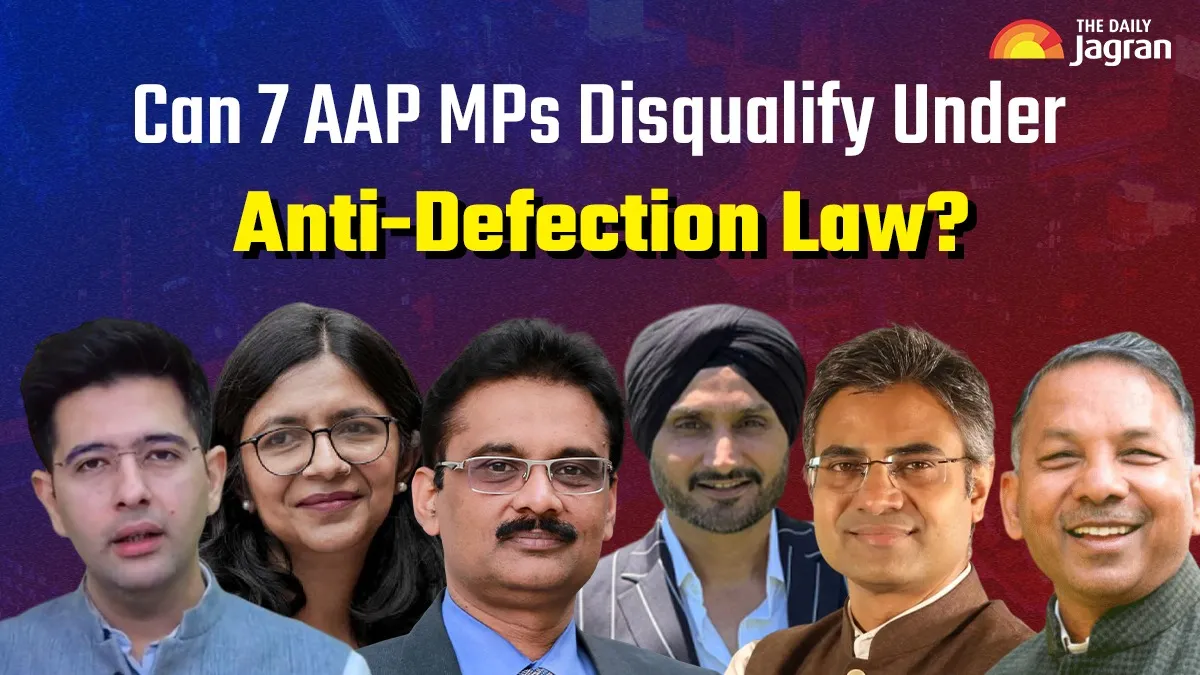
AAP MPs Row: With seven Aam Aadmi Party (AAP) MPs having merged with the Bharatiya Janata Party (BJP), two claims are flying in the air. While turncoats - Raghav Chadha, Sandeep Pathak, Ashok Mittal, Harbhajan Singh, Swati Maliwal, Vikramjit Sahney, and Rajinder Gupta - claimed that the tally (2/3rd of the total 10 AAP MPs in the Upper House) provides them immunity from disqualification from their posts under the Anti-Defection Law, Arvind Kejriwal's party said rebel leaders violate the law.
#WATCH | 2/3rd MPs of AAP in Rajya Sabha announce merging with the BJP.
— ANI (@ANI) April 24, 2026
AAP MP Raghav Chadha says, "There are 10 AAP MPs in the Rajya Sabha, more than 2/3rd of them are with us in this. They have signed and this morning we submitted the signed letter and documents to the Rajya… pic.twitter.com/mn4kuYs2ht
What Law Says
The matter falls under the Tenth Schedule to the Constitution of India, also known as the Anti-Defection Law and the Parliament (Prevention of Disqualification) Act, 1959 ( politically known as "Aya Ram Gaya Ram"), that disqualifies MPs or MLAs if they voluntarily resign from their party or vote against party instructions (whip). The Anti-Defection Law says that an MP does not automatically lose their seat if he/she is expelled by the party. MPs will also not be disqualified if 2/3rd of the total number merge with another party.
What Legal Expert Says
In the case of MPs, the decision is taken by the Lok Sabha Speaker or the Rajya Sabha Chairman. They decide whether disqualification applies according to the rules.
"Earlier, there was a 1/3 rule known as split, but it has now been removed. Now, only one valid exception exists to the merger. If at least two-thirds of the MPs of a party join another party, then disqualification does not apply," Ashish Chaubey, SC Advocate, explained.
If 7 out of these 10 MPs (2/3) merge with another party and submit a written memorandum of merger, then according to the above rules, their membership should remain valid, and they should not be disqualified, he added.
AAP Seeks Disqualification Of Rebel MPs
AAP leader Sanjay Singh on Saturday slammed party leaders who joined the BJP, calling it unconstitutional and against parliamentary rules. He alleged that the manner in which the MPs joined the BJP violated constitutional provisions and the anti-defection law.
Singh said, "Seven people announced joining the BJP in a manner that was unconstitutional, illegal, and against the rules. This is completely wrong legally."
ALSO READ: 'Rahman Dakait Of Delhi': BJP Reveals Arvind Kejriwal’s New ‘Sheesh Mahal’; AAP Issues Rebuttal
AAP's Explanation On Seeking Disqualification
AAP leader, citing the Anti-Defection Law, said the Constitution clearly states that any split or factional breakaway is not allowed in the Assembly, Rajya Sabha, or Lok Sabha, and has no constitutional validity. The rebel MPs' action is tantamount to voluntarily relinquishing membership of their original party under the Tenth Schedule of the Constitution, Singh explained.
Reiterating AAP's stand, Singh said the decision of the MPs was invalid and demanded strict action. "The seven Rajya Sabha MPs of the Aam Aadmi Party who have defected--this is illegal, wrong, unconstitutional, and against parliamentary rules," he said.
ALSO READ: AAP's Crisis To Worsen? Seven MLAs In Delhi Could Follow Raghav Chadha, Says Report
He further announced plans to escalate the matter to the Rajya Sabha Chairman. "That is why today I will write to the Chairman of the Rajya Sabha, the Hon'ble Vice President, citing all these rules, requesting that the membership of all seven of these Rajya Sabha MPs be terminated completely," Singh said.
मैं माननीय राज्यसभा सभापति को एक पत्र प्रस्तुत करूँगा, जिसमें राघव चड्ढा, अशोक मित्तल और संदीप पाठक को भारतीय जनता पार्टी (BJP) में शामिल होने के कारण राज्यसभा की सदस्यता से अयोग्य घोषित करने की मांग की जाएगी, क्योंकि यह संविधान की दसवीं अनुसूची के अंतर्गत स्वेच्छा से अपनी पार्टी…
— Sanjay Singh AAP (@SanjayAzadSln) April 24, 2026
Matter Likely To Reach Court
Similar issues have been seen in Maharashtra, which were resolved by the Supreme Court. The splits in Shiv Sena and NCP created confusion over the Anti-Defection Law. In the AAP case too, two versions of the law emerged, which may see a solution in the court or by the Chairman of the Rajya Sabha.
(With ANI Inputs)