
- By Brand Desk
- Wed, 27 May 2026 06:24 PM (IST)
- Source:JNM
India’s crypto market is undergoing a major structural transformation. What was once primarily a spot-driven retail market is increasingly becoming a futures-led ecosystem, mirroring a broader global shift in digital asset trading.
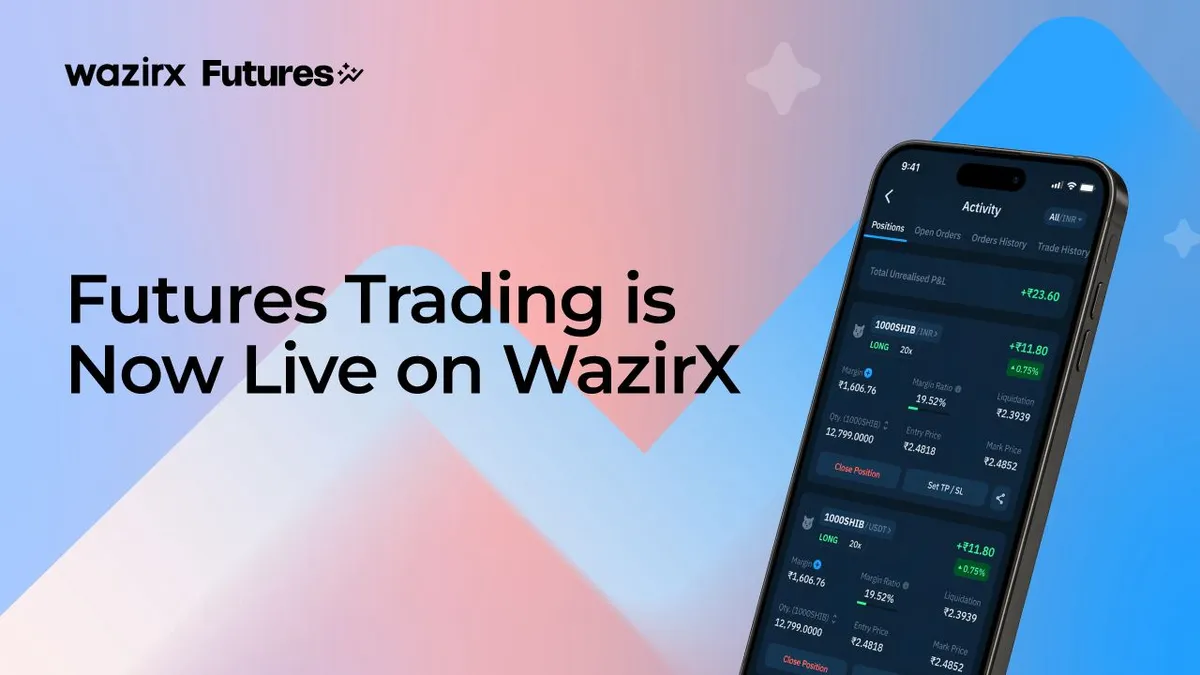
The launch of WazirX Futures reflects a broader market evolution rather than just a product expansion. WazirX’s new futures platform introduces one of the lowest fee structures among Indian crypto exchanges, with a maker fee of 0.02% and a taker fee of 0.04% without volume-based restrictions. More importantly, it enables direct INR access to futures products without requiring users to first convert funds into USDT.
Globally, crypto derivatives have become the dominant segment of the market. Industry estimates suggest crypto derivatives volumes reached nearly $85.7 trillion annually in 2025, with futures and perpetual contracts accounting for more than 70% of total crypto exchange activity. The shift is being driven by faster execution, deeper liquidity, leverage access, and the ability to trade global volatility in real time.
India is now seeing a similar transition but with uniquely local drivers. The turning point came in July 2022, when India introduced a 30% flat tax on virtual digital assets alongside a 1% TDS on crypto spot transactions. The move fundamentally altered trading economics for active retail users. Multiple industry reports indicated that spot trading volumes on Indian exchanges declined by as much as 85% after implementation.
For active traders, the issue was not just taxation but capital efficiency. Frequent spot traders found capital constantly locked due to TDS deductions on every transaction, significantly reducing available liquidity for high-frequency participation. As a result, a large segment of Indian traders began migrating toward futures and perpetual products, many of them on offshore exchanges.
Crypto futures offered several advantages:
- lower upfront capital requirements,
- leverage access,
- 24/7 exposure to global markets,
- no TDS on futures trades,
- and the ability to set off losses against gains in certain jurisdictions and structures.
However, a significant portion of India’s crypto derivatives activity historically moved offshore due to limited domestic infrastructure for futures trading. Global exchanges offered better liquidity, more advanced trading interfaces, leverage products, and institutional-grade tools that many Indian platforms lacked at the time.
WazirX’s approach also attempts to localise participation responsibly. Users complete mandatory knowledge checks covering leverage, margin, and liquidation risks before accessing futures trading. This reflects a growing recognition globally that derivatives participation must be paired with stronger risk disclosures, education frameworks, and operational safeguards.
"Globally, derivatives have become the dominant layer of crypto market activity, and India is now seeing a similar transition," said Nischal Shetty, Founder, WazirX. "Over the last few years, we’ve seen a meaningful shift in user behavior from long-term spot investing toward more active futures participation."
"The introduction of the 1% TDS significantly changed trading dynamics for Indian users. Many active traders found spot trading capital-inefficient, which accelerated migration toward derivatives products and offshore platforms," he added.
India’s futures market evolution is also increasingly intersecting with advances in AI-driven trading systems. Automated risk management, predictive analytics, dynamic stop-loss systems, and AI-powered market monitoring tools are becoming more accessible to retail traders. While institutional desks historically dominated algorithmic trading infrastructure, newer platforms are attempting to democratize access to advanced trading intelligence for retail participants.
For India, the larger opportunity may lie in building stronger local infrastructure that allows users to participate within compliant, transparent, and India-focused ecosystems rather than relying entirely on offshore platforms.
A large portion of India’s crypto activity has historically been driven by retail users. If domestic exchanges can combine lower fees, INR accessibility, stronger risk controls, improved liquidity, and better user education, India could emerge as one of the world’s most significant retail-driven crypto derivatives markets over the coming decade. The shift from spot to futures is no longer just a market trend. It is becoming the defining structural change in India’s crypto trading ecosystem.