

- By Aditya Pratap Singh
- Fri, 19 Jun 2026 08:17 PM (IST)
- Source:JND
rtificial Intelligence (AI) is not an alien word for most of the organised sectors, as the adoption of the new technology has been at its peak, especially over the past two years. On the NASSCOM AI Adoption Index, India scores 2.45 out of 4, showing that 87 per cent of enterprises were actively using AI solutions in 2025.
The journey has evolved further as nearly half of Indian enterprises (47 per cent) now have multiple Generative AI (GenAI) use cases live in 2026, and 76 per cent of business leaders believe that GenAI will have a significant business impact, according to an EY report.
The adoption is not limited to the tech and IT sectors. Banking, healthcare, hospitality, governance and all major sectors are betting big on AI and AI tools, and the transportation industry is not untouched either, as the sector chases something beyond GenAI.
According to experts, as the global transportation industry moves toward greater automation, researchers and technology companies are shifting their focus to one of the big challenges ahead for AI–perception.
While advances in generative AI and large language models have captured public attention, experts say the future of autonomous vehicles, intelligent transportation networks, robotics, and smart mobility systems will depend heavily on how effectively machines can understand and interpret the physical world around them.
AI perception refers to a machine's ability to identify objects, understand surroundings, estimate depth, recognise patterns, and respond to changing environmental conditions in real time. Unlike controlled digital environments, roads present a constantly changing set of variables. Traffic patterns shift by the second, weather conditions affect visibility, pedestrians behave unpredictably, and infrastructure conditions vary across locations.
Industry experts believe perception technology will play a central role in determining how quickly intelligent mobility solutions can be deployed at scale.
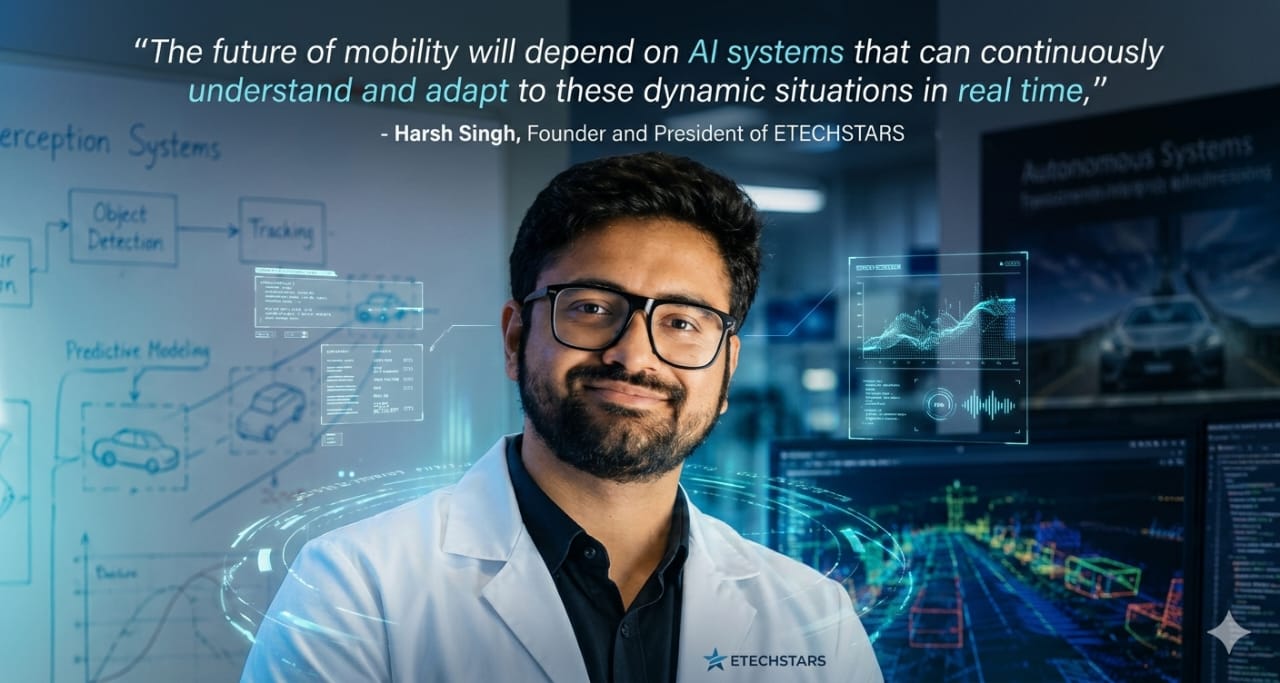
"Transportation environments are among the most complex operating conditions for artificial intelligence. Every second, vehicles must interpret changing traffic patterns, weather conditions, road users, and unexpected events. The future of mobility will depend on AI systems that can continuously understand and adapt to these dynamic situations in real time," said Harsh Singh, Founder and President of ETECHSTARS.
Growing investment in intelligent transportation systems has placed greater emphasis on technologies that improve environmental awareness and decision-making, and companies working in this area are exploring ways to help machines process visual information more efficiently and respond more accurately to real-world conditions.
"The next decade of innovation in transportation will be defined by perception-driven intelligence. Whether it is commercial fleets, autonomous vehicles, robotics, or smart infrastructure, systems that can accurately perceive and predict their surroundings will play a critical role in improving safety, efficiency, and operational reliability," Harsh Singh added.
AI Perception Design: An Investment Bet For Companies
Several technology companies are now investing in AI perception platforms designed to improve situational awareness across mobility applications.
Experts argue that advancements in perception technology could help address some of the most significant barriers facing future mobility solutions. Improved environmental understanding may contribute to safer navigation, better traffic management, reduced operational risks, and more efficient transportation networks.
The challenge, however, remains substantial as Unlike language-based AI systems that operate primarily in digital environments, perception systems must continuously interpret physical surroundings where conditions can change without warning.
"This requires the integration of computer vision, machine learning, sensor intelligence, and real-time decision-making capabilities," Harsh stated.