- By Aditya Pratap Singh
- Mon, 07 Sep 2026 03:45 PM (IST)
- Source:PTI
- India's battery industry is expected to create 1.5-2 million jobs.
- Shift from import-assembly to full domestic manufacturing and recycling
- Karnataka and Gujarat to lead hiring in the battery sector.
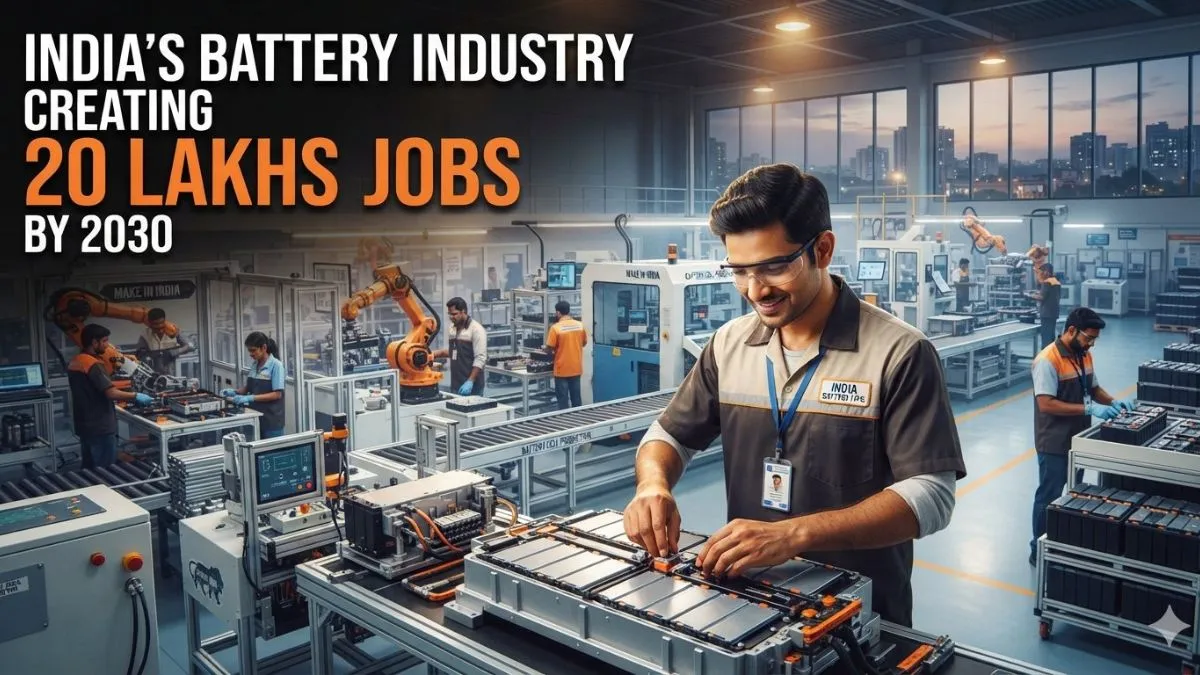
India’s battery industry is moving ahead from the phase of importing and assembling lithium-ion cells, as companies are now entering the full-on manufacturing phase along with building a recycling ecosystem. With this, the country's battery industry is expected to generate 1.5-2 million jobs–15-20 lakhs jobs– by 2029-30 as it enters its most capital- and employment-intensive phase.
According to talent company Adecco India, the sector is evolving from an assembly-and import-dependent sector into a fully integrated cell-to-recycling industrial ecosystem.
India's battery industry is moving from importing and assembling lithium-ion cells to manufacturing batteries domestically, spanning from cells to complete battery packs and recycling, Adecco India Director and Head of General Staffing Deepesh Gupta told PTI.
2 Million Jobs By 2030: The industry could create 1.5-2 million jobs by 2030, with about 25 per cent direct jobs and 75 per cent indirect jobs, with hiring expected to grow by 25-30 per cent annually, according to Adecco India.
Hiring Cluster: Karnataka, Telangana, Gujarat And Haryana
Gigafactory clusters continue to be the primary employment engine for the sector, concentrated in Karnataka, Telangana, Gujarat and Haryana.
Over 70 per cent of total hiring demand is concentrated across these clusters, with 30 per cent of new mandates expected to originate from tier II and III industrial corridors as component parks, battery recycling facilities and supplier ecosystems mature around the anchor gigafactories.
Also Read: GST Council Meeting Rescheduled To October 7 Due To BRICS Summit; Registration Reforms On Agenda
Karnataka, Gujarat Lead Hiring
State-wise, Karnataka and Gujarat are expected to account for the largest share of this hiring at 24 per cent and 22 per cent respectively, followed by Telangana (18 per cent) and Haryana (14 per cent), as cell manufacturing, pack assembly and ancillary supplier capacity scales across these clusters.
The Cell Manufacturing and Battery Components segment will account for the largest share of hiring (42-45 per cent). Recycling and materials recovery are becoming central to the sector's workforce planning as hiring in this segment is projected to grow by 25-30 per cent.
This insight about the battery industry by Adecco India is based on inputs from its over 30-client base in the country. Further, Adecco India revealed that recruitment in the industry will tilt toward more skilled professionals in electrochemistry, materials science, battery engineering, manufacturing, and recycling.
"With battery manufacturing capacity currently at around 60 GWh and expected to approach 100 GWh by the end of 2026, along with upcoming gigafactory investments in Gujarat, Karnataka, Haryana and Telangana, the sector is moving beyond assembly and building the depth of a full industrial ecosystem," Gupta said.
Atmanirbhar Bharat: A Catalyst For Domestic Manufacturing
Catalysing the vision of ''Atmanirbhar Bharat'', this localisation drive, supported by the Critical Minerals Mission and India's participation in the Quad Critical Minerals Initiative Framework, will reduce the country's reliance on imported cells and refined materials, while creating employment opportunities across established manufacturing hubs and emerging tier II and III industrial corridors, he added.
Lithium Battery manufacturing is expected to contribute 50-60 per cent of India's projected green manufacturing jobs by 2030, with specialised battery engineering talent commanding salary premiums of up to 35 per cent to 40 per cent over conventional manufacturing and electronics roles.
India's battery manufacturing is now translating into plant-level capacity. Under the PLI Scheme for Advanced Chemistry Cells, the government has committed Rs 18,100 crore to develop 50 GWh of domestic ACC manufacturing capacity, with an additional 5 GWh reserved for niche chemistries.
Disclaimer: This story has been published from an agency feed with changes in the intro, the headlines, and the order of content. Except for the headline and intro, no changes have been made by 'The Daily Jagran Staff'.