
- By Pawan Mishra
- Fri, 21 Aug 2026 05:57 PM (IST)
- Source:JND
Normal Petrol Vs Power Petrol: Vehicle owners are often confused about the difference between Normal Petrol and Power Petrol. Power petrol is a high-grade fuel type that is advised to be used in vehicles running on a turbocharged engine. The debate around various fuel products, ethanol-blended petrol, and fuel efficiency has grown over the last few months, since the government has mandated the sale of E20 (petrol blended with 20 per cent ethanol) across the country.
Normal Petrol Vs Power Petrol: The Difference
Normal Petrol Vs Power Petrol | ||
Feature | Normal Petrol | Power Petrol |
Price (Delhi) | ₹102.12 per litre | ₹109.24 per litre |
Fuel Efficiency | Standard | Up to 3.95 per cent increase with compatible vehicle (Indian Oil) |
Octane Rating | 91 RON | 95 |
Ethanol Percentage | 20 per cent | 20 per cent |
Engine Knocking Resistance | Standard | High Resistance |
Additives | Standard Detergents & Basic friction Modifiers | Polyetharamine Cleaning Agents & Advanced friction modifiers |
Best Suited For | Naturally Aspirated (NA) Petrol Engines | Turbocharged Engines |
Disclaimer: Petrol prices may vary depending on the state. Mentioned prices reflect fuel prices in Delhi.
Normal Petrol Vs Power Petrol: Which Option Is Better For Turbo Engine?
Considering the benefits provided by power petrol, many might believe that it is the right choice for all kinds of vehicle owners. However, that's not the case.
Premium petrol requires higher heat and more than normal petrol. Naturally Aspirated (NA) petrol engines produce a lower amount of heat and pressure. Thus, an NA engine can't fully utilize its potential.
Turbocharged engines, on the other hand, produce a higher amount of heat and pressure, and they fully utilize the potential of premium petrol. Thus, it is advised to be used with Turbocharged engines.
Which Option Has Less Ethanol?
The Ethanol-blended petrol (EBP) has remained a hot topic across the country over the last few months. Older vehicle owners are looking out for fuel alternatives without an ethanol blend. In fact, ‘How Much Ethanol Is In Xp95 Petrol?’ has become one of the most searched queries on Google. The government has mandated blending all types of petrol with ethanol, except for the Xp100 petrol. Thus, the regular petrol, along with premium petrol types, has the same percentage of ethanol, i.e., 20 per cent.
Also Read: BMW X1 LWB Launch Today: Dual Screens, Autonomous Parking, And More Expected
Which Petrol Type Is Better?
The regular petrol contains standard detergents and basic friction modifiers. Due to this, carbon deposits can accumulate on internal parts of the engine. Additionally, it provides standard engine knocking resistance due to a lower octane rating. The more premium power petrol, on the other hand, has a higher octane rating with better engine knocking resistance. Additionally, it cleans internal parts of the engine with advanced friction modifiers and polyehtaramine cleaning agents.
What Does Engine Knocking Mean?
Engine knocking happens when fuel burns in small pockets instead of proper combustion. In simpler words, the fuel needs to burn properly for the engine to function smoothly. When fuel and air mix in such a way that the fuel struggles to burn completely and starts exploding in small pockets. These explosions end up in vibrations and unusual sounds from the engine chamber, and this is called engine knocking.
Which One Offers Better Mileage?
It is worth noting that the fuel efficiency of a vehicle depends on different factors, including driving style, vehicle maintenance, usage of air conditioning, and more. Thus, fuel efficiency delivered by any particular fuel type can’t be claimed. However, IndianOil Corporation Limited (IOCL) claims that Xp95 (IOCL’s version of premium petrol) gives an additional 3.95 per cent of mileage depending on the vehicle.
Also Read: Tata Avinya EV To Launch This Year? Here’s What We Know So Far
Why Is Power Petrol More Expensive?
As mentioned earlier, power petrol includes several advanced friction modifiers, cleaning agents, and a higher octane rating. While the addition of all of these features makes the fuel alternative a better one, they also increase its price.
Conclusion
Many think that using premium petrol with a Naturally Aspirated (NA) engine might increase the mileage. However, that might not be the case as mentioned above. In my own opinion and experience in the automotive industry, I will not suggest anyone use premium petrol for a NA engine because of these two main reasons:
Cost: Petrol prices were hiked in the country in May 2026, and it has been trading above ₹100 across the entire country since then. Premium petrol costs ₹7.12 more than regular petrol; it is not worth spending additional money to expect enhanced mileage unless the fuel type is not highly compatible with the vehicle.
Full Potential: As mentioned above, premium petrol has a higher resistance against heat and pressure generated by the engine. Thus, it is advisable to use the fuel with an engine that can utilize its full potential, especially if you’re spending extra money on it.
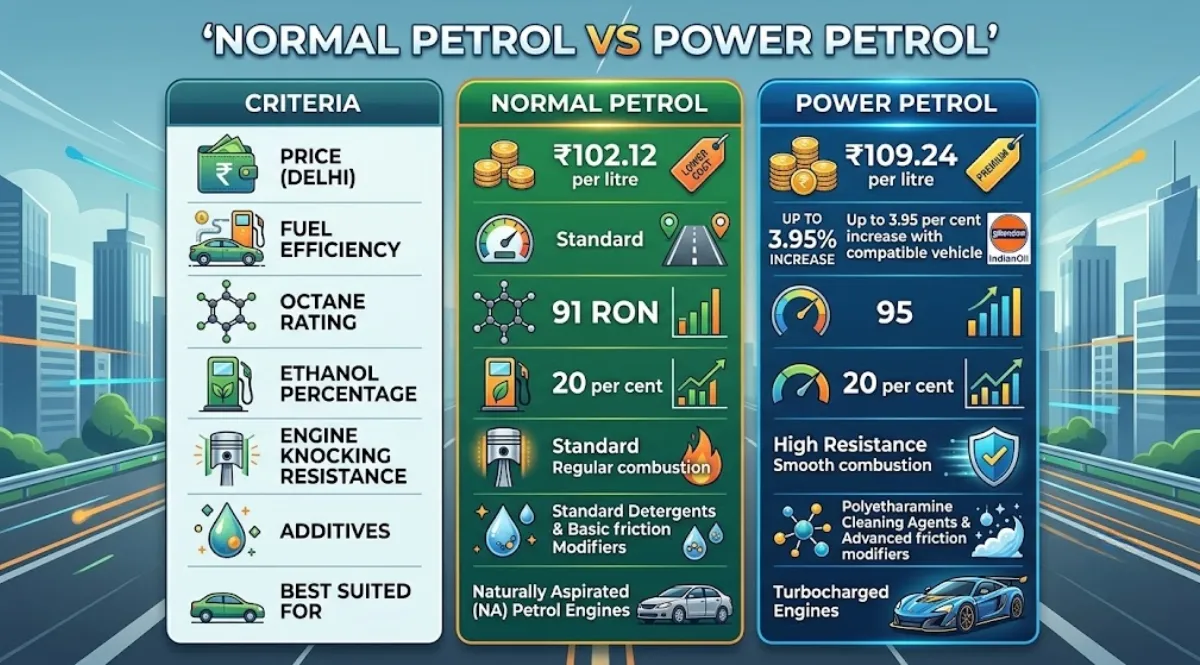
Image Credit: AI
FAQs
What is the difference between normal petrol and power petrol?
Normal petrol has a lower octane rating, and it features standard additives. The power petrol, on the other hand, features advanced cleaning agents and has a higher octane number.
What is the price of power petrol in India?
Prices vary depending on the state in India. Different power petrol products are named differently by Oil Manufacturing Companies, he Xp95 is currently priced at ₹109.24 in Delhi.
Who should use power petrol?
Power petrol is advised to be used with a turbocharged engine, as they utilize it to full potential. Additionally, power petrol’s properties make it highly compatible with turbo-powered engines.