
- By Pawan Mishra
- Mon, 01 Jun 2026 04:28 PM (IST)
- Source:JND
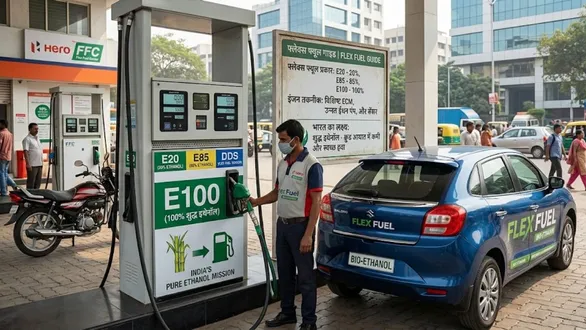
E100 Fuel Meaning: This week will mark a historic inflection point in the Indian automotive landscape. On June 3, the largest two-wheeler manufacturer in India will take the wraps off its first flex-fuel motorcycle, followed by the launch of the first flex-fuel car from Maruti Suzuki, the largest car manufacturer in the country, on June 4. India’s transition to flex-fuel is spearheaded by the Union Minister of Road Transport and Highways, Nitin Gadkari, and the government has also made significant amendments for vehicle testing. While India is stepping up to the flex-fuel vehicles, many are unaware of the technology behind the concept. In this comprehensive explainer, we will break down core questions, such as what flex fuel is. What are the different types, and why is India pushing for the adoption of pure Ethanol cars?
What Is Flex Fuel?
In simpler words, Flex fuel is a blend of two types of fuel, and it acts as an alternative to traditional fuel types, such as petrol and diesel. Flex fuel can be obtained by blending petrol with an oxygenate, such as Ethanol or Methanol. While a petrol-ethanol blend is the most common flex-fuel type, methanol-blend petrol is rare, and currently, China is the largest user of Methanol fuel blends and uses M15 and M30 blend standards. Damage to the engine metal and plastics, along with phase separation, are some of the most common risks associated with Methanol blend fuel, and thus, most of the major global automotive manufacturers prefer ethanol blend petrol. Vehicles that run on flex-fuel are called Flexible-Fuel Vehicles (FFVs), and they feature a modified internal combustion engine and specialised powertrain components.
Also Read: India Records Highest-Ever Monthly EV Sales; More Than 26,000 Electric Cars Registered
Types Of Flex Fuel
As mentioned earlier, the most common type of flex fuel is the Ethanol-blended petrol, which is Ethanol mixed with petrol in a certain ratio. Different types of flex fuel simply mean different percentages of Ethanol blended with petrol. Retail petrol pumps in India offer up to E20 blend fuel. E20 simply means 20 per cent of ethanol blended with 80 per cent of petrol. Now, the country is planning to roll out E30 fuel blends, which will contain 30 per cent of Ethanol and 70 per cent of petrol. The Indian Ministry of Road Transport and Highways has recently amended the Central Motor Vehicle Act 1989 to include E85 and E100 in the regulatory framework.
Also Read: The Legend Returns! 2026 Mitsubishi Pajero Teased, Land Cruiser Rival Launch Confirmed For 2026
Flex Fuel: Pros & Cons
Flex fuels also have their own set of pros and cons. Beginning with the positives, Ethanol-blended fuel burns cleaner than pure petrol, essentially emitting reduced greenhouse gases. Additionally, Ethanol can be produced from agricultural waste, sugarcane, or corn. This makes it a renewable fuel and also supports the farm economy of a country. Moreover, Ethanol costs are lower when compared to regular petrol, resulting in cost savings. Moving to the negatives, a higher ethanol blend can result in reduced fuel economy of a vehicle. Scientifically speaking, Ethanol has a lower energy density per unit volume than gasoline. In simpler words, to generate the same amount of power, the engine will need to burn more ethanol as it has a lower energy density. Another downside of using ethanol-blended fuel is that it can make engine starting difficult in cold weather, as it requires more heat for vaporisation.
Also Read: 2026 Honda City Facelift Video Review: This Hybrid Sedan Gives 28 KMPL?
Why India Is Pushing For Ethanol?
The Indian government is rapidly making changes to adopt higher ethanol blend standards in the country. To begin with, the country currently imports more than 89 per cent of its fuel demand. While this makes us more reliant on other countries for our fuel needs, it also reduces our foreign exchange. Additionally, India is moving towards cleaner fuel options, and Ethanol presents itself as a viable alternative. Lastly, India is an agricultural country. Ethanol production will boost the rural economy of the country, resulting in increased employment opportunities and a secondary market for farmers.
Also Read: Hero Motocorp First Flex-Fuel Motorcycle Launch On June 3; Here’s What To Expect
First Flex Fuel Car Of India
As mentioned earlier, Maruti Suzuki, the largest car manufacturer in India, will be revealing its first flex-fuel car on June 4, 2026. The brand has not yet shared the exact details of its first flex-fuel car. However, we expect it to be either the Maruti Suzuki Wagon R Flex-Fuel or the Maruti Suzuki Fronx Flex-Fuel. Both of these vehicles were showcased at the Bharat Mobility Global Expo 2025. Union Minister for Road Transport and Highways, Nitin Gadkari, will be launching the first flex-fuel car in India on June 4. The exact ethanol blend rating of the vehicle has not yet been shared, but we expect it to support up to E100 (100 per cent Ethanol) blend fuel.
Also Read: Maruti Suzuki Flex-Fuel Vehicle Launch On June 5; Here’s All That Can Be Expected
First Flex Fuel Bike Of India
Hero Motocorp, the largest two-wheeler manufacturer in India, will also be launching its first flex-fuel motorcycle in the country on June 3, 2026. The motorcycle will be launched in the presence of Union Minister of Road Transport and Highways, Nitin Gadkari, and the Minister of Petroleum and Natural Gas, Hardeep Singh Puri. The brand has not yet revealed the name or any details of its first flex-fuel motorcycle. However, as per reports, we can expect it to be one of the brand’s most popular motorcycles. We expect it to be either the Hero Splendor or the Hero HF Deluxe. The brand had showcased its first flex-fuel motorcycle at Bharat Mobility Global Expo 2025, and it was based on the HF Deluxe. We expect the first Flex-Fuel motorcycle in India to support up to E85 blended fuel.