
- By Prateek Levi
- Sun, 22 Feb 2026 03:00 AM (IST)
- Source:JND
Astronomers have found what could be one of the most extreme galaxies that have ever been discovered, and it is a faint galaxy that is almost entirely made up of what scientists refer to as dark matter. This galaxy, named CDG-2, is located in the Perseus Cluster, which is about 300 million light years away from our planet. It is not just the distance that makes this galaxy so interesting, but the fact that we can’t see much of it.
ALSO READ: Vivo X300 FE Reportedly Surfaces On IMDA And TUV Databases; Hardware Details Leak
The discovery was led by Dayi David Li from the University of Toronto, using observations gathered from the Hubble Space Telescope, the Euclid mission of the European Space Agency, and Japan’s Subaru Telescope.
Finding a galaxy without looking for its stars
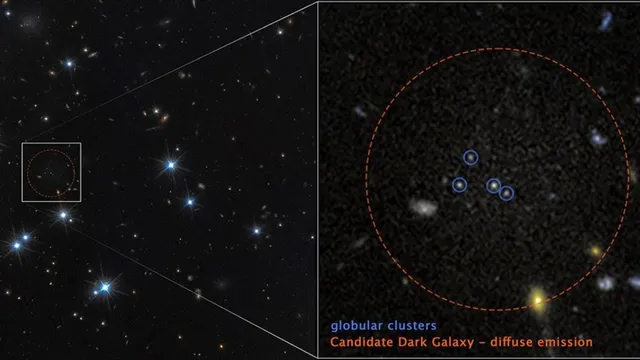
What is unusual about this discovery is how it was made. Rather than looking for the glow of stars, scientists looked for globular clusters. These are tight balls of stars that orbit galaxies like satellites. In areas of space like the Perseus Cluster, where stars are packed tightly, finding these small clusters of stars can sometimes be an indication of a much larger one hiding in the darkness.
Using combined data from Hubble, Euclid, and Subaru, the team identified four unusually dense globular clusters. When they overlaid images from the three telescopes, they detected a faint halo of light surrounding them. That faint glow turned out to be CDG-2 itself.
Recommended For You




A galaxy dominated by dark matter
Further analysis showed just how extreme this galaxy is. CDG-2 emits as much light as only about six million Suns, which is extraordinarily dim by galactic standards. Around 16 percent of that light comes from its globular clusters. More striking, however, is its mass composition. Researchers estimate that roughly 99 percent of its total mass is dark matter.
According to Li, this is the first galaxy ever identified purely through its globular clusters rather than through its main body of stars. In other words, astronomers effectively traced the outline of something nearly invisible.
ALSO READ: ChatGPT Introduces New Lockdown Mode And Risk Alerts: What Is It All About?
The team believes CDG-2 may have lost most of its gas long ago due to gravitational interactions within the Perseus Cluster. Without gas, star formation would have stalled, leaving behind a ghostly structure made up largely of dark matter and a handful of star clusters.
Looking ahead, future surveys with tools such as the NASA Nancy Grace Roman Space Telescope and the Vera C. Rubin Observatory may uncover more galaxies like CDG-2. If so, scientists may gain further insight into the role of dark matter in the universe on large scales.