
- By Raju Kumar
- Sat, 07 Mar 2026 06:49 PM (IST)
- Source:JND
US-Iran War: In what is seen as a delicate balancing act, Iran, in a surprising move, apologised to its neighbours after raining missiles and drones on them on Saturday. Iranian President apologised for attacks on regional countries even as its missiles and drones flew toward Gulf Arab states, following airstrikes across Iran by the US and Israel jointly. The softening approach came after marking one week of the war as the Islamic Republic's armed forces carried out intense strikes in the Middle East, targeting US bases and other key installations.
The message from President Masoud Pezeshkian, one member of a tripartite leadership council overseeing Iran since a February 28 airstrike starting the war, killed Supreme Leader Ayatollah Ali Khamenei, again underlined the limited powers being exercised by theocracy's leaders over its paramilitary Revolutionary Guard.
Iranian President Calls For Diplomatic Solution
"I should apologise to the neighbouring countries that were attacked by Iran, on my own behalf," the president said. "From now on, they should not attack neighbouring countries or fire missiles at them, unless we are attacked by those countries. I think we should solve this through diplomacy," he added.
US Says More Intense Bombing Lies Ahead
However, on the other side, the US hints at intensifying the ongoing war with American President Donald Trump saying he would not negotiate with Iran without its "unconditional surrender". US Treasury Secretary Scott Bessent said in a television interview on Friday that the "biggest bombing campaign" of the war was still to come.
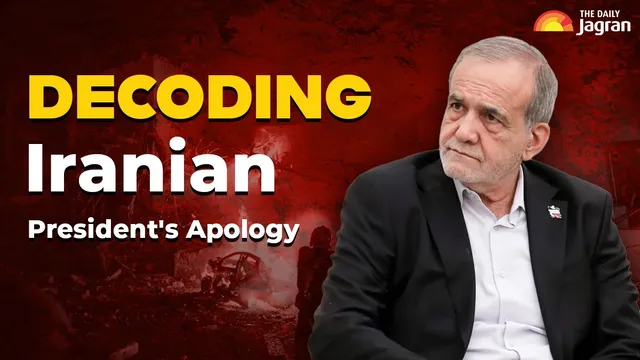
Decoding Iranian President's Apology
Now, the question arises as to why the President apologised to the neighbouring countries amid intense war in which over a thousand Iranians were killed in the US-Israel attacks. Is it a turning point of the week-long war or a tactic to test the water? Iran made its surrounding countries - the UAE, Qatar, Bahrain and Saudi Arabia - enemies by attacking them in response to the joint US-Israel bombing, in which it lost its Supreme Leader Ruhollah Khomeini and other senior leaders.
It looks like Tehran desires good relations with the Gulf countries because the war-torn country is already weakened by losing its top leadership in the war. A further increase in hostility with its neighbours risks economic losses, which are already in a fragile state. No country has so far provided open support to Iran; hence, Tehran fell into isolation. By saying it would attack passing merchant ships in the Strait of Hormuz, Iran upsets oil-importing nations, which added another dimension to the conflict against Tehran.
Oman and Qatar, which have previously mediated, were also attacked in the last couple of days. Iran understands that only its neighbouring countries can bring peace by mediating, as they are partners of the US. With the apology, Iran signalled that it would accept mediation efforts if any neighbouring country came forward, as the war was costing all oil-exporting nations dearly. The oil trade is their prime source of income, and a long war can damage their economy as well.
Meanwhile, the fighting has killed at least 1,230 people in Iran, more than 200 in Lebanon and 11 in Israel, according to officials in those countries. Six US troops have been killed, resulting in a huge loss of oil trade in the other Gulf countries.
(With Agencies inputs)