
- By Ajeet Kumar
- Tue, 09 Jun 2026 08:20 AM (IST)
- Source:JND
- US judge blocks Trump's $100,000 H-1B visa fee.
- Decision brings major relief for Indian tech professionals.
- Fee deemed unlawful tax, not authorized by Congress.
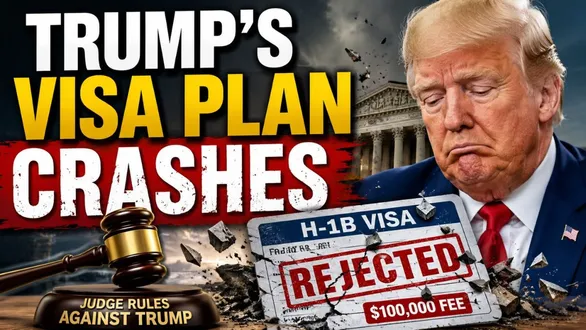
In a major relief for lakhs of Indians seeking H-1B visa, a Barack Obama-appointed judge has thrown out a massive USD 1,00,000 tax imposed by the Trump administration on those seeking entry into America for highly skilled jobs. The federal judge termed it “unlawful” and threw out the logic that the prosecutor said: it was a “penalty”, not the tax imposed by the administration.
While hearing the case, the judge referred to the February ruling when the court declared that the Trump administration has no authority to impose reciprocal tariffs on countries which are trading with America for decades.
What is H-1B visa program?
The H-1B program offers 65,000 visas annually, with another 20,000 visas for workers with advanced degrees, approved for three to six years. Employers seeking a visa for a foreign worker before Trump's proclamation typically paid about USD 2,000 to USD 5,000 in fees, depending on various factors.
What judge said
US District Judge Leo Sorokin in Boston issued the ruling in a lawsuit filed by 20 Democratic state attorneys general challenging a fee Trump announced in September that dramatically raised the cost of obtaining H-1B visas, which tech companies in particular rely heavily on to bring in foreign workers.
The administration argued the fee constituted a lawful monetary penalty that the president was authorised to impose under federal immigration law, which gives him the power to restrict the entry of certain foreign nationals when he deems it "detrimental to the interests of the United States."
But Sorokin concluded that the fee was not a penalty but a tax that the Republican president lacked any authorisation from Congress to issue, and that the US State Department and US Citizenship and Immigration Services could not implement.
"Here, the substance and application of the USD 1,00,000 payment reveal that it is a tax, regardless of what the payment is called," wrote Sorokin.
Judge derives a parallel from the tariff ruling
The judge cited the US Supreme Court's February ruling striking down Trump's sweeping tariffs, which he pursued under a law meant for use in national emergencies. Under the logic of the justices' decision in that case, Trump similarly had no authority under immigration law to levy a tax, Sorokin said.
Trump, in imposing the hefty new fee, in a proclamation said the H-1B program "has been deliberately exploited to replace, rather than supplement, American workers with lower-paid, lower-skilled labour."
What it means for Indians
Indian nationals historically receive nearly three-quarters of all approved H-1B visas annually. The judge’s decision has massive, immediate implications for Indian IT professionals, students, and tech giants:
1. When the USD 1,00,000 fee was introduced, it acted as a functional ban, throwing the career plans of thousands of young Indian tech graduates and professionals into absolute chaos. By reverting the baseline costs to the original range of $2,000 to $5,000, the entry barrier has been lowered overnight, restoring a viable pathway to the US job market.
2. Indian IT bellwethers like TCS, Infosys, and Wipro rely heavily on the H-1B program to deploy skilled personnel to US client sites. Paying USD 1,00,000 per new visa would have completely destroyed their operating margins and forced massive structural changes. The ruling allows these companies to resume standard workforce planning without catastrophic overhead costs.
3. Level playing field
While massive tech conglomerates like Google or Amazon might have been able to absorb localised fee spikes, mid-sized firms, smaller US companies, and startups simply could not. Because smaller firms can afford to sponsor foreign talent again, Indian applicants are no longer limited to a tiny handful of ultra-wealthy corporate sponsors.
(With inputs from Reuters)
You may also like to watch