
- By Shivangi Sharma
- Tue, 03 Feb 2026 07:54 PM (IST)
- Source:JND
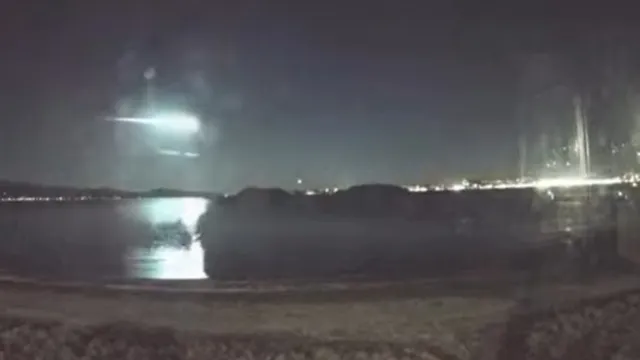
A mysterious glowing “fireball” streaking across the night sky left residents of New Zealand’s capital region stunned, triggering online speculation over whether the dazzling sight was a meteor or falling space debris. The unusual moment was captured live on a webcam at the Heretaunga Boating Club near Wellington and later circulated widely on social media.
The footage was first shared by PredictWind, a leading global marine forecaster, which described the phenomenon as a meteor illuminating Wellington’s night sky.
The video begins with a dark, calm skyline before a bright circular glow suddenly appears. Within seconds, the object transforms into a long, luminous tail as it moves rapidly across the sky, reportedly entering over the Eastern Hutt Hills around 10 pm on January 30. The rare green fireball remained visible for several seconds, lighting up the skies over Wellington and especially Lower Hutt.
View this post on Instagram
Meteor: The Most Likely Explanation
Early assessments indicate the spectacle was most likely caused by a meteor, a small fragment of space rock burning up as it entered Earth’s atmosphere. According to experts, the green hue can occur when elements such as nickel or oxygen are heated intensely during atmospheric entry. Although meteors are often no larger than pebbles, friction can make them appear extraordinarily bright before they disintegrate high above the Earth.
Similar green streaks were also reported from Manawatū-Whanganui earlier the same evening, raising the possibility that either multiple meteors entered the atmosphere or a single object travelled across several regions during its descent.
Could It Have Been Space Debris?
Another theory suggests the light may have been caused by space debris re-entering Earth’s atmosphere. With decades of space exploration, Earth’s orbit has become increasingly congested. The European Space Agency estimates that more than 6,000 launches have placed tens of thousands of objects into orbit, many of which are now defunct.
Old satellites, discarded rocket parts and collision fragments can fall back toward Earth, sometimes producing fiery trails that closely resemble meteors.
As the BBC noted, even clear video clips rarely provide enough information for definitive identification. For now, the glowing fireball remains an awe-inspiring reminder of both nature’s cosmic displays and the growing clutter in Earth’s orbit.