
- By Raju Kumar
- Fri, 06 Feb 2026 07:31 PM (IST)
- Source:JND
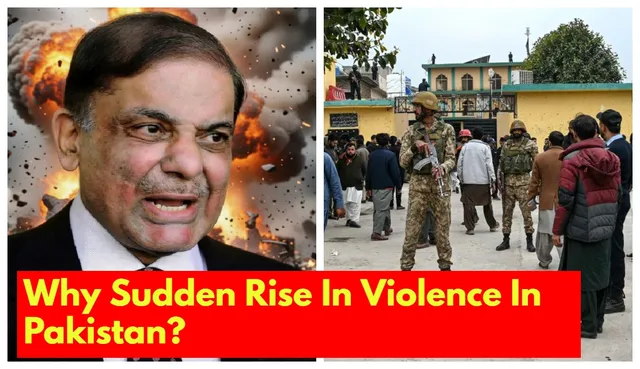
Islamabad Mosque Blast: A massive suicide bomb blast rocked Pakistan's national capital, claiming at least 31 people's lives and leaving over 160 injured, highlighting the loosening grip of Prime Minister Shahbaz Sharif over law and order in the country. According to news agency, PTI, a suicide bomber detonated himself at an Imambargah mosque during the 'Friday prayer' in Terlai Imambargah, located in the Shehzad Town.
Pakistan has a long history of violence, but in the last couple of days, people in the South Asian nation saw a sudden rise in violent incidents that created panic among people in the debt-ridden country. Recently, people witnessed a sharp surge in violence, particularly in Khyber Pakhtunkhwa (KP), Balochistan, border regions and now in the capital city.
ALSO READ: Why Mosque Attacks Persist In Pakistan Despite Being A Muslim-Majority Country; Explained
According to the Islamabad-based Pakistan Institute for Conflict and Security Studies (PICSS), the year 2025 was one of the deadliest years, and January 2026 alone saw a 43% increase in conflict-related deaths.
Though the reasons for the rise of violence are multidimensional, a combination of militant insurgency, separatist attacks, and government counter-operations are responsible.
Here Are The Key Five Reasons For Spike In Violent Incidents In Pakistan:
- Tehrik-i-Taliban Pakistan (TTP): Since the Taliban returned to power in Afghanistan in 2021, the TTP has expanded rapidly across Pakistan and strengthened itself with new recruits. Under the Taliban rules, Afghanistan allegedly became a safe haven for TTP and TTP militants managed to intensify drone attacks, suicide bombings, and other attacks on security forces in KP and border areas. In response, Pakistan, on several occasions, launched airstrikes on TTP camps in Afghanistan, deteriorating ties with the neighbouring country.
- The Baloch Separatist Insurgency: Rebellion outfits like the Balochistan Liberation Army (BLA) have carried out sophisticated and large-scale attacks, including train hijackings, police station attacks, suicide bombings, and targeting Chinese interests, leading to mass killings by the Pakistan armed forces. The rebel in the Baloch region was fueled by resentment over resource exploitation, neglect of local populations, and anger against CPEC projects.
- Political Instability: Since Shahbaz Sharif returned to power, Pakistan entered political instable era, where the top opposition leaders, including Imran Khan were put behind bars. A divided government have weakened the state's unified response to the rising domestic challenges. The weak governance has allowed militants to exploit local grievances for recruitment and launch anti-government operations.
- Border Tensions With Afghanistan: Pakistan often accuses the Taliban government of supporting the TTP, leading to border clashes, airstrikes, and direct confrontations. In late 2025, both neighbouring countries engaged in armed conflict in which hundreds of people living near the border died. Pakistan and Afghanistan resorted to armed attack after “precision” airstrikes inside Kabul.
- Terror Heavens: Pakistan is home to several terror groups. They don't have uniformity or a single ideology, and they launch attacks against each other to establish their supremacy in Pakistan. The coordination among the TTP, BLA, and other groups, along with sectarian and other forms of violence, has further complicated the situation. In the mess, common people become prey in their power struggle.