
- By Priyanka Koul
- Fri, 06 Mar 2026 11:24 AM (IST)
- Source:JND
Iran-Israel War: Seven days into the escalating conflict, Iran continues to strike Israel, the United States and Gulf nations following the killing of its Supreme Leader, Ayatollah Ali Khamenei, in joint airstrikes carried out by Washington and Tel Aviv. Since Saturday, Tehran has launched thousands of unmanned aerial vehicles (UAVs), signalling that the confrontation is far from slowing down.
As the attacks continue, analysts and military experts are increasingly raising concerns that the United States and Israel could begin running short of missile interceptors needed to neutralise Iran’s drones and ballistic missiles, which are being launched in large numbers.
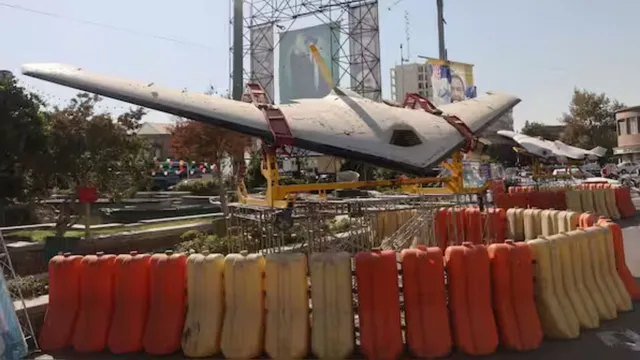
Both sides have relied heavily on missiles, drones and precision-guided bombs throughout the conflict. However, one weapon in particular has drawn widespread international attention: Iran’s Shahed-series drones. These drones are significantly cheaper to produce compared to the expensive missile systems required to intercept them.
This has triggered a growing debate among defence analysts, 'Is Iran gaining the upper hand in the drone war against the United States and Israel?
The United States and Israel are reportedly carrying out extensive bombing campaigns across Iran. Washington has also deployed the low-cost unmanned combat attack system (Lucas) drones in combat for the first time.
However, according to a Firstpost report, the availability of these drones remains limited. Each Lucas drone costs about $35,000 (Rs 32.1 lakh) and has reportedly been reverse-engineered from Iran’s Shahed-136, often described as the “poor man’s cruise missile”.
At the same time, Iran has continued its barrage against Israel while also targeting US military assets across West Asia and the Gulf. Tehran has launched hundreds of ballistic missiles and drones towards nearly a dozen countries that host American military bases and personnel.
Iran has managed this sustained campaign through a decentralised command structure, a strategy it refers to as the “Mosaic Defence”.
“We’ve had two decades to study defeats of the US military to our immediate east and west,” Iranian foreign minister Seyed Aragashi wrote on X. “We’ve incorporated lessons accordingly. Bombings in our capital have no impact on our ability to conduct war. Decentralised Mosaic Defence enables us to decide when – and how – war will end.”
Late on Thursday, Kuwait, Bahrain and the United Arab Emirates were also targeted in Iranian strikes. In a post on social media, the Kuwaiti army’s general staff said the country’s air defence systems were intercepting projectiles within its airspace.
According to CNBC, US officials claim that Iran had launched more than 2,000 drones by Wednesday. Experts speaking to The National, however, said Iran possesses a large drone stockpile and is capable of producing hundreds of UAVs every week. Earlier this week, Tehran released footage showing a massive underground drone arsenal. The BBC has also reported that Iran had manufactured tens of thousands of the low-cost Shahed-136 drones before the conflict began.
Although the United States, Israel and their Gulf allies have intercepted dozens of Iranian ballistic missiles and drones, concerns are growing over the sustainability of their defensive stockpiles. Bloomberg reported that the number of available missile interceptors may already be dangerously low. The report noted that defenders require far more interceptors than they currently possess in order to effectively counter Iranian drones, ballistic missiles and cruise missiles.
Military officials say that each incoming missile or UAV may require two or even three interceptors to be fired in order to successfully destroy it. If Iran continues its attacks at the same intensity and scale, interceptor stockpiles could drop to critical levels within days.
There are also indications that US allies in West Asia and the Gulf are facing similar shortages of interceptor weapons, including the Patriot and THAAD air defence systems.
Iran’s Shahed-136 drones are produced at a relatively low cost, estimated to be between $20,000 (Rs 18.3 lakh) and $50,000 (Rs 45.9 lakh) per unit.
By contrast, the sophisticated interceptor missiles used to stop these kamikaze drones — including the Patriot and THAAD systems — cost millions of dollars. CNBC, citing US Department of Defense documents, reported that interceptor missiles used by Israel and Gulf states are priced between $3 million (Rs 27.52 crore) and $12 million (Rs 110.08 crore) per unit.
This cost imbalance has created a strategic dilemma. By spending relatively small amounts on drones, Iran is forcing its adversaries to spend vastly larger sums on defence, a strategy that could effectively drain their resources over time.
“The Shahed-136, among other unmanned aerial systems, has allowed states like Russia and Iran a cheap way to impose disproportionate costs,” Patrycja Bazylczyk, analyst with the Missile Defense Project at the Center for Strategic and International Studies in Washington DC, told CNBC.
Meanwhile, the Trump administration has blamed the previous leadership for weakening US military readiness.
“Unfortunately, we had a very stupid and incompetent leader in this White House for four years who gave away many of our best weapons for nothing, for free, to another country very far away by the name of Ukraine,” White House Press Secretary Karoline Leavitt said.
Earlier, Trump vowed that “combat operations” would continue “until all of our objectives are achieved” and warned that there would “likely be more” US casualties. His comments came after US Central Command confirmed that three American service members had been killed and five seriously wounded in an Iranian attack.
For now, the outcome of the conflict remains uncertain, and it remains to be seen which side will be able to sustain the fight for longer.