
- By Chetna Shree
- Sun, 01 Mar 2026 07:32 PM (IST)
- Source:JND
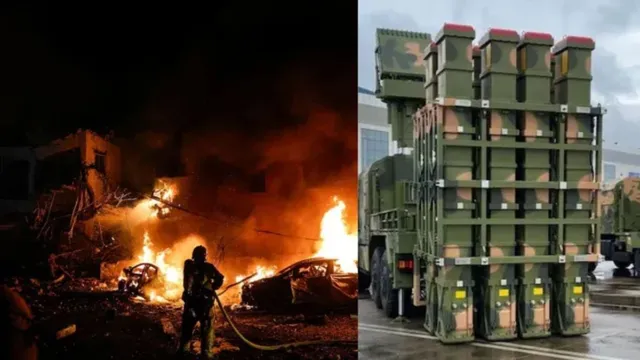
Iran-Israel War: As coordinated US-Israeli strikes struck targets across major Iranian cities, including Tehran, the focus has shifted to the failure of Tehran's air defence system in intercepting incoming projectiles. The HQ-9B air defence system, which Iran recently procured from China to strengthen its defensive capabilities, appears to have fallen short of its task.
Earlier, the HQ-9B failed to adequately protect key targets in Pakistan during India's Operation Sindoor, launched in retaliation for the Pahalgam terror attack, NDTV reported. This latest sub-par performance in Iran has led analysts to question the effectiveness of the HQ-9B system.
What Is HQ-9B?
China's HQ-9B was developed by the China Aerospace Science and Industry Corporation, taking inspiration from the Russian S-300PMU and American Patriot PAC-2 systems. However, it has evolved into a fully indigenous air defence solution. It was first tested in 2006 and has been operational for over a decade.
According to an NDTV report, the system has a range of 260 km and can shoot targets at altitudes of up to 50 km. Features such as active radar homing and passive infrared seeker make it effective against stealth aircraft. It is reportedly capable of simultaneously engaging 6-8 targets while tracking up to 100.
The HQ-9B has been deployed in Beijing, Tibet, and the South China Sea, areas critical to China's strategic interests, making this surface-to-air missile system a cornerstone of the country’s air defence system.
Iran's Air Defence Overhaul Amid Tensions In Gulf
As tensions escalated in the Gulf, Iran moved to strengthen its security arsenal. According to reports, HQ-9B was procured as part of an oil-for-weapon deal with China.
The acquisition of HQ-9B marked a major upgrade after the Russian S-300PMU-2 reportedly performed poorly against the Israeli missile strikes during the 2025 conflict. The HQ-9B forms the long-range layer of Tehran's air defence network, supported by S-300PMU-2 and Bavar-373 (long-range), Khordad-15 and Raad (medium range) and short-range Tor-M2, Pantsir-S1, Zolfaqar, tactical MANPADS missiles.
The HQ-9B has reportedly been deployed around key locations, including the Natanz nuclear facility, the Fordow Fuel Enrichment Plant, IRGC missile and UAV bases, as well as major airbases near Tehran and Isfahan.
Operation Epic Fury was a combat mission conducted by the United States, with support from Israel, targeting key Iranian military infrastructure, including missile facilities, naval installations, command centres and sites near the office of Supreme Leader Ali Khamenei in Tehran. In response, Iranian forces, including the Islamic Revolutionary Guard Corps, launched missile and drone attacks against US bases across the Middle East.