
- By Ajeet Kumar
- Tue, 10 Feb 2026 10:59 AM (IST)
- Source:JND
- Bangladesh secured 19% US tariff, zero-duty textiles.
- Deal includes zero reciprocal duty for US-made materials.
- Zero-duty access gives Bangladesh competitive edge over India.
Bangladesh has secured a reduced 19 per cent tariff under a trade agreement with the United States that would exempt some textiles and garments manufactured with US materials, interim government chief Muhammad Yunus said. Earlier, the Trump administration had imposed a 20 per cent tariff on Dhaka. This means the American government has awarded a relief of only a 1 per cent tariff to Bangladesh.
Bangladesh to get zero reciprocal tariff on US-produced cotton
In an X post on Monday, interim government chief Muhammad Yunus said Washington had "committed to establishing a mechanism for certain textile and apparel goods from Bangladesh using US-produced cotton and man-made fibre to receive zero reciprocal tariff in the US market". Yunus, known for his pro-US stance, said the deal was reached after nine months of negotiations since April last year.
Bangladesh, US sign reciprocal tariff agreement
— Chief Adviser of the Government of Bangladesh (@ChiefAdviserGoB) February 9, 2026
WASHINGTON DC, February 9: The Agreement on Reciprocal Tariff between Bangladesh and the United States was signed on Monday. On the Bangladesh side, the signatories were Commerce Adviser Sheikh Bashir Uddin and National Security…
According to Commerce Secretary Mahbubur Rahman, Bangladesh's key export-earning ready-made garments (RMG) made from cotton and synthetic fibres imported from the US would enjoy zero reciprocal duty under the deal.
The South Asian nation in August last year secured a reduction in US tariffs on its exports to 20 per cent, down from 37 per cent initially proposed by Washington. Bangladeshi policymakers earlier said they expected the tariff could be brought down to 15 per cent.
Business analysts, however, said the deal offered much-needed relief to Bangladesh's apparel exporters as the RMG sector accounts for more than 80 per cent of its export earnings and employs some 4 million workers, mostly women, and contributes about 10 per cent to gross domestic product (GDP).
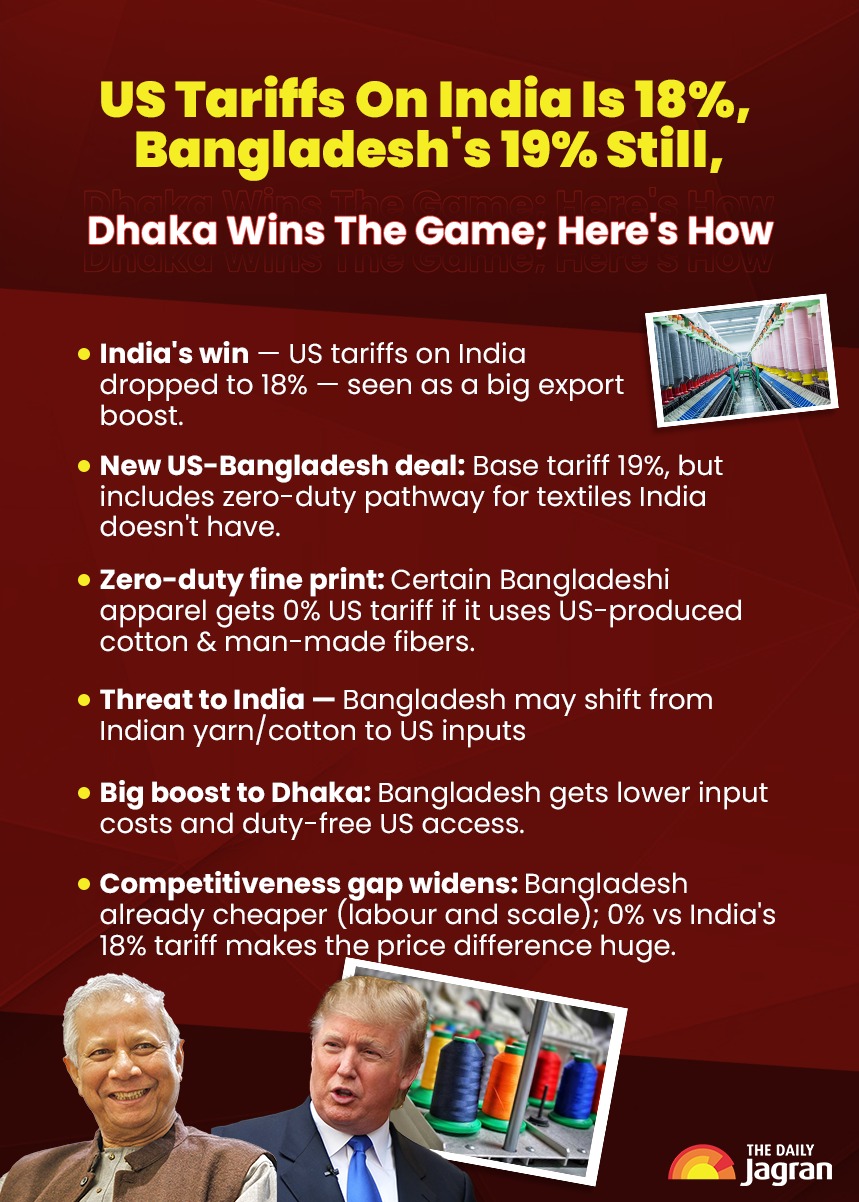
US Tariffs On India Is 18 per cent, Bangladesh's 19 per cent Still, Dhaka Wins The Game; Here's How
Although India has negotiated a much tougher deal from a 50 per cent tariff to 18 per cent, even a one per cent margin as compared to Bangladesh’s 19 per cent would have given an additional edge to the Indian textile exporter.
ALSO READ: Is Yunus Inking 'Secret Deal' With US Amid Pressure After India-America Trade Pact?
However, there is a catch: How Bangladesh’s higher tariff is still a setback against India’s lower tariff
1. India secured a reduction in US reciprocal tariffs to 18 per cent, which was widely seen as a major boost for Indian exporters, particularly in textiles and other sectors.
2. However, the new US-Bangladesh deal changes the landscape after both sides signed an agreement on reciprocal trade.
3. Bangladesh's base reciprocal tariff is set at 19 per cent , which looks slightly higher than India's 18 per cent, but it includes provisions for zero-duty access on select items that India lacks.
4. The key zero-duty mechanism for textiles. It means the agreement commits the US to establishing a system allowing certain Bangladeshi textile and apparel goods to enter the US at 0 per cent reciprocal tariff.
5. Although this applies to a specified volume of imports, tied directly to Bangladesh's purchases of US-produced cotton and man-made fibre textile inputs.
ALSO READ: Will India Ties Improve After Bangladesh Polls? Hasina Extradition Is Big Test
6. This could impact Indian yarn and cotton exports as Bangladesh has historically been a major buyer of Indian yarn and cotton for its garment industry. If Bangladesh shifts toward sourcing more US cotton or fibres to qualify for the zero-duty benefit, it could reduce demand for Indian inputs while gaining a cost edge in the US market.
6. This will widen the competitiveness gap. Bangladesh already enjoys advantages over India in garments due to lower labour costs and large-scale operations.
7. A 0 per cent tariff on qualifying exports vs. India's 18 per cent could significantly widen the price differential, making Bangladeshi garments more competitive in the US.
(With inputs from agencies)